AstraZeneca Accelerates China Expansion Amid Surge in Regulatory Approvals and Strategic Moves

AstraZeneca
Biopharmaceutical Manufacturer
Recently, AstraZeneca has been reporting frequent successes.
On November 9, AstraZeneca recently announced its Q3 financial report for 2023. The report shows that AstraZeneca's sales in the third quarter of 2023 were $11.492 billion, increasing by 13% year-on-year. The sales in the first three quarters were $33.787 billion, increasing by 15% year-on-year.
On the same day, AstraZeneca announced that it had entered into an exclusive licensing agreement with Chime Biologics to acquire the global rights to the latter's next-generation oral GLP-1 product, ECC5004, for a transaction amount exceeding 2 billion US dollars. Due to the recent surge in popularity of weight-loss drugs, this move indicates AstraZeneca’s intention to strengthen its position in this field. If successful, the future of this field will be dominated by a tripartite rivalry.
On November 14, AstraZeneca announced that its anticancer drug Durvalumab had been approved for marketing in China, becoming the first approved combination therapy drug for biliary tract cancer in China.
Durvalumab Doubles Two-Year Survival Rate!
Biliary tract cancer is a malignant tumor that occurs in the bile ducts and gallbladder. Due to its rapid onset and the increasing number of patients in China each year, there is an urgent need in China for new therapeutic drugs to address unmet clinical demands.
The timely emergence of Durvalumab has brought a glimmer of new hope to patients with biliary tract cancer. Durvalumab is a humanized PD-L1 monoclonal antibody drug that blocks tumor immune escape by inhibiting the binding of PD-L1/PD-1 with CD80.
The approval of durvalumab this time is mainly based on the results of its Phase III clinical study. The results showed that, compared with monotherapy, the use of durvalumab in combination therapy reduced the risk of death by 20%. Among patients receiving durvalumab combination therapy, the two-year survival rate was 24.9%, while the two-year survival rate for those receiving monotherapy was only 10.4%. Therefore, the use of durvalumab in combination therapy can more than double the two-year survival rate of patients with biliary tract cancer.
In recent years, the global research progress on biliary tract cancer has been slow. The success of Durvalumab in combination therapy will bring hope to countless patients with biliary tract cancer. The advent of Durvalumab is like a ray of hope shining into the limited lives of patients with biliary tract cancer.
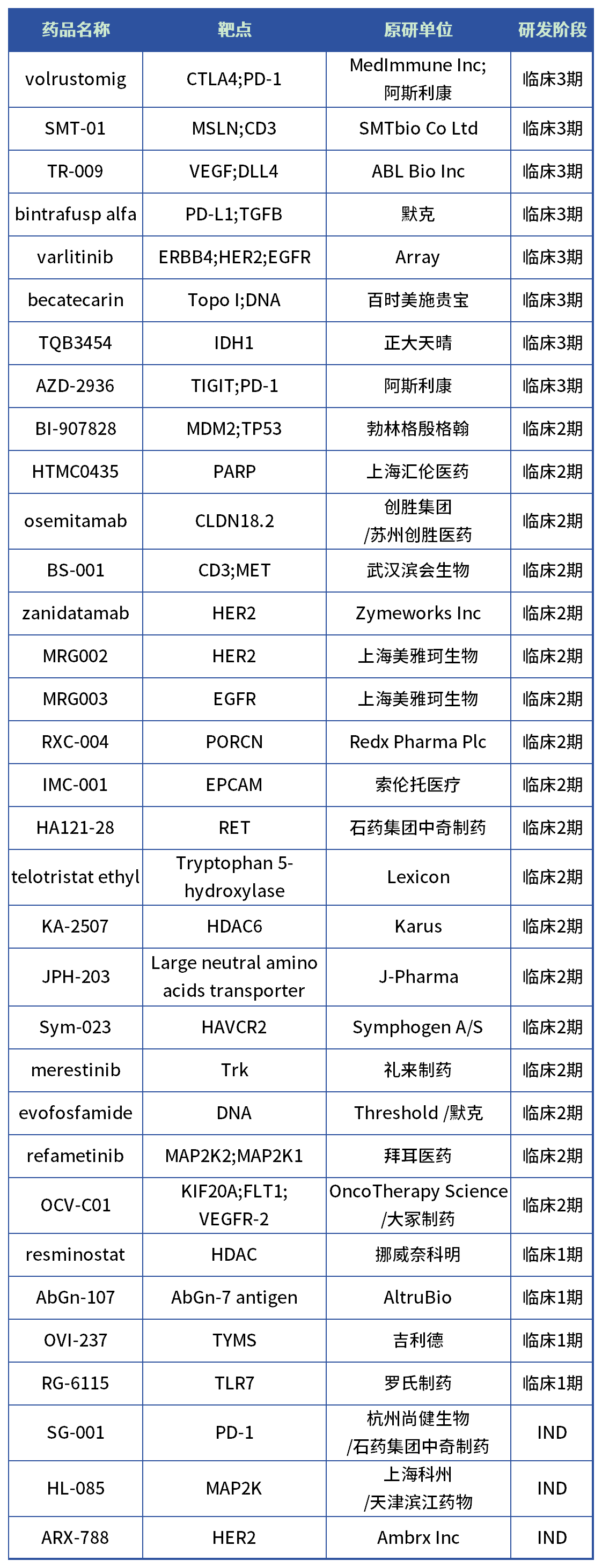
In addition to Durvalumab, there are currently multiple drugs in clinical stages globally. Table 1 below lists the drugs currently in clinical stages for biliary tract cancer, and several drugs have already entered phase 3 clinical trials.
Table 1 Global Biliary Tract Cancer Drugs in Development
Data Source: PharmCube Data
AstraZeneca Pipeline Analysis
"The Four Great Guardians" Unite Their Strength
As can be seen from its published Q3 2023 financial report, the oncology sector is AstraZeneca's largest source of revenue. The Q3 report shows that the sales of oncology drugs in the first three quarters were $13.458 billion, accounting for 40% of AstraZeneca's total sales, with a year-on-year sales growth of 17%.
Cardiovascular, renal, and metabolic business is AstraZeneca's second-largest source of revenue. The sales of cardiovascular, renal, and metabolic business in the first three quarters were $7.926 billion, accounting for 23% of AstraZeneca's total sales, with a year-on-year sales growth of 14%.
Rare disease field has become the third largest source of revenue. The sales of cardiovascular, renal and metabolic field in the first three quarters were $5.793 billion, accounting for 17% of AstraZeneca's total sales, with an increase of 11% year-on-year.
Respiratory and Immunology is AstraZeneca's fourth largest source of revenue, with sales in the first three quarters reaching $4.729 billion, accounting for 14% of AstraZeneca's total sales, representing a 6% year-on-year increase.
The above are AstraZeneca's current "Four Pillars," which are also a significant source of revenue for the company. According to financial reports, the sales of these "Four Pillars" have maintained steady growth, providing ample financial support for AstraZeneca's recent collaborations and acquisitions.
In terms of the R&D pipeline, AstraZeneca currently has 167 projects in clinical stages globally, including 14 new molecular entities in late-stage development and 3 new molecular entities in the filing stage. The pipeline covers areas such as oncology, cardiovascular, renal and metabolic diseases, respiratory and immunology, rare diseases, as well as vaccines and immunotherapies.
AstraZeneca's R&D pipeline spans multiple fields and is distributed across various clinical stages, poised to break the future dearth of innovation.
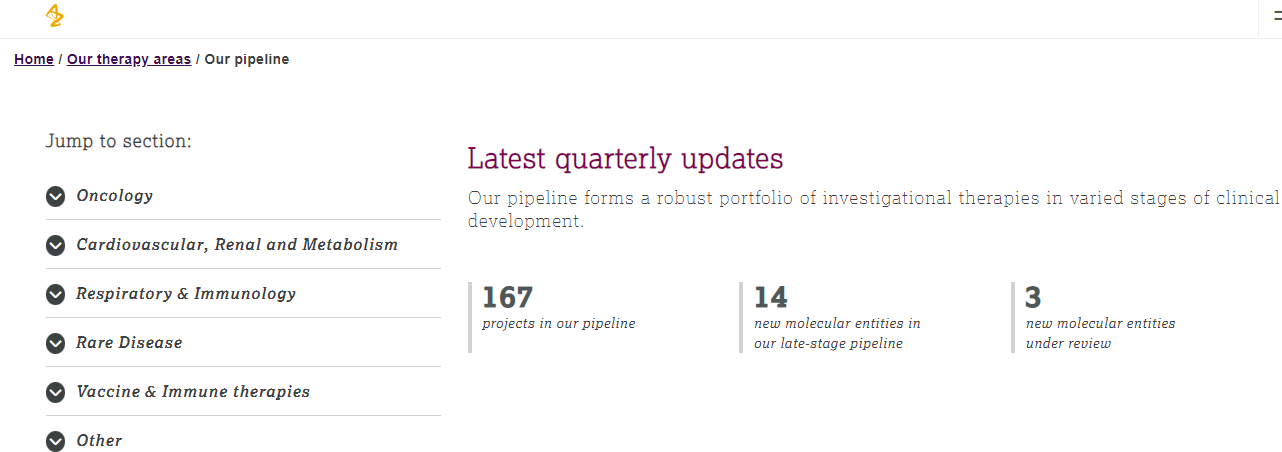
Figure 1 AstraZeneca's R&D Pipeline
Image Source: AstraZeneca Official Website
Top Ten Single Products of AstraZeneca
The revenue of the "Four Pillars" accounts for over 90% of AstraZeneca's total revenue, and all of the top ten best-selling products of AstraZeneca are also within their portfolio.
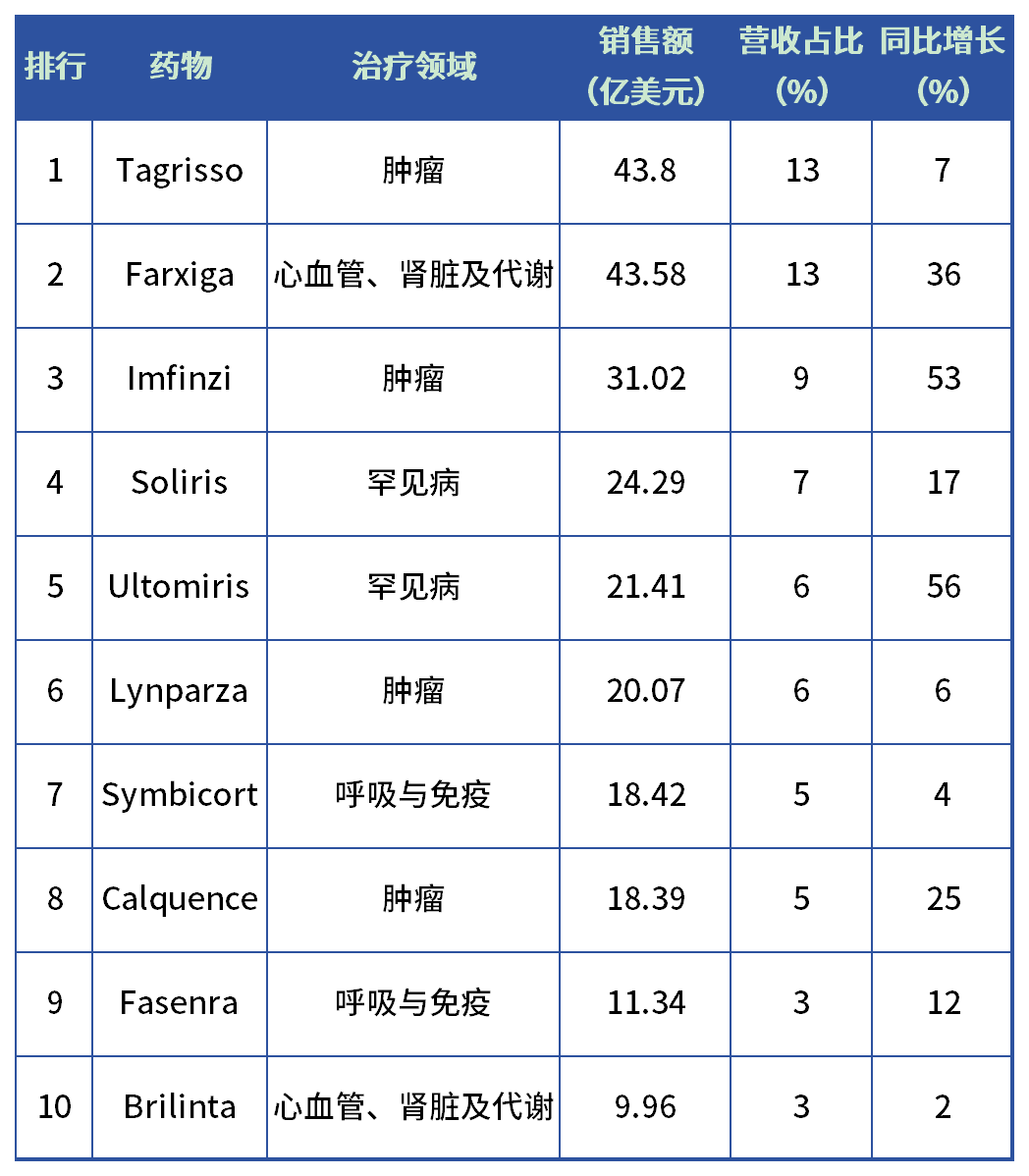
Firstly, in the field of oncology, the representative drugs in this area are Tagrisso, Imfinzi, Lynparza, and Calquence, which have achieved rankings of 1st, 3rd, 6th, and 8th respectively in the top ten single product list with sales of $4.38 billion, $3.102 billion, $2.007 billion, and $1.839 billion, showing remarkable performance. Among them, Imfinzi's sales increased by 56% year-on-year, and Calquence's sales increased by 25% year-on-year. Future sales will continue to grow.
Next is the cardiovascular, renal, and metabolic diseases field, where the representative drugs are Farxiga (Dapagliflozin) and Brilinta (Ticagrelor), ranking 2nd and 10th respectively on the top ten product list with sales of $4.358 billion and $996 million. Notably, Farxiga still maintains a growth rate of 36%.
The third area is the rare disease field, where the representative drugs are Soliris (eculizumab) and Ultomiris, which ranked 4th and 5th on the top ten single-product sales list with revenues of $2.429 billion and $2.141 billion, respectively. Notably, Ultomiris exhibited a sales growth rate of 56%, ranking first in terms of growth speed.
Finally, in the respiratory and immunology field, the representative drugs are Symbicort (Pulmicort Turbuhaler) and Fasenra (Benralizumab), which ranked 7th and 9th on the top ten single-product list with sales of $1.842 billion and $1.134 billion, respectively.
AstraZeneca's approved products have a relatively clear advantage: the revenue of various major products is balanced, avoiding a top-heavy situation. But at the same time, this is likely also AstraZeneca's regret, as who wouldn't hope to have a single drug with annual sales breaking $20 billion?
The following Table 2 lists the top ten best-selling products of AstraZeneca in the first three quarters of 2023. Among them, four products belong to the oncology field, two products are from the cardiovascular, renal, and metabolic fields, two products are from the rare disease field, and two products are from the respiratory and immunology fields. The above four fields encompass all of the top ten best-selling products.
Table 2 AstraZeneca's Top Ten Products Sales in the First Three Quarters of 2023
Data source: AstraZeneca Q3 Report 2023
In terms of the market, the United States still holds the largest market share. In the first three quarters of 2023, AstraZeneca's revenue in the U.S. reached $13.94 billion, accounting for 41% of the company’s total revenue. Among AstraZeneca’s newly expanded markets, China performed well, with revenue of $4.495 billion in the first three quarters, representing 14% of AstraZeneca’s global total income. In the future, the Chinese market will remain a key focus for AstraZeneca’s expansion.
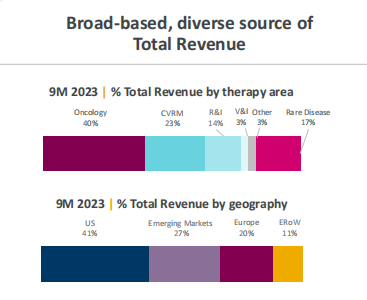
Figure 2 AstraZeneca Sales Share and Market Share in Various Fields
Image source: Reference 1
Summary
A Review of AstraZeneca's Financial Performance in the First Three Quarters of 2023 Shows Impressive Results, with All Major Businesses Advancing Equally and Balanced Growth. However, AstraZeneca Does Not Have a Product That Can Compete for the "Top Drug" Throne. In Recent Years, AstraZeneca Has Been Very Active in the Fields of Oncology, Cardiovascular, and Rare Diseases, Hoping to Strengthen These Sectors. It Remains to Be Seen Whether They Intend to Create a "Top Drug." We Look Forward to AstraZeneca's Future Performance.
References
[1]https://www.astrazeneca.com/content/dam/az/PDF/2023/q3/9M_and_Q3_2023_results_presentation.pdf
[2]https://www.astrazeneca.com/our-therapy-areas/pipeline.html#oncology
[3]https://www.astrazeneca.com/content/dam/az/PDF/2023/q3/9M_and_Q3_2023_results_announcement.pdf

Editor: Pea Shooter
Disclaimer: The views expressed in this article are solely those of the author and do not represent the position of Pharma Intelligence. We welcome discussions and additional insights in the comment section; for reprints, please be sure to credit the author and source. If there are any issues regarding the content, copyright, or other aspects of the work, please leave a message on this platform, and we will address it promptly.