

Gilead Deepens Bet on Arcellx’s Next-Gen CAR-T Pipeline with $285M Follow-On Investment After $4B Deal

Kite Pharma
CAR-T Cell Immunotherapy R&D Provider

Arcellx
Developer of Immunocyte Therapy

Gilead Sciences
Antiviral Drug Developer
On November 15, Gilead Sciences' Kite Pharma (hereinafter referred to as Kite) and Arcellx announced the expansion of their initial collaboration established in December 2022. Kite has exercised its option to obtain the development license rights for Arcellx's investigational cell therapy ACLX-001.
In addition, the collaboration between the two parties will also include the application of Arcellx's CART-ddBCMA in the field of lymphoma treatment. This drug was initially developed for the treatment of relapsed or refractory multiple myeloma (MM).
According to the terms of the agreement, Arcellx will receive an upfront payment of $85 million. In addition, Arcellx will also obtain a $200 million equity investment from Gilead Sciences for the purchase of 3,242,542 shares of its common stock, with Gilead holding approximately 13% of the shares.
CART-ddBCMA is an autologous BCMA-targeted CAR-T cell therapy derived from Arcellx's D-Domain (DD) technology. DD is a compact, stable, fully synthetic hydrophobic core binder with potential advantages such as higher transduction efficiency, significant cell surface expression, and reduced sustained signaling.
Its unique D domain can replace the scFv in traditional CAR-T as the extracellular antigen-binding region. After binding to the antigen on the target cell, ddCAR will activate T cells to kill the target cell. Clinical research results from Arcellx demonstrate that the D domain protein can enhance cytotoxic efficacy and persistence while improving safety.
Phase I Clinical Trial Data of CART-ddBCMA for R/R MM Patients Shows 100% Objective Response Rate (ORR) and 71% Complete Response Rate (CR) Among 38 Patients Treated at Various Doses, with No Grade 3 or Higher Adverse Events Reported, Except for One Case (3%) of Grade 3 Immune Effector Cell-Associated Neurotoxicity Syndrome (ICANS).
Currently, CART-ddBCMA has been granted Fast Track designation, Regenerative Medicine Advanced Therapy (RMAT) designation, and Orphan Drug designation by the FDA for the treatment of relapsed or refractory MM.
With outstanding clinical data, on December 9 last year, Arcellx reached a collaboration with Kite. According to the agreement, Kite obtained the qualification to co-develop CART-ddBCMA with Arcellx for an upfront payment of $225 million, up to $3.9 billion in milestones, and $100 million in equity investment.
However, the "good times didn't last long." In June this year, the pivotal Phase II clinical study iMMagine-1 of CART-ddBCMA was put on hold by the FDA due to the sudden death of a patient participating in the trial. Following this news, Arcellx's pre-market trading share price fell by approximately 23%.
However, Arcellx later stated that the deceased patient did not actually meet the treatment criteria of the trial protocol, and the subsequent management approach conflicted with the protocol, indicating no safety issues with CART-ddBCMA. Two months later, the FDA lifted the clinical hold.
In addition to CART-ddBCMA, Arcellx has another BCMA-targeted CAR-T cell therapy in its pipeline—ACLX-001, which consists of ARC-T cells and SparX protein, for the treatment of relapsed or refractory MM.
SparX Protein is a fusion protein composed of multiple DDs and a TAG protein that can be specifically recognized by ARC-T. By injecting different SparX proteins into patients, ARC-T cells can be guided to target different disease antigens, eliminate tumor cells, and SparX proteins for different antigens can address the issue of immune escape caused by antigen loss in tumor cells.
The results of its preclinical studies showed that ACLX-001 has good anti-tumor effects. Currently, ACLX-001 is being evaluated for its efficacy in Phase I clinical trials.
In 2012, the first patient with B-Cell Acute Lymphoblastic Leukemia, Emily Whitehead, underwent CAR-T therapy targeting CD19. Three weeks later, her cancer cells had completely disappeared. Eleven years have passed, and there has been no recurrence. The "miracle" of Emily's tumor cure has attracted countless pharmaceutical companies to enter the CAR-T field.
In 2017, the world's first CAR-T product was approved for marketing. To date, a total of 9 CAR-T therapies have been approved for marketing, including 6 CAR-T products approved by the U.S. FDA and 3 CAR-T products approved in China.
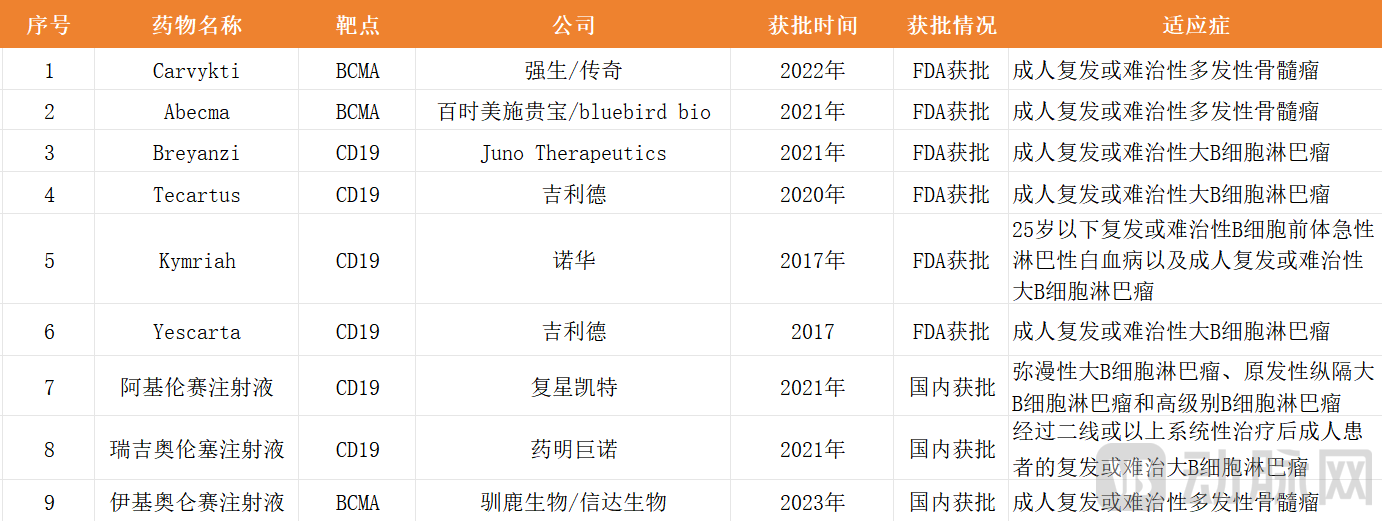
Currently Approved CAR-T Products
Data source: Collated from public information, chart created by VCBeat
Among them, Gilead Sciences' two CD19-targeted CAR-T products—Yescarta and Tecartus—are also included. These were the products that Gilead previously acquired at great cost.
In 2017, Gilead Sciences acquired Kite Pharma for $11.9 billion, gaining access to the CAR-T therapy Yescarta, which was then under FDA review. However, in the third quarter of 2019, global sales of Yescarta reached only $118 million, far below the anticipated peak annual sales of $2 billion that Gilead had projected at the time of the acquisition.
According to Gilead Sciences' Q3 2023 earnings report, Yescarta's sales in Q3 2023 were $391 million, a year-over-year increase of 23%; whereas Yescarta's sales in 2022 amounted to $1.16 billion.
Despite the continuous increase in Yescarta's sales revenue in recent years, it remains challenging to achieve an annual sales figure of $2 billion. Moreover, in December last year, Yescarta was "returned" by Daiichi Sankyo, which handed back the sales rights for the Japanese market to Gilead Sciences' Japan division.
In 2019, this $11.9 billion acquisition was also listed by Fierce Pharma as one of the 15 most failed pharmaceutical M&A deals in the past decade.
This time, Gilead has shifted to the second most popular target in CAR-T cell therapy drug development, BCMA, betting on CART-ddBCMA.
However, in the BCMA "pool," two products have already been approved and launched: Abecma from Bristol-Myers Squibb/bluebird bio and Carvykti from Johnson & Johnson/Legend Biotech, both of which are approved as fifth-line therapies. Arcellx stated that CART-ddBCMA is expected to be commercialized by 2026. In comparison, the progress of CART-ddBCMA, which is currently in Phase II clinical trials, appears to be somewhat slow.
However, based on the clinical data released by Arcellx, the clinical efficacy of CART-ddBCMA appears to be better compared to Abecma and Carvykti.

Comparison of Clinical Data for Abecma, Carvykti, and CART-ddBCMA
Data source: Collated from public information, chart created by VCBeat
According to the "CAR-T Cell Therapy Industry —— Breakthroughs in Early-Line Treatment for Hematologic Tumors, Awaiting Advances in Solid Tumors and Commercial Takeoff" report released by CMB International Securities, the market size of BCMA CAR-T in the United States is projected to reach $9.59 billion by 2030, while the market size in China is expected to reach 6.24 billion yuan.
Currently, many pharmaceutical companies, like Gilead Sciences, have avoided the crowded CD19 CAR-T赛道 and shifted their focus to BCMA. According to incomplete statistics from the Pharma Intelligence global drug R&D database, there are currently 89 CAR-T cell therapy drugs targeting BCMA under development.
Can CART-ddBCMA stand out in the highly competitive BCMA CAR-T field and become Gilead's next CAR-T product with over a billion dollars in sales?