

Bristol Myers Squibb Announces FDA Approval of Augtyro (repotrectinib) for ROS1-Positive Non-Small Cell Lung Cancer
Bristol-Myers Squibb
Biopharmaceutical and Nutritional Product R&D and Sales
▎WuXi
Edited by Kant Content Team
Bristol Myers Squibb announced that the U.S. FDA has approved its oral tyrosine kinase inhibitor (TKI) Augtyro (repotrectinib) for the treatment of adult patients with locally advanced or metastatic ROS1-positive non-small cell lung cancer (NSCLC).According to the press release, Augtyro is the first approved next-generation TKI therapy for ROS1-positive NSCLC patients.
This approval is mainly based on the results of the TRIDENT-1 trial, an open-label, single-arm, Phase 1/2 trial that evaluated the efficacy and safety of Augtyro in both TKI-naïve and TKI-pretreated patients. The primary endpoint of the trial was the objective response rate (ORR), defined as the percentage of patients whose tumors decreased in size (partial response) or showed no signs of cancer (complete response) within a certain period after receiving treatment.
Analysis shows,The ORR in TKI-naive patients (n=71) was 79% (95% CI: 68-88), with a median duration of response (mDOR) of 34.1 months.In patients previously treated with one ROS1 TKI and not previously treated with chemotherapy (n=56), the ORR was 38% (95% CI: 25-52), and the mDOR was 14.8 months.Among patients with detectable central nervous system (CNS) metastases at baseline,Intracranial lesion relief was observed in 7 of 8 TKI-naive patients (n=71) and 5 of 12 TKI-pretreated patients (n=56).
Repotrectinib is a ROS1 and NTRK targeted inhibitor developed by Turning Point (now acquired by Bristol-Myers Squibb). It has a unique structure, binding to the "ATP pocket" of the target protein, and is unaffected by various resistance mutations. Therefore,It can overcome various gene mutations that are resistant to other TKIs, kill a variety of tumor cells carrying ROS1 or NTRK gene fusions, and has the potential to treat ROS1-positive NSCLC, as well as solid tumors that are positive for ROS1, NTRK, and ALK.
In July 2020, Zai Lab announced a collaboration with Turning Point to obtain exclusive development and commercialization rights for repotrectinib in Greater China. Under the terms of the agreement, Turning Point received a $25 million upfront cash payment and potential milestone payments of up to $151 million. In June 2022, Bristol-Myers Squibb Company announced an agreement with Turning Point to acquire the latter for over $4 billion, thereby incorporating repotrectinib into its R&D pipeline.
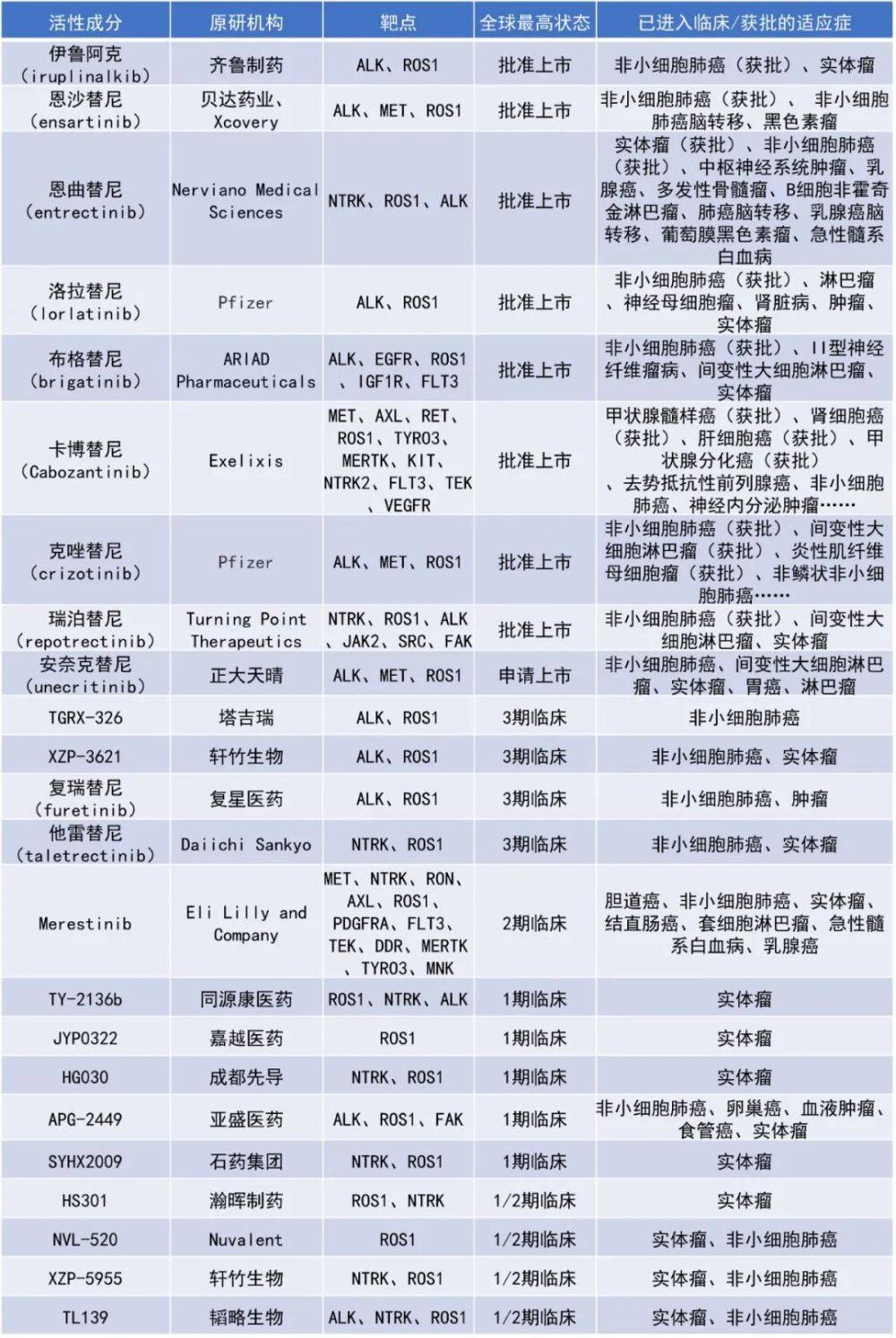
▲ A Review of the Clinical Progress of Globally Active Targetable ROS1 Therapies
Note: This table was compiled by the WuXi AppTec content team based on publicly available information and is not a comprehensive list. If there are any omissions, please feel free to add them.
Currently, among the therapies targeting ROS1 that are in active development globally, eight have been approved for marketing. The main indications are concentrated in non-small cell lung cancer, with other indications including renal cell carcinoma, hepatocellular carcinoma, medullary thyroid cancer, differentiated thyroid cancer, and solid tumors. It is hoped that such therapies will achieve positive progress as soon as possible, providing more treatment options for a wide range of patients.