

Attenuated IL-2 Muteins Leverage TCR Signaling to Enhance Regulatory T Cell Homeostasis and Therapeutic Response

Amgen
Developer of Treatment Drugs for Serious Diseases
TregsTo a variety of stimuli in systemic and tissue-specific environmentsReact. Among themTCRAndIL-2Signal Regulation in the BodyTregQuantity, phenotype, and function. Due to thymic originTregIt is inMHC IISelected from the provided self-antigen derived peptides, thus manyTregExperiencing antigen signals during in vivo homeostasis. Additionally,TregsWith a limited quantityIL-2The ability to respond. UtilizeTregsCorrectIL-2Enhanced sensitivity, low doseIL-2And various attenuatedIL-2Currently in clinical development, aimed at prioritizing the improvement ofTregsThe ability to suppress disease-causing inflammatory responses.
The previous analysis of a large set of engineered human IL-2 mutant proteins,These mutant proteins exhibit a wide range of affinity and activity. Attenuated IL-2 mutant proteins were found to increase Treg selectivity and induce STAT5-mediated downstream biological responses.The response of Treg cells in vitro to IL-2 mutant proteins is largely associated with STAT5 activation. However, the mechanism by which Treg cells respond to IL-2 still requires further understanding, and it is necessary to determine whether attenuated IL-2 mutant proteins induce the critical activation responses required for Treg function in vivo.
Recently, scientists from Amgen published a research article titled "Attenuated IL-2 muteins leverage the TCR signal to enhance regulatory T cell homeostasis and response in vivo" in the Frontiers in Immunology journal.The study investigates the effects of wild-type (WT) and attenuated IL-2 mutant proteins on Treg expansion and activation using a mouse model. The results show that attenuated IL-2 reduces STAT5 activation but still promotes Treg expansion. Mechanistically, the IL-2 mutant protein can promote Treg expansion without activating Tregs, maintaining homeostasis. Meanwhile, the mutant protein facilitates the phenotypic conversion of effector Tregs. A psoriasis pathology model demonstrates that attenuated IL-2 reduces skin inflammatory responses in mice, indicating that rational design of IL-2 is significant for disease treatment.
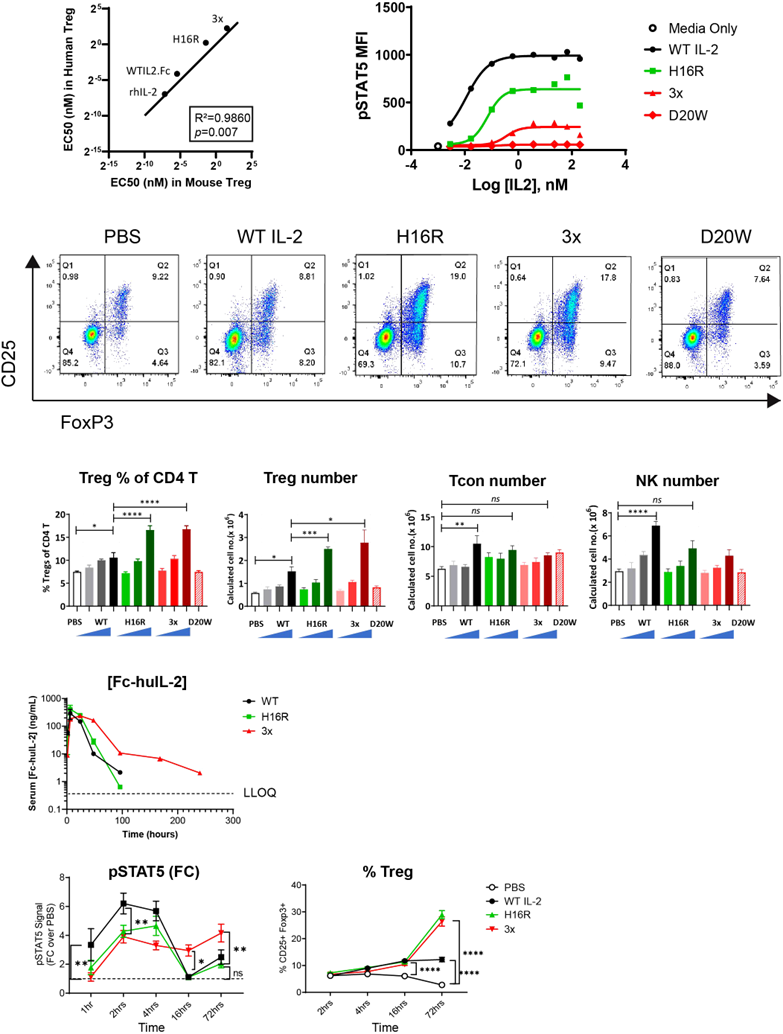
Using the STAT5 activation assay, the in vivo responses of two different attenuated IL-2 mutant proteins (H16R, V91K D20A M104V (referred to as 3x)) and wild-type (WT) IL-2 on human and murine Treg cells were examined. The results showed that, in addition to promoting Treg expansion, the attenuated mutant proteins induced disproportionately lower Treg activation.
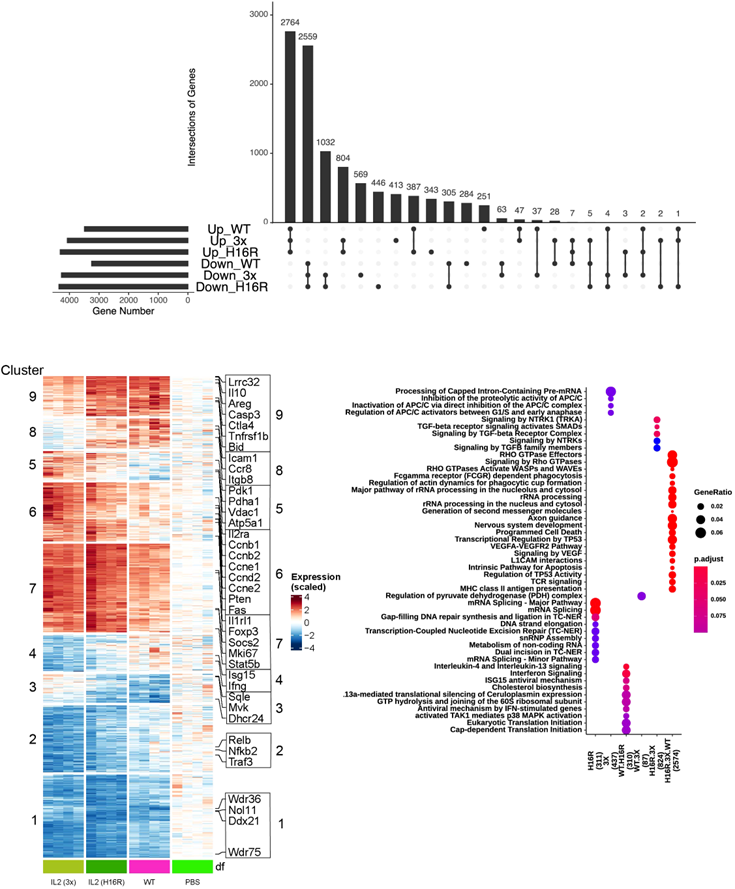
Transcriptomic analysis of IL-2-affected Treg cells showed that two different attenuated IL-2 mutant proteins could promote the transformation of Treg cells towards an effector Treg (eTreg) phenotype.
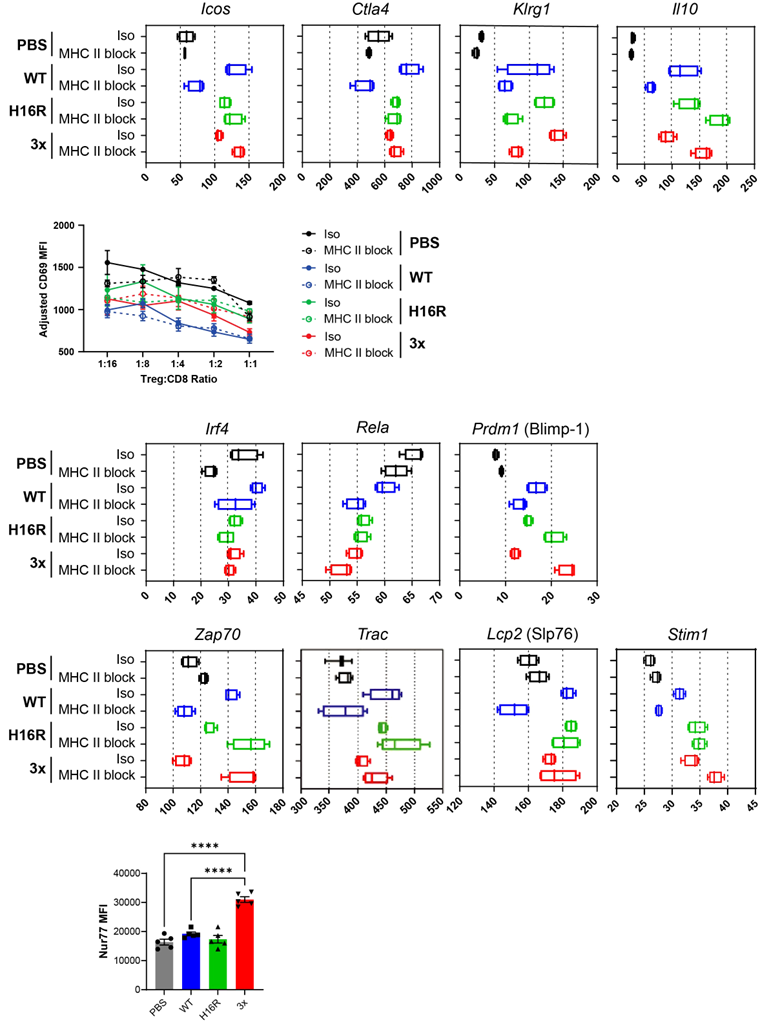
Study the mechanisms that trigger reactions,The results show that attenuated IL-2 mutant proteins enhance TCR signaling, promote Treg expansion, but do not activate Treg. Since TCR signaling is not required for activation, it indicates a reduced dependency of Treg cells on TCR signaling.
A short-term psoriasis model was established in mice using Imiquimod cream, and treatment with attenuated IL-2 mutant proteins (H16R, 3x) was applied. The results showed that, compared to WT IL-2 exacerbating disease progression, the two mutant IL-2 proteins enhanced selectivity for Treg cells.And express activation and effector Treg cell markers (Gitr, Icos, Klrg1), while significantly reducing pathological lymphocyte (NK, γδT) skin infiltration, delaying disease progression.
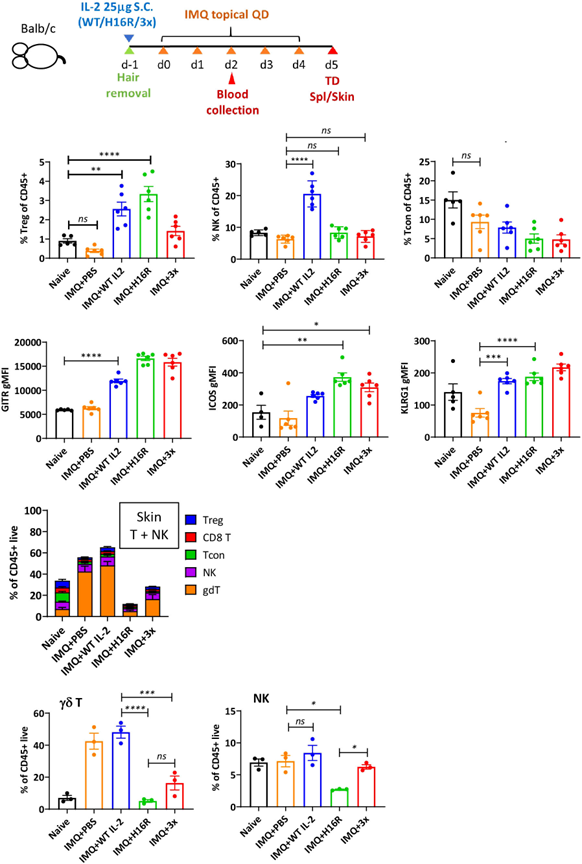
The results reveal that IL-2 affects the sensitivity of Tregs to antigen signals, and the combined effects can be utilized for the therapeutic use of attenuated IL-2 mutant proteins.
Thought
Research has found that Tregs largely rely on the synergistic effects of IL-2 and TCR signaling to maintain and activate homeostasis. These pathways interact closely rather than acting in parallel, and their combined effects may set the activation threshold and response duration.Compared with wild-type IL-2, the attenuated IL-2 mutant protein generates a lower peak STAT5 signal but still induces robust Treg expansion and better suppresses pathogenic cell infiltration. These effects are accompanied by signs of enhanced TCR signaling in circulating Tregs.However, further research is needed in the future to understand how to integrate additional pathways to modulate Treg responses in vivo, and to improve the rational design of Treg-targeting and IL-based therapies.
Reference:Attenuated IL-2 muteins leverage the TCR signal to enhance regulatory T cell homeostasis and response in vivo. Front Immunol. 2023 Sep 22:14:1257652. doi:10.3389/fimmu.2023.1257652.