

Commercialization Pitfalls: CAR-T Therapy Abecma Reports 40% Q3 Revenue Drop
Bristol-Myers Squibb
Biopharmaceutical and Nutritional Product R&D and Sales
Disclaimer: Due to limited expertise, errors are inevitable, and some information may not be the most up-to-date. Comments are welcome to point these out. This article is only an introduction to pharmaceuticals related to healthcare and is not a recommendation of treatment plans (if involved). This article does not constitute any investment advice.
If you are curious about the pitfalls of CAR-T drug commercialization,A good example is 2seventy bio, the Abecma partner of Bristol-Myers Squibb (BMS) Company.In the third quarter of 2023, the two companiesRevenue from multiple myeloma cell therapy plummeted,Illustrates the risks of scaling up a process before demand is below expectations.。
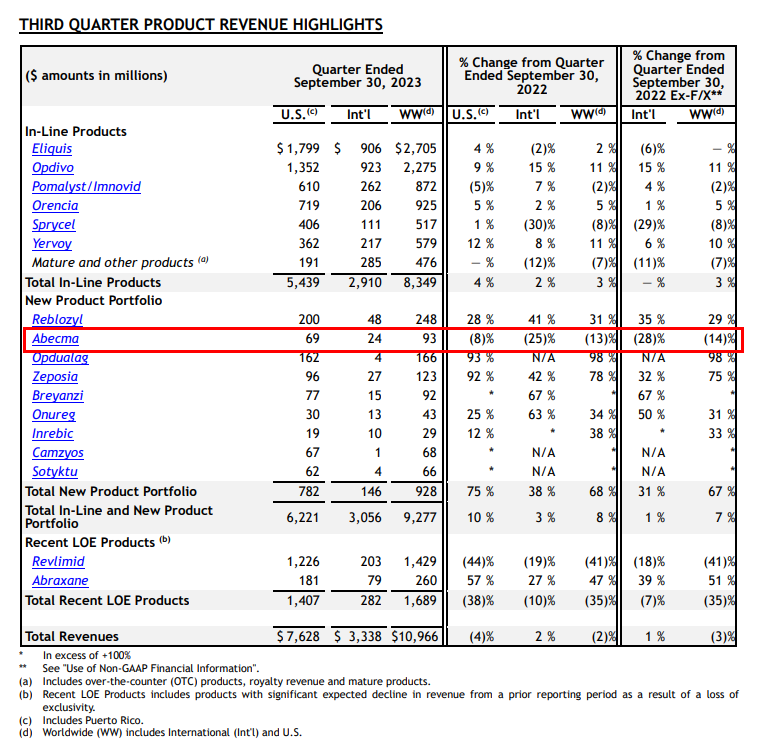
2seventy and BMSSplit EvenlyAll profits and losses related to the development, manufacturing, and commercialization of Abecma in the United States.Cell Therapy in Q3The gross profit margin in the United States is only117"Million US dollars,"The cost of goods sold per dose of Abecma was $361,000, compared to $210,000 per dose in the second quarter.,This meansThe final cost of sales for CAR-T products mainly depends on the management expenses of the production base and equipment utilization rate.Analysts said, "When product sales and production volume do not reach the scale of process design, the main business cost will increase exponentially, and the expansion of commercial production bases may exacerbate losses in the third quarter."
As early as September this year, 2seventy bio had announced the restructuring of its business operations and R&D model.Save money to prolong life.As part of the restructuring, 2seventy will cut 176 positions across various departments, accounting for approximately 40% of its total workforce. The company announced that 2seventy CEO Nick Leschly will also step down from his position as CEO once a successor is found and transition to the role of Chairman of the Board.

Abecma, jointly developed by BMS and Bluebird, is one of the three CAR-T therapies approved for the treatment of relapsed/refractory multiple myeloma. As the first BCMA CAR-T cell to receive FDA approval, Abecma's sales reached $388 million in 2022, with a year-on-year growth of 136%. Its annual sales have surpassed some earlier CD19-targeted CAR-T products, ranking third. The FDA is expected to make a decision on the label expansion by December 16, which will enable patients to access treatment more quickly.
The principle of Abecma is to chimerically express the BCMA receptor on the patient's T cells. The preparation process involves isolating T cells from the patient’s blood, then modifying the T cells using a lentiviral vector encoding the BCMA antigen receptor, enabling the T cells to express the BCMA receptor on their surface.