Statement:Due to limited level, errors are inevitable, and some information may not be the latest. WelcomeWelcome to leave a message to point out.This article only provides an introduction to medical and health-related drugs, not a recommendation for treatment plans (if involved); this article does not constitute any investment advice.
Recently,AstellasAnnouncement of AAV Gene Therapy for X-linked Myotubular MyopathyAT132The safety and efficacy, as well as the causes of death of four patients in the trial.
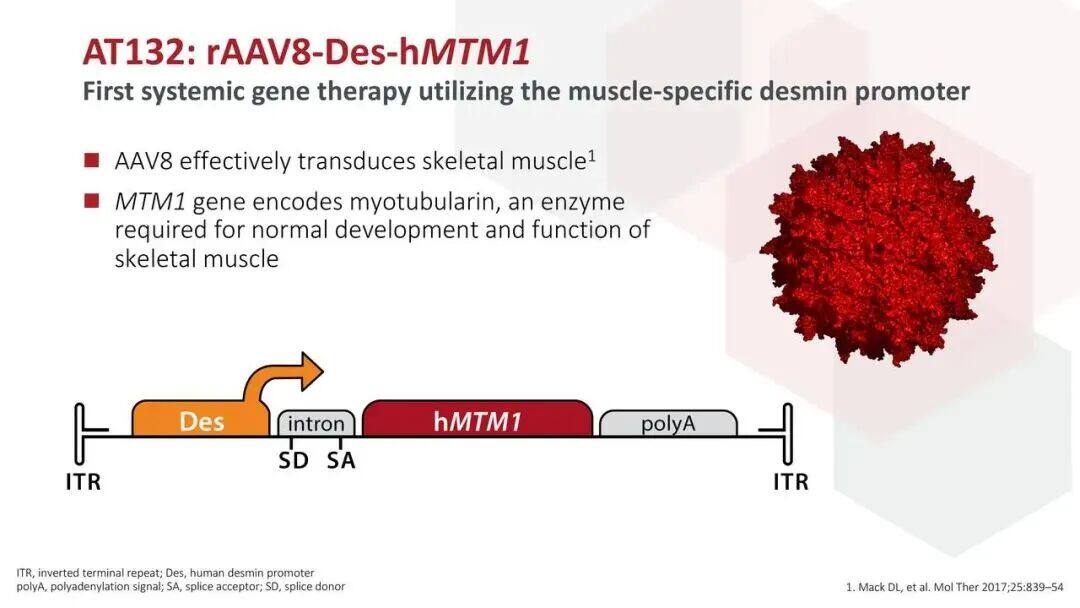
X-linked Myotubular Myopathy (XLMTM)Is a severe monogenic disease of skeletal muscle caused by the loss of expression/function mutations in MTM1 (myotubularin) gene. It presents in infancy, characterized by neonatal hypotonia and severe weakness. 25-50% of affected patients die within the first year of life, while surviving patients are highly dependent on technology (80% require wheelchair, ventilator, and feeding tube support) and have a shortened lifespan.Currently, there is no specific treatment for patients with myotubular myopathy.。AT132 is a gene therapy based on the adeno-associated virus (AAV) vector.The most commonly used AAV vector is the AAV9 vector, while AT132 uses the AAV8 vector, whose safety still needs to be verified. AT132 can deliver a normal gene copy to patients, thereby enhancing the expression of myotubularin in target tissues to treat XLMTM.As of February 28, 2022, a total of 24 boys who are ventilator-dependent were enrolled in the clinical trial for AT132. The trial was divided into two doses: low dose (1.3x10¹⁴ vg/kg) and high dose (3.5x10¹⁴ vg/kg). Among them, 7 received the 1.3×10¹⁴ vg/kg dose, and 17 received the 3.5×10¹⁴ vg/kg dose.Trial data show:After 24 weeks of treatment, the average ventilator support time (in hours) in the low-dose group decreased by approximately 77.7% compared to the control group, with 6 patients achieving ventilator independence and 5 patients able to walk independently; compared to baseline.In the high-dose group, there was a 22.8% reduction, with 10 patients achieving ventilator independence and 3 patients able to walk independently.In terms of safety:In the low-dose group, 2 severe adverse events (SAEs) were observed; in the high-dose group, 9 SAEs were observed. Four patients died, and among the remaining 20 survivors, 5 had cholangitis.Among the 14 participants in the untreated group (2 in the control group and 12 in the natural history study group), none achieved ventilator independence, but at 48 weeks, 5 participants were able to sit independently for 30 seconds without achieving other motor milestones.These data indicate that AT132 still has therapeutic significance for XLMTM.AT132 was acquired by Astellas for $3 billion in cash through the acquisition of U.S. gene therapy company Audentes Therapeutics. The clinical trial of AT132 has been full of twists and turns.In 2020, three pediatric subjects in the high-dose group developed cholestatic hepatitis and progressed to liver failure after treatment, subsequently dying from secondary sepsis or severe gastrointestinal bleeding. As a result, the U.S. Food and Drug Administration (FDA) suspended this clinical trial. In 2021, one death occurred in the low-dose group. This trial has remained on hold ever since.Perry B. Shieh, Ph.D., Professor of Neurology and Pediatrics at UCLA and Principal Investigator of ASPIRO, stated: "Preliminary data from the trial...According to the first proofAT132It may offer clinical improvement for XLMTM patients, including reducing ventilator dependence and achieving major motor milestones. Additionally, significant issues related to liver health have been identified in treated participants and require attention.Continue"Careful evaluation."Astellas will subsequently communicate with the FDA to lift the clinical hold on AT132 as soon as possible.https://www.astellas.com/en/news/28691