

Kerui Bio's First Immune Cell Therapy CRTE7A2-01 TCR-T Injection Receives IND Approval in China

CorreGene
Developer of Tumor Immunotherapy and Gene Therapy Technologies
On November 21, 2023, Beijing Kerui Biological Technology Co., Ltd. received clinical trial approval for its first immunocyte treatment product, CRTE7A2-01 TCR-T Cell Injection, marking the company's official entry into the phase of conducting registration clinical trials.
CRTE7A2-01 TCR-T Cell Injection, developed by Beijing Kerui Biological Technology Co., Ltd., is an immunotherapy cell treatment product indicated for HPV16-positive and HLA-A*02:01-positive advanced solid tumors (including cervical cancer, head and neck cancer, anal cancer, and other tumor types). On November 21, 2023, after successfully addressing all concerns raised by the Center for Drug Evaluation (CDE) during the Pre-IND consultation meeting and IND review process, Beijing Kerui Biological Technology Co., Ltd. received clinical trial approval for CRTE7A2-01 TCR-T Cell Injection. Simultaneously, the CDE’s official website announced tacit approval for the clinical trial of Kerui Biological's CRTE7A2-01 TCR-T Cell Injection. This marks the formal progression of Beijing Kerui Biological Technology Co., Ltd. into the phase of conducting registrational clinical trials.
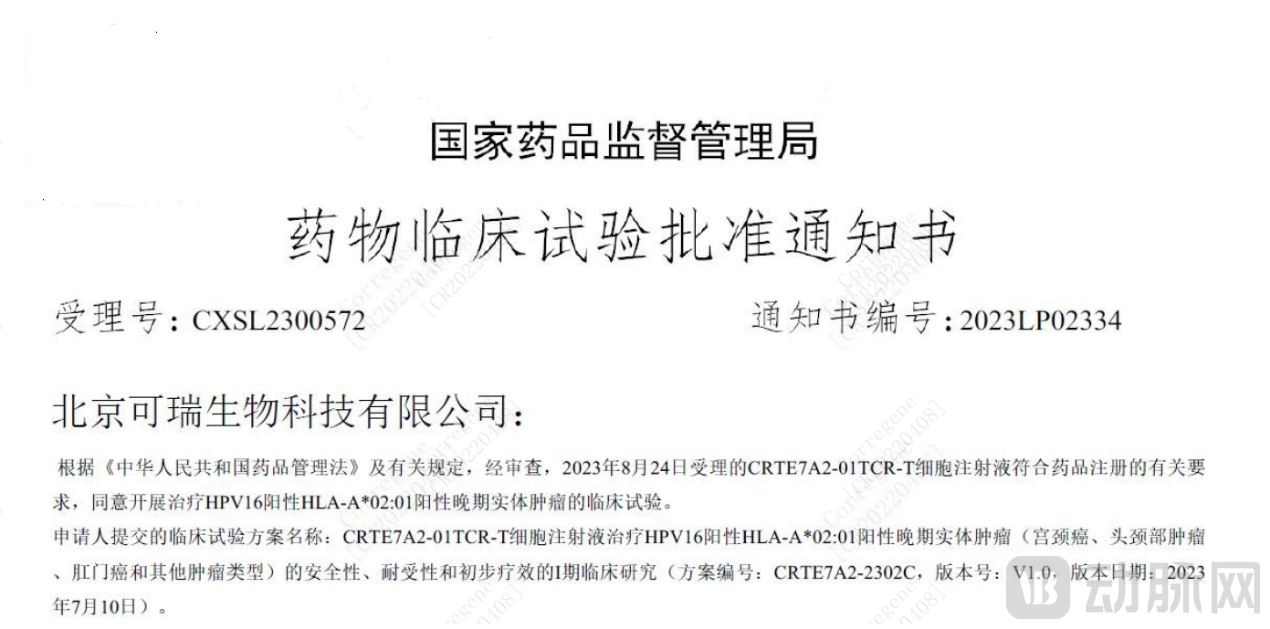
Above: Approval Notice for Clinical Drug Trials
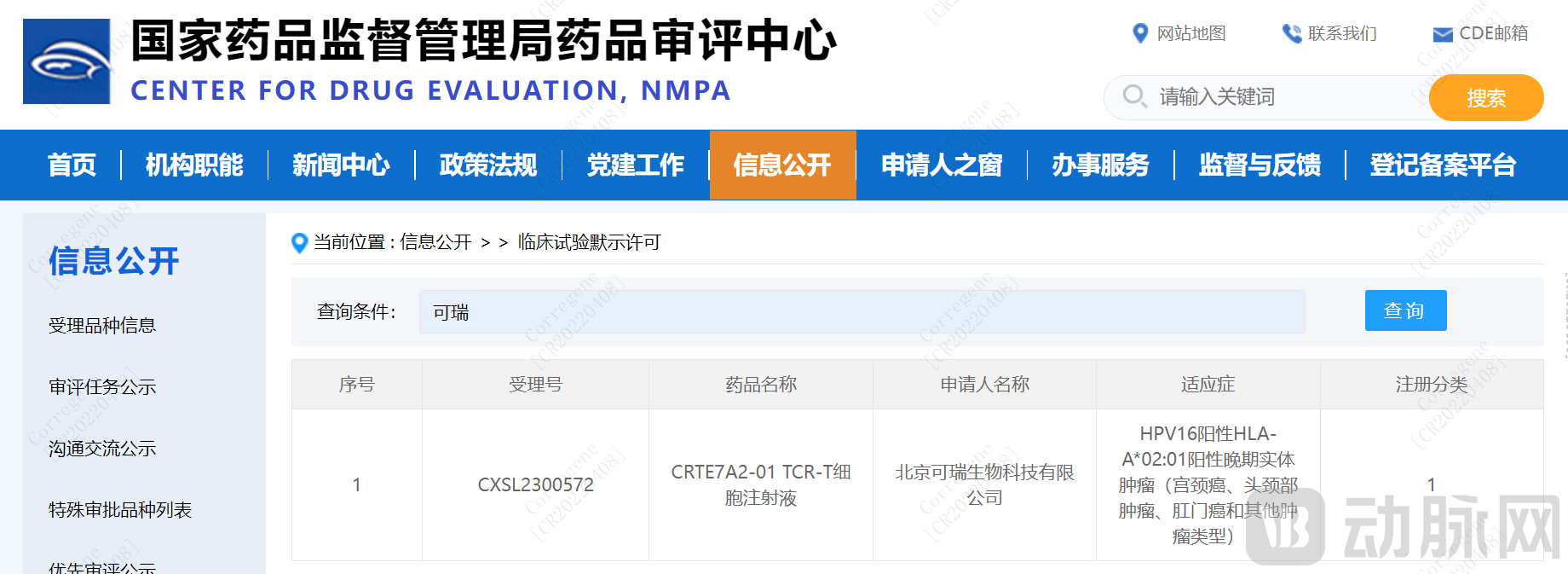
Above: CRTE7A2-01 TCR-T Cell Injection Clinical Trial Implied Permission
Persistent high-risk human papillomavirus (HPV) infection has been identified by the WHO as a Class I carcinogenic factor. Common high-risk HPV types in China include 16, 18, 31, 33, 45, 52, 58, etc., but HPV-16 is the most prevalent high-risk HPV type in HPV-related cancers. There is a causal relationship between HPV infection and nearly all cases of cervical cancer. HPV infection can also lead to various head and neck cancers and anogenital tumors. According to data from the 2022 National Cancer Center report, there are approximately 119,000 new cases of cervical cancer in China, making it the sixth most common malignant tumor among women. About 37,000 deaths occur due to cervical cancer annually, accounting for 20.2% of the global cervical cancer burden, with an incidence rate increasing rapidly at 10.5% per year. Current treatment options for cervical cancer mainly include surgery, radiotherapy, and chemotherapy. Although the majority of patients with early-stage cervical cancer can achieve long-term survival after standardized treatment, some patients still experience recurrence. The recurrence rate for patients with FIGO (Federation International of Gynecology and Obstetrics) stage IB-IIA cervical cancer is 11%-22%, while for those with FIGO stage IIB-IV, the recurrence rate is 28%-64%. The five-year survival rate for metastatic advanced cervical cancer is only around 10%.
TCR-T involves cloning T-cell receptors (TCRs) that can specifically recognize particular HLA-tumor antigen peptide complexes using relevant experimental techniques. The TCR gene coding sequence is then delivered into more T cells via gene delivery methods such as lentiviral vectors, endowing these T cells with new antigen recognition specificity. Patient-derived T cells are transduced with the TCR gene in vitro and expanded in large quantities, enabling them to effectively recognize tumor-specific antigens. When these T cells are reinfused into the patient, they can specifically kill tumor cells and exert anti-tumor activity. Since both intracellular and extracellular antigens can be presented by HLA and recognized by TCRs, TCR-T can target most tumor-specific antigens, especially those derived from intracellular tumor antigens (which account for approximately 90% of all antigens). Therefore, TCR-T holds promise for use in the treatment of almost all tumors, particularly various solid tumors.
Persistent infection with high-risk HPV is an important cause of tumors such as cervical cancer. The mechanism involves the loss of HPV E2 function, integration of the viral genome into the host chromosome, leading to continuous high expression of the oncogenic proteins E6 and E7. These proteins interact with the tumor suppressor genes p53 and pRB within the cell, promoting increased RAS GTpase activity and TRAF2 expression, allowing cells to tolerate apoptosis induced by TNF-α stimulation, thereby promoting cell proliferation, causing chromosomal instability, and resulting in cellular immortalization. Previous studies have found that the E7 antigen of HPV16 can be effectively presented by HLA molecules, making it an ideal antigen target for specific TCR recognition. Beijing Kerui Biological Technology Co., Ltd. utilized its leading self-developed platform to obtain a TCR sequence with excellent activity against the E7 antigen and extremely low off-target risk. This TCR was then used to develop a TCR-T cell injection for clearing HPV16-positive tumor cells. In preclinical studies, this product demonstrated excellent activity and good safety, and its safety and efficacy have been validated in earlier IIT studies. These efforts have laid a solid foundation for our registration clinical trial. Our company will conduct a Phase I clinical study on the safety, tolerability, and preliminary efficacy of CRTE7A2-01 TCR-T cell injection in treating HPV16-positive, HLA-A*02:01-positive advanced solid tumors (cervical cancer, head and neck cancer, anal cancer, and other tumor types) according to the CDE-approved protocol.
Beijing Kerui Biological Technology Co., Ltd. was co-founded by multiple Peking University alumni and returned overseas students, and is committed to the development of innovative drugs based on TCR. Through technological innovation, Kerui Biological has established a systematic TCR R&D platform that addresses a series of technical difficulties in TCR cloning and optimization, enabling high-efficiency, high-throughput TCR innovative drug development. Particularly, its self-developed SMART-TCR affinity optimization platform, based on this revolutionary TCR affinity optimization technology, significantly improves the success rate and efficiency of TCR affinity optimization, breaking through the development barriers of TCR innovative drugs. In the future, Kerui Biological will develop various indications for treating tumors, chronic infections, and autoimmune diseases through two types of products: cell therapy and soluble TCR protein drugs, targeting a trillion-level disease market.