

RDN Sector Sheds 23-Year Shadow as Key Products Gain FDA Approval

ReCor Medical
Developer of Renal Denervation Devices

Medtronic
Chronic Disease Medical Device and Therapy Developer
From the first clinical discovery to obtainingIt took 23 years for RDN products to gain FDA approval.
On November 8, 2023, the first percutaneous renal denervation (RDN) product in the United States was approved — the Paradise uRDN System from ReCor Medical for the treatment of hypertension. Nine days later, Medtronic's Symplicity Spyral radiofrequency ablation system also received FDA approval, becoming the second RDN product approved in the United States for patients with uncontrolled hypertension despite medication.
These two bombshells once again shook the industry. Previously, at the FDA advisory panel meeting in August for Medtronic's Symplicity Spyral system, the benefit-risk profile received 7 votes against, 6 votes in favor, and 1 abstention from the expert panel. This led some to believe that it would either prevent or delay the approval of the Symplicity Spyral system. After all, the FDA’s decisions usually align with the voting outcomes recommended by the Panel.

ReCor Medical's Paradise uRDN System Becomes the First RDN Product in the U.S., Seen as Expected by Most. Previously, the FDA held a review hearing for the Paradise uRDN System, which received 12 votes in favor for safety, 8 votes in favor for efficacy, and 10 votes in favor and 2 against for the benefit-risk ratio.
This data put Medtronic's Symplicity Spyral system at a disadvantage compared to ReCor's Paradise uRDN system. Moreover, due to differences in their technical approaches, the market has begun debating whether the disparity in voting results stems from clinical trial data or the superiority of one technical approach over the other. Different answers will steer the industry toward different technological paths.
The approval of Medtronic's Symplicity Spyral system this time might bring an end to the three-month-long debate. However, the successive approvals of Recor Medical and Medtronic's RDN products will bring new shocks and impacts to the industry, sparking another major debate in the market about products with different technical approaches.
23 years is a long time for any company or entrepreneurial team. The reason why companies like Medtronic have been able to persist in the continuous development of RDN products for 23 years is due to a significant clinical discovery.
In 2000, at the College of Physicians and Surgeons, Columbia University, Professor Wang Jie, Dr. Howard Levin, and Dr. Joshua Weintraub discovered while treating a patient with renal colic:Local anesthetics injected around the renal artery can block the nerves surrounding the renal artery, achieving a blood pressure-lowering effect.。
It is understood that blood pressure is controlled through the interaction of signals from multiple systems in the body, including the nervous system, circulatory system, and endocrine system. Among these, the renal artery is rich in sympathetic nerve plexus, and excessive activation of renal sympathetic nerves can lead to increased adrenaline secretion, sodium reabsorption, and reduced renal perfusion. Increased sympathetic nerve activity plays a key role in the pathophysiology of primary hypertension.
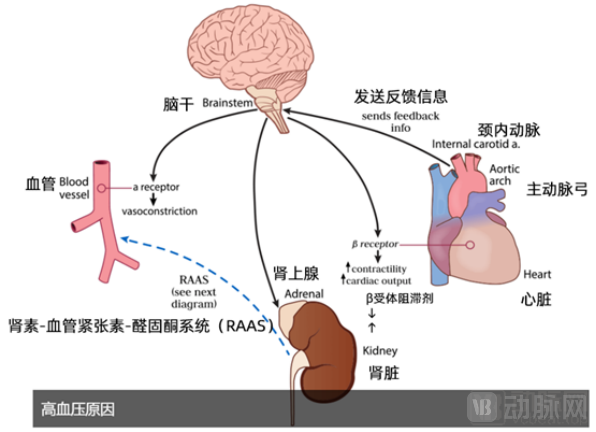
(The pathway by which the kidneys affect blood pressure, image source: ReCor Medical official website)
Afterward, by searching medical literature, they found that doctors had historically studied "Treating Hypertension by Interfering with the Renal Artery Peripheral Nerves". However, the surgical procedures at that time faced challenges such as technical difficulty and severe postoperative complications. After the emergence of antihypertensive drugs, surgical treatment was replaced by medication.
Based on this important clinical finding, Professor Wang Jie and Dr. Howard Levin, as heart failure specialists, first considered:High sympathetic tone is one of the main pathological mechanisms of heart failure. Blocking renal sympathetic nerves can reduce high sympathetic tone, thereby treating heart failure.They also verified this result in subsequent animal experiments: blocking renal nerves can promote diuresis, natriuresis, and improve heart failure symptoms in animals.
With these data, Professor Wang Jie and others finally reached out to the right investor after experiencing multiple financing setbacks: The Foundry, a medical device incubator on the West Coast of the United States. After preliminary discussions, the person in charge of The Foundry believed that renal sympathetic nerve block therapy would have great potential. They decided to invest in this project and established a company to operate the project: Ardian Inc.
After receiving angel investment, Professor Wang Jie's team quickly launched a clinical trial at Columbia University Medical Center in the United States to study drug-induced renal sympathetic nerve blockage for treating heart failure. However, due to slow progress, the trial was later moved to China.
On the other hand, Ardian analyzed the results of clinical pre-trials and previous cases related to heart failure research.Believes that it will take a huge amount of money and a long time for renal denervation therapy to be approved for the treatment of heart failure.。Because the FDA stipulates: registration trials for heart failure treatments should use patient mortality as the primary clinical endpoint.。
Based on this, Ardian changed the indication to hypertension and conducted clinical trials in Australia on renal denervation therapy for treating hypertension.。
After changing the indications, Ardian also optimized the surgical procedure and product.
Compared with the previous method of blocking renal nerves through drug injection, Ardian has developed a percutaneous interventional radiofrequency ablation system combined with renal artery ablation to block renal nerves. This procedure is simple and easy to perform, familiar to cardiac intervention doctors, and easy to promote and use.
Under the methodical clinical trials, Ardian has achieved encouraging results. The released Symplicity HTN-1 and Symplicity HTN-2 trials on RDN therapy showed that patients' office systolic blood pressure decreased by 22 mmHg and 32 mmHg respectively six months post-operation, demonstrating significant effects.
This data directly exploded in the medical industry.In 2010, Medtronic was the first to enter the market by acquiring Ardian for $800 million in cash and $550 million in milestone payments. Subsequently, Boston Scientific, St. Jude Medical, ReCor Medical, Medtronic, Terumo, Johnson & Johnson, and other companies have aggressively developed RDN products. Data shows that global mergers and acquisitions involving RDN technology have exceeded $5 billion.
In a short period of time, there are more than sixty companies worldwide engaged in the research and development of RDN devices, rapidly heating up the RDN track.
However, this excitement quickly faded. After completing the acquisition, Medtronic changed the previous ablation catheter to the single-electrode ablation catheter Flex and used this product to conduct the Symplicity HTN-3 clinical trial. The results showed that: there was no significant difference in blood pressure reduction between the RDN group and the sham operation group, and the trial results did not meet expectations. This time, Medtronic, which was the first to enter the RDN industry and ignite the entire track, personally poured cold water on this track. Giants such as Boston Scientific, Abbott, and Johnson & Johnson have all abandoned this product line.
However, Medtronic remains persistent, and the medical community still holds a very positive outlook on the future of RDN. Professor Wang Jie previously stated, "The basic and clinical academic communities in Europe and America have always maintained considerable confidence in this therapy because there is a substantial accumulation of anatomical, histological, physiological, and pathophysiological evidence supporting it."
Jason Weidman, Senior Vice President and President of the Cardiovascular Portfolio at Medtronic, also stated: "Medtronic has always believed in the potential of this therapy. Even as other companies exit the RDN space, Medtronic remains committed to advancing it based on our confidence in the treatment."
Therefore, Medtronic improved its original product in 2015 and developed the second-generation Symplicity Spyral ablation catheter, while initiating the Spyral-Off Med and Spyral-On Med clinical trials.
In 2017, Medtronic released the results of the SPYRAL HTN-OFF MED pilot trial at the European Society of Cardiology Annual Meeting: Compared with the sham procedure group, the RDN group showed a reduction in 24-hour mean ambulatory systolic and diastolic blood pressure by 5.0 mmHg and 4.4 mmHg respectively, and office systolic and diastolic blood pressure decreased by 7.7 mmHg and 4.9 mmHg respectively at 3 months post-procedure, indicating that the RDN group was more effective. (A 10 mmHg reduction in blood pressure in hypertensive patients will decrease cerebrovascular accidents by 55% and cardiovascular accidents by 33%.)
In 2018, Medtronic announced the results of the SPYRAL HTN-ON MED study at the European Cardiovascular Intervention Conference: after 6 months of follow-up, the average 24-hour systolic and diastolic blood pressure in the RDN group decreased by 9 mm Hg and 6 mm Hg, respectively, while in the control group, the decreases were 1.6 mm Hg and 1.9 mm Hg, once again proving the significant effect of the RDN group.
Based on the clinical data and innovation of RDN products, the FDA has designated the RDN products from four companies—Medtronic, ReCor Medical, Sonivies, and Mermaid Medical—as "Breakthrough Devices." Meanwhile, multiple expert consensuses have recognized the effectiveness of RDN, recommending it for the treatment of hypertension.
In November 2023, Medtronic's Symplicity Spyral finally received FDA approval for marketing after experiencing five major setbacks: financing difficulties, changes in indications, failed clinical trials, impacts from the COVID-19 pandemic on the implementation of clinical trial protocols, and rejection by The Circulatory System Devices Panel. From the clinical discovery in 2000 to the approval for marketing in 2023, Symplicity Spyral has taken 23 years.
How did the first person to eat crab fall behind? Perhaps it was because there were two people watching him eat the crab, and their subsequent actions and paths were optimized based on the first person’s experience. This is likely how Medtronic was overtaken in the RDN field.
In 2010, Medtronic made a substantial acquisition of Ardian, the undisputed leader in the RDN field. As a globally renowned multinational medical device company, every move by Medtronic draws significant attention from industry insiders. This also sparked an innovation boom in RDN. Following the failure of Medtronic's Symplicity HTN-3 clinical trial, numerous innovative companies analyzed the reasons behind the failure, optimizing their products and refining clinical trial protocols accordingly.
For example, based on Medtronic's foundation, Xinmai Medical has innovatively developed the world's only Renal Denervation (RDN) product with renal nerve mapping functionality. This product can selectively remove renal sympathetic nerves while preserving renal parasympathetic nerves and other neural components. Xinmai Medical believes that precise ablation after mapping can lead to better clinical outcomes, which has been partially validated in clinical trials.
Biosensors International's subsidiary, Antong Medical, has developed the world's only Renal Denervation (RDN) product that can be used for interventional treatment via both the radial artery and the femoral artery — the Iberis Renal Artery Denervation System.
Meliweiye drew lessons from Medtronic's HTN-3, making multi-faceted improvements and innovations in design concept, product structure, trial design, and operational procedures. They developed a basket-like structure that enhances catheter compliance and superior vessel wall apposition, while the 360-degree spiral arrangement of the six-electrode design enables more efficient ablation therapy.
Innovative companies such as ReCor, SoniVie, Verve, Venus Medtech, and Hantong Medical have opted for a new energy source, utilizing ultrasonic energy instead of radiofrequency energy. They believe that ultrasonic energy offers the clinical advantages of deeper penetration, a larger 360° coverage area, and almost no damage to the vascular intima.
In addition, Kangfeng Bio adopted cryoablation and developed the world's first cryoablation system for treating hypertension, Cryofocus. Kangfeng Bio believes that cryoballoon ablation of renal sympathetic nerves has the advantages of complete nerve damage, precise ablation location, minimal vascular endothelial injury, and low risk of thrombosis. It is reported that the product was designated as a breakthrough device by the FDA in December 2022.
By improving their products, innovative companies have narrowed the gap with Medtronic's Symplicity Spyral. By refining clinical trial protocols, ReCor Medical successfully leapfrogged ahead.。
It is understood that the first challenge of RDN clinical trials is the interference of antihypertensive drugs with the blood pressure-lowering effect of RDN. Specifically, during the 6-month clinical trial follow-up period, patients are required not to adjust their medications if their blood pressure at enrollment is >150mmHg, which goes against patient benefits and is unethical. However, adjusting medications would make it impossible to observe the net effect of RDN on blood pressure.
The clinical trial protocol for Medtronic's SPYRAL HTN-ON MED was set with the primary clinical endpoint being blood pressure at 6 months post-operation. The results showed that a significant number of patients in the trial changed their hypertension medications, not only violating the trial protocol but also causing the 6-month On-Med trial results to fall short of the expected clinical endpoint.
ReCor changed the 6-month period to 2 months because it is feasible to keep patients from changing antihypertensive drugs within 2 months. The excellent clinical data of ReCor also proved the correctness and rationality of this plan.
The second challenge is the measurement of blood pressure in clinical trials. Medtronic24-Hour Ambulatory Systolic Blood PressureAs the primary clinical endpoint. However, at 6 months, there was a significant loss of 24-hour ambulatory blood pressure monitoring data, leading to repeated inquiries.
ReCor Medical's design is more ingenious, with its pre-designDaytime Systolic Blood Pressure in Ambulatory Blood Pressure MonitoringAs the primary clinical endpoint, it achieved the preset endpoint in all three clinical trials. Therefore, despite the smaller scale of ReCor's clinical trials, the results are sufficient to demonstrate that its Paradise uRDN system can safely and effectively reduce patients' blood pressure.
This enabled FDA's The Circulatory System Devices Panel to be more favorable towards the Paradise uRDN system during the review hearing, and allowed the FDA to approve the Paradise uRDN system more quickly, making it the first RDN product in the United States. Medtronic's Symplicity Spyral became the second RDN product in the United States.
It is worth mentioning that the inquiry and rejection of Medtronic by The Circulatory System Devices Panel is not a failure of the radiofrequency ablation system, and the FDA's approval of the Paradise uRDN system as the first RDN product in the United States does not mean a victory for the ultrasound ablation system. This is largely just a difference in clinical trial design.Because the response rate of hypertensive patients to RDN treatment was very similar in the clinical trials conducted by ReCor Medical and Medtronic.
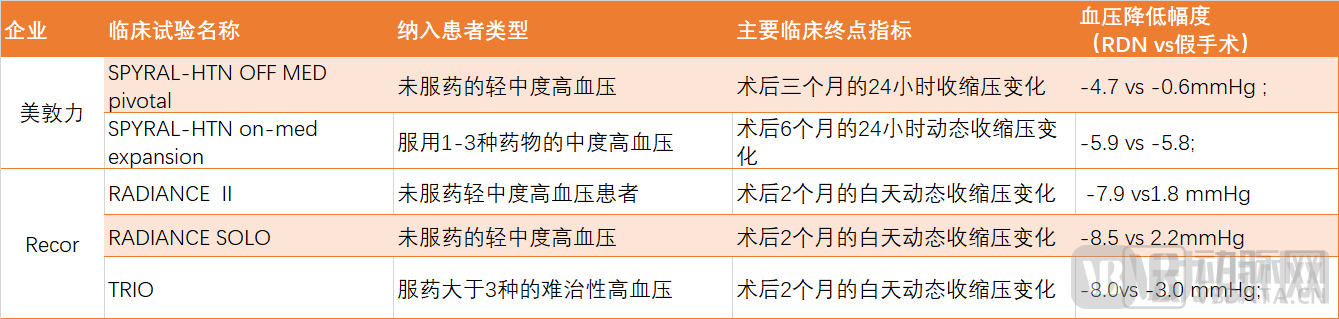
(Comparison of Clinical Trial Data Between ReCor and Medtronic)
Regarding the technical pathway, more real-world data is still needed to make a judgment. However, what can be observed is that: at this stage, there are many studies related to radiofrequency ablation on the market, and the technology is relatively mature, while ultrasound ablation requires further research. Additionally, different technical pathways have their own technical barriers. Among them, the core difficulty in the radiofrequency ablation pathway lies in the production of the radiofrequency ablation device and the control of the energy source. In the ultrasound ablation pathway, the key challenges are the product’s structure and complex manufacturing process.
Besides ReCor Medical and Medtronic, other companies in the global RDN field have also made respective progress.
Among them, Meili Weiye, Xinmai Medical, and Antong Medical successively announced the clinical data of their respective RDN products, with results meeting expectations. For instance, the Netrod clinical trial data published by Meili Weiye showed that two months post-operation, the office blood pressure in the treatment group decreased by 25mmHg, while the control group saw a decrease of 6mmHg, indicating a significant difference between the two groups.
Xinmai Medical announced the complete six-month results of the registration clinical trial for its renal nerve mapping/selective ablation system, showing that 95% of patients treated with msRDN achieved blood pressure control (office systolic blood pressure <140mmHg) while using significantly fewer antihypertensive medications compared to the control group.
Not only have advances been made in clinical settings, but domestic companies have also achieved breakthroughs in other areas. For instance, Hantong Medical completed tens of millions of yuan in financing at the beginning of June to advance its core products. Moreover, Hantong Medical's uRDN product has been submitted for registration inspection, and a clinical trial led by top domestic experts is about to commence.
Overseas, Verve Medical announced in July 2023 that it received FDA approval to initiate the pivotal IDE trial for RDN to treat resistant hypertension and lower blood pressure.
SoniVie announced in June 2022 that the FDA had granted IDE approval for its "REDUCED1" pilot study. The REDUCED1 study will further expand the company's clinical experience based on two renal denervation clinical trials conducted with the previous-generation TIVUS. Notably, in addition to using ultrasound nerve ablation for treating resistant hypertension, SoniVie has also launched an ultrasound ablation product for treating pulmonary arterial hypertension.
In China, an innovative company named Pulnovo Medical has independently developed a new therapy for pulmonary hypertension: a device product based on Percutaneous Pulmonary Artery Denervation (PADN), which uses radiofrequency ablation to block the sympathetic nerves in the pulmonary vascular endothelium, thereby reducing pulmonary artery pressure and slowing disease progression.
It is reported that Pulnovo Medical released the follow-up results of the PADN-5 study in March 2023: PADN demonstrated excellent long-term benefits over a three-year follow-up period, consistently showing significant superiority over the control group. Compared with sildenafil combined with standard heart failure drug therapy, PADN combined with standard heart failure drug therapy significantly reduced the incidence of clinical deterioration.
In addition, with the PADN radiofrequency ablation catheter, Pulnovo Medical quickly obtained the FDA Breakthrough Device Designation within just 16 days, becoming the first company in China to receive this designation in the field.
Overall, multiple products in the RDN field are about to be approved. The promotion by clinical experts, inclusion in guidelines and consensus, and user-friendly procedures will all drive RDN products to quickly enter the market. However, we do not expect the industry to become intensely competitive right away, as companies have invested substantial funds and want to recoup their costs before the centralized procurement.
References:
Yanda Medical Voice Network "Wang Jie: Tracing the Origins, The Past and Present of RDN Technology"
MedTF "RDN: Ultrasound Ablation Takes the Lead, Who Is Expected to Become China's ReCor?"
VCBeat "FDA Approves Three Breakthrough Devices in a Row, Will Medtronic's Setback in Hypertension Treatment Be Reversed?"
VCBeat "Medtronic Faces Challenges Again in a Billion-Dollar Market: The Reasons Behind Reflect Two Major Industry Issues"