

We-Linking Secures Nearly RMB 100 Million in Two Rounds of Funding Within a Year, Pioneering China's First Fully Implantable Brain-Computer Interface Full-Stack Technology Chain
WE-LINKING
Developer of Medical-Grade Fully Implantable Wireless Brain-Computer Interface Systems
In extremely"On the 'disruptive' technology stage, brain science is undoubtedly one of the most cutting-edge, forefront, and dazzling fields."Especially in the context of a cooling market environment, the热度 of brain science and brain science medical device sectors continues to increase, with growing interest and confidence from investors in brain-computer interface technology.
According to statistics from the official database of VCBeat, the financing progress of brain-computer interface companies in 2023 has been continuously advancing. As of the time of writing, a total of 11 financing events have occurred, with publicly disclosed single-round financing amounts ranging from tens of millions to hundreds of millions of RMB. Additionally, two companies have secured two rounds of financing each in less than a year.
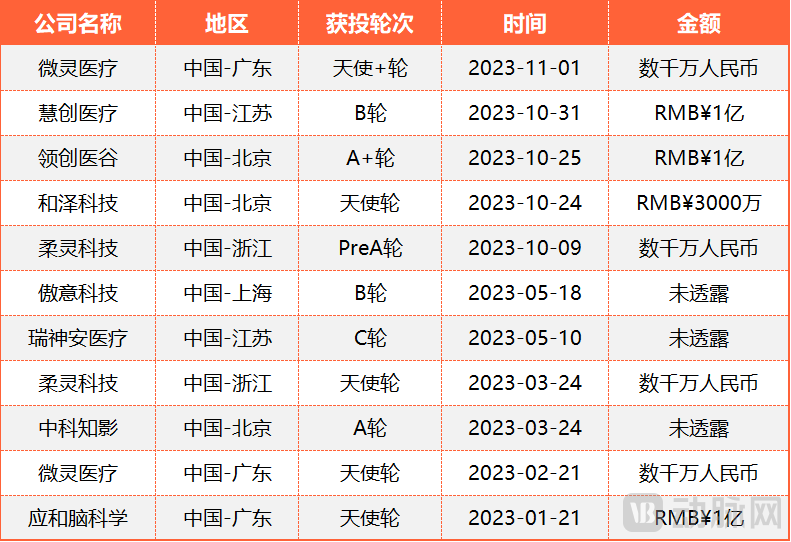
Financing Events in the Brain-Computer Interface Sector in 2023 (As of the Time of Writing)
Among them, WE-LINKING (Shenzhen WE-LINKING Medical Equipment Co., Ltd.), a leading enterprise in brain-machine intelligent fusion technology, successively completed two rounds of financing in February and November 2023, each reaching tens of millions, with a total amount close to 100 million yuan.
VCBeat had previously reported in detail on these two rounds of financing. However, against the backdrop of a cooling investment climate in the early-stage medical field, why has WE-LINKING been favored by capital twice? Where does the capital's confidence in it lie?
Globally, the brain-computer interface industry is an emerging field, let alone China's market, which started slightly later than in Europe and the U.S. Most companies in China's industry are small-scale and still in the early stages of development. However, compared to other traditional technology fields, the brain-computer interface sector actually presents more opportunities for leapfrogging advancements.
Among these opportunities, technical strength plays a decisive role in the competitiveness of brain-computer interface enterprises.
Although WE-LINKING, founded in 2019, is also a "young" innovative company, its founder and CTO Li Xiaojiang has been deeply engaged in the brain science field for more than two decades. The story of how Li Xiaojiang became involved with brain-computer interfaces begins with his academic journey.
In June 2010, Li Xiaojian graduated with a Ph.D. from the Institute of Biophysics at the Chinese Academy of Sciences. During this period, Li Xiaojian mainly focused on the collection, extraction, and decoding analysis of brain information. In the same year, after obtaining his doctorate, Li Xiaojian chose to further his studies in the United States.
During his study abroad from 2010 to 2018, Li Xiaojiang successively conducted postdoctoral research on brain science and technology at the Medical College of Georgia and the Feinberg School of Medicine at Northwestern University in the United States. His research covered cutting-edge technological theories such as high-throughput acquisition of dynamic neural information, neural circuit analysis and decoding techniques, and new neuro-modulation technologies.
It was also during this period that Neuralink, the brain-computer interface company that has opened the world's imagination, announced its establishment in 2016. During the same period, more than a decade of academic and professional experience allowed Li Xiaojiang to accumulate a vast amount of foundational technology related to brain-computer interfaces. Through his research, he also discovered that the clinical application of brain-computer interfaces still required more advanced hardware for support.
Therefore, in response to the development of the times and the needs of scientific research, in the autumn of 2018, Li Xiaojian chose to return to China and went all the way south to Guangdong, joining a leading scientific research institute in China. Without delay, he established a laboratory, launched technical research, and wrote an innovative chapter full of confidence for China's brain-computer interface industry.
Looking back on this journey, the birth and growth of WE-LINKING have always been aligned with international leading technologies and concepts. The path taken by the company's implantable brain-computer interface (iBCI) is not one of imitation, but rather a pioneering and innovative route unique to China.
In July 2023, Li Xiaojiang, who has a comprehensive R&D background in precision mechanical engineering, optical engineering, electronic engineering, and neural engineering, received the Outstanding Young Scholar Award at the first Brain-Computer Interface Conference "Hua Nao Award" for "being the first in China to fully integrate the entire technology chain of implantable brain-computer interfaces and leading the world in non-genetic neural remote control methods based on opto-nanotechnology."
What is the full-stack technology chain of implantable brain-computer interfaces?
WE-LINKING has basically completed the R&D of the full-stack hardware and software systems for brain-computer interfaces around the technology chain of implantable brain-computer interfaces. Li Xiao Jian introduced to VCBeat, "In terms of the hardware system, the key core components include high-density ultra-compliant neural sensor arrays, integrated acquisition-stimulation closed-loop neural electronic chips, thousands of channel-level miniaturized brain-computer information interaction instruments, and wireless transceivers for brain information. In terms of the software system, it includes preprocessing algorithms, decoding analysis algorithms, and brain-like control algorithms, etc."
Among them, the electrodes and chips of brain-computer interfaces are the hardware components at the core of technological competition. Specifically, the high-density, ultra-flexible neural sensor array developed by WE-LINKING adopts a high-density mesh-like ultra-thin structure based on MEMS technology and uses composite nanotechnology to enhance neurocompatibility and conductivity.
As an implantable brain-computer interface, this electrode can obtain high spatiotemporal precision neural signals simply by being attached to the surface of the cerebral cortex. Moreover, it can be implanted multiple times in the same target area of the brain, solving the technical challenge of implantable brain-computer interfaces where the implant site has only a single lifespan due to brain damage caused by penetrating electrodes. Additionally, the surgical procedure is relatively simple and can be mastered by neurosurgeons with experience in craniotomy.
Secondly, for chips, different laboratories have different research focuses, and they have their own demands and understanding of the functions and performance of chips. Internationally, Neuralink has started to produce semiconductor chips on its own, which is relatively rare in the medical device field.
Against this backdrop, WE-LINKING has successfully developed a neural electronic signal chip that integrates acquisition and stimulation, achieving a closed-loop design for neural modulation.
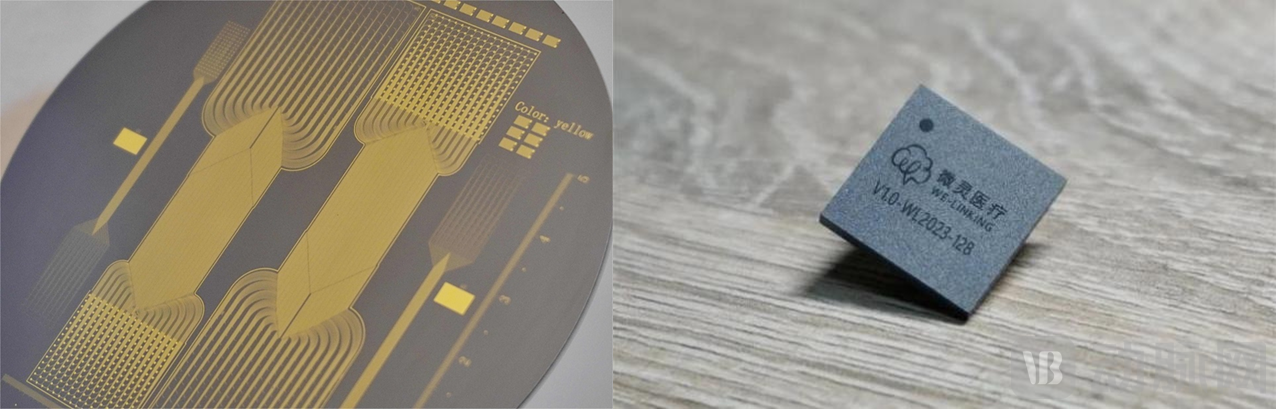
High-Density Ultra-Compliant Neural Sensor Array, Neural Electronic Signal Chip
In addition, the company's core foundational modules—such as the high-throughput neural signal real-time analysis and transcoding device, the thousands-of-channels-level miniaturized brain-computer information interaction instrument, and the brain-inspired intelligent computation and control system—have also reached technological maturity and are soon to "come to fruition."
At the system platform level, WE-LINKING has also established a complete preclinical research paradigm and functional evaluation system for implantable brain-computer interfaces, successfully completed brain-computer interface implant surgeries in multiple rhesus monkeys, and conducted experiments on collaborative motor control training using brain-computer interfaces and brain-inspired algorithms.
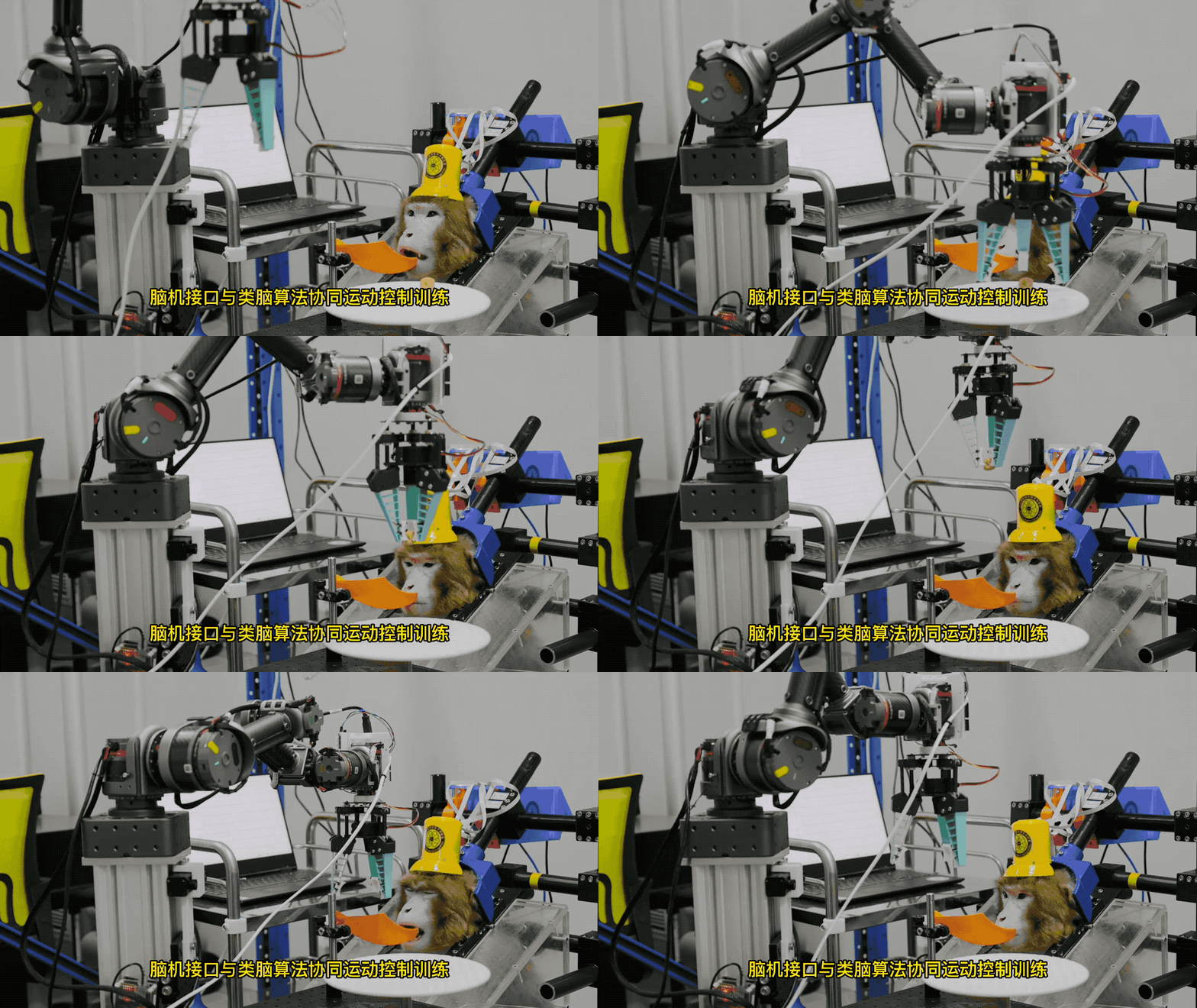
Brain-Computer Interface and Brain-Inspired Algorithm Collaborative Motion Control Training
After witnessing a large number of theoretical innovations and the emergence of sophisticated technical products, people's perception of brain-computer interfaces is no longer limited to "science fiction." Both society and the market are viewing this industry from a more calm and objective perspective, while the industry itself is accelerating the transformation of innovative achievements into clinical medicine and other fields, as well as industrial applications.
"Whether compared with foreign companies or domestic companies, a deep understanding of the industry will become the core advantage for who can break through in the competition," said Li Xiao Jian.
Since its inception, WE-LINKING has focused on developing full-stack medical-grade implantable brain-computer interface devices with rigid clinical needs. It consistently adheres to medical device requirements as the design guideline, allowing clinical needs to drive the specific design of brain-computer systems.
As a direct connection pathway created between the brain and external devices, the core of brain-computer interface (BCI) technology is to bypass the human body's own organs and fully leverage the advantages of the human brain. WE-LINKING's short-term goal is to help paralyzed individuals achieve mind-controlled functions such as wheelchairs, robotic arms, and typing, as well as enabling paralyzed individuals to walk freely and blind individuals to regain sight, ultimately achieving a "human-machine symbiosis." WE-LINKING’s technology extends to multiple specific research and clinical application scenarios, with several BCI products nearing systematic completion of development and planned for market release in the near future.
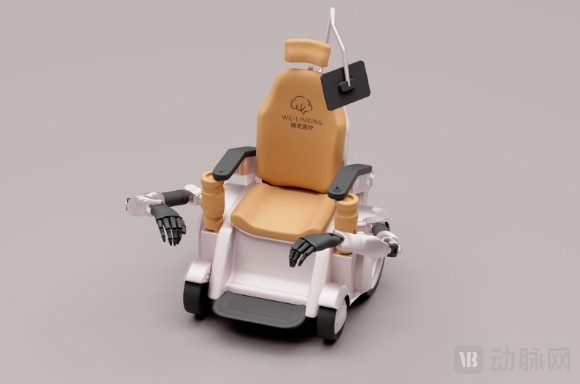
WE-LINKING Smart Wheelchair
As one of the most representative companies in China's implantable brain-computer interface field, WE-LINKING has established its headquarters and R&D center in Shenzhen, with clinical research and data centers in Beijing and Suzhou respectively, and a North American branch in Maryland, USA. This is of great significance to WE-LINKING's globalization strategy.
The clinical and market value of brain-computer interfaces is self-evident. Internationally, implantable brain-computer interface technology is transitioning from research to clinical application. Several companies in the U.S. have received the FDA's Breakthrough Device Designation or entered the patient clinical trial phase.
In this regard, Li Xiaojian concluded in the interview, "As the only team in China capable of independently developing brain-computer therapies and delivering tailored solutions, WE-LINKING considers it a core mission to bring system-level products to clinical applications, enabling patients to benefit as soon as possible. We hope to achieve the next leap in brain-computer interfaces by using miniature yet high-performance implantable devices as a solution, while advancing both engineering hardware-software capabilities and our understanding of the brain."