Nearly 50 Drug Development Pipelines Terminated as Multinational Pharma Companies Streamline Operations

Takeda
Biopharmaceutical Manufacturer
1. Nearly 50 pipelines have been terminated from development.
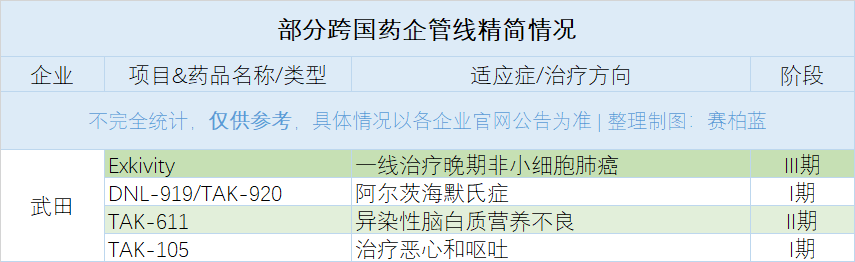
Recently, Takeda disclosed in its third-quarter financial report that due to a series of uncontrollable factors, its net loss increased, and the full-year net profit forecast was reduced by 71%. Additionally, Takeda announced four pipeline programs that need to be streamlined, covering treatment areas for diseases such as lung cancer and Alzheimer's disease, one of which involves an already marketed product.
Last month, after consultation with the FDA, Takeda announced that it would initiate the voluntary withdrawal of mobocertinib succinate (mobocertinib, trade name: Exkivity) from the U.S. market.
It is reported that the FDA and National Medical Products Administration (NMPA) approvals for Mobocertinib were based on its Phase I/II single-arm trial as a second-line treatment. Afterwards, Takeda did not continue its application in the second-line setting but instead focused on first-line treatment research by initiating the EXCLAIM-2 trial. However, due to the confirmatory study in Phase III clinical trials failing to meet its primary endpoint, the EXCLAIM-2 trial was terminated.
The work of voluntarily withdrawing the approved indications in the U.S. has also commenced. Takeda stated that the subsequent plans for Mobocertinib in China and other countries/regions where it has been approved are actively being communicated with the regulatory authorities in each region.
In addition to Mobocertinib, DNL-919/TAK-920, an Alzheimer's disease candidate drug co-developed by Takeda and Denali, was discontinued due to "moderate, reversible hematological effects" observed at the highest dose. Moreover, the enzyme replacement therapy candidate TAK-611 and the anti-nausea and vomiting candidate TAK-105 were also halted from further development for not meeting primary or secondary endpoints and lacking data support.
Source of article images: CphiCN Official WeChat
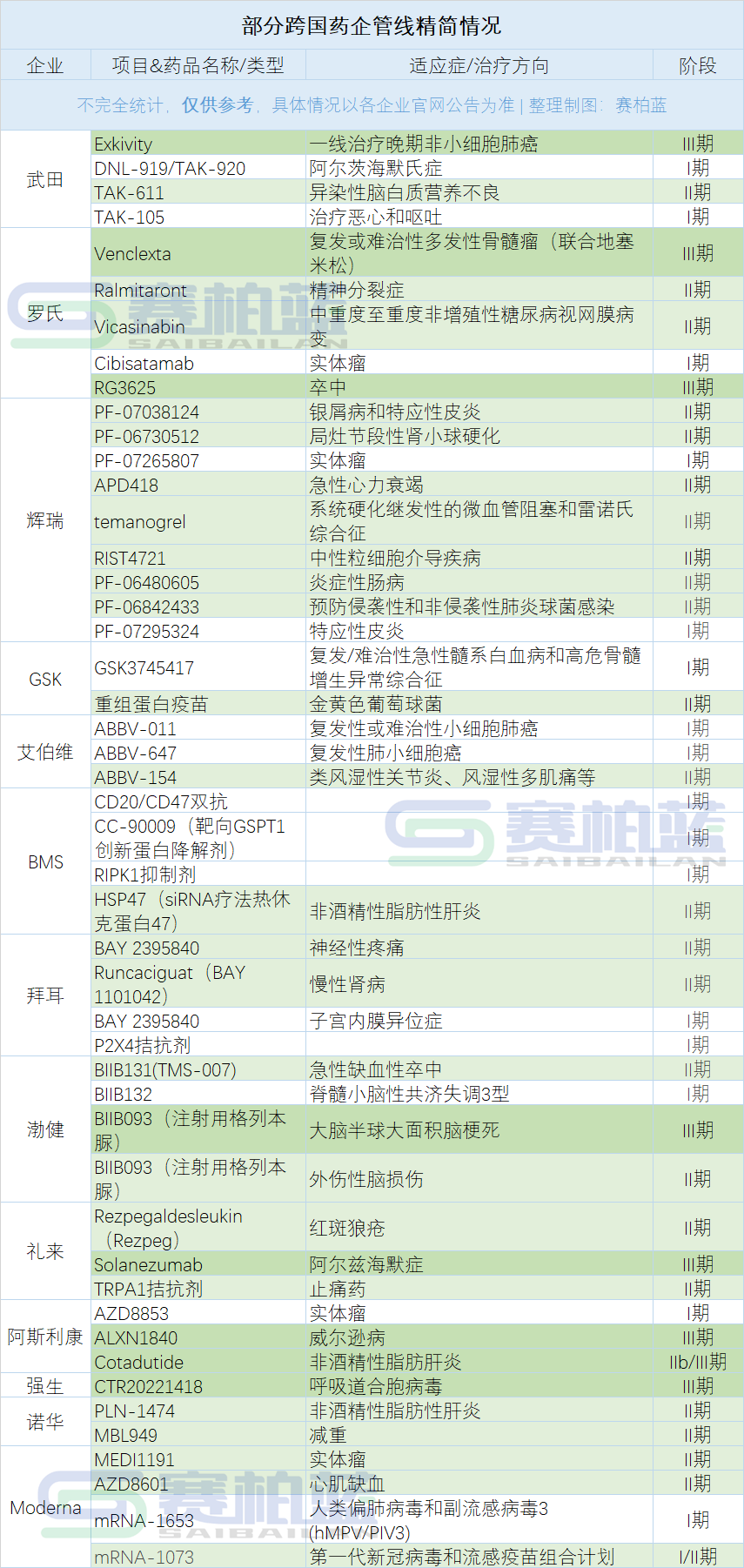
This year,More Than Ten Large Multinational Pharmaceutical Companies Announce Multiple Streamlining Plans, Nearly 50 Pipelines Cut(See the statistical list at the end of the article).
Recently, Roche's Q3 financial report and other information showed that four of its R&D pipelines will be streamlined, including one in Phase III, two in Phase II, and one in Phase I, covering treatment areas such as multiple myeloma, diabetic retinopathy, and schizophrenia.
Specifically, these include the discontinuation of the study on Venclexta combined with dexamethasone for the treatment of relapsed or refractory multiple myeloma due to Phase III results not meeting expectations; the abandonment of the Phase II project on TAAR1 agonist Ralmitaront for schizophrenia treatment due to failure in futility analysis and not reaching the primary endpoint; the termination of the Phase II project on Vicasinabin for diabetic retinopathy due to not achieving the primary endpoint; and the cessation of the Phase I trial of the T-cell bispecific antibody Cibisatamab in solid tumors based on "the totality of efficacy and safety data as well as the evolving treatment landscape in the therapeutic area."
Six months ago, Roche also successively halted the development of multiple drugs, including the Angelman syndrome ASO drug Rugonerse, tenecteplase for stroke treatment in Phase III, and the hemophilia A gene therapy RG6358 in Phase II.
2. Half of the terminated pipelines were halted in Phase II
By clinical stage, among the 48 pipelines suspended in this statistics, the largest number were in Phase II (counted by the more advanced stage, e.g., Phase IIb/III is counted as Phase III, same below), accounting for about half, reaching 24 pipelines.
Taking Pfizer as an example, it has at least 8 clinical projects that have stalled at this stage, including the topical PDE4 inhibitor PF-07038124 for the treatment of psoriasis and atopic dermatitis, the β3-adrenergic receptor antagonist APD418 for the treatment of acute heart failure, and Temanogrel for the treatment of microvascular obstruction and Raynaud's syndrome secondary to systemic sclerosis.
Phase II trials, also known as efficacy trials or clinical effectiveness trials, primarily aim to preliminarily evaluate the therapeutic effects and safety of a drug in patients with the target indication.
At this stage, the cohort of subjects often expands from the previous trial phase. As the number of subjects increases, potential safety issues of the drug are more likely to be identified. In addition to safety, if the therapeutic effects demonstrated by the drug in this phase do not show significant advantages compared to existing treatment options, the corresponding pipeline is also highly likely to be terminated.
In this statistics, the frequency of Phase I projects being terminated followed that of Phase II, with approximately 16 pipelines halted around this stage; about 8 projects were terminated in Phase III.
In terms of drug types, small molecule drugs appear most frequently.
Taking Bayer as an example, the four pipelines it announced to terminate are all small-molecule drugs, including BDKRB1 receptor antagonist BAY2395840 for neuropathic pain, oral soluble guanylate cyclase (sGC) agonist Runcaciguat for chronic kidney disease, as well as BAY2395840 and a P2X4 antagonist for endometriosis.
In recent years, the pharmaceutical industry has often seen a "crowding" phenomenon in popular sectors, with dozens or even hundreds of pharmaceutical companies entering certain fields for research and development. However, only a few will eventually succeed in bringing their products to market and achieving commercialization.
As the market environment changes, large pharmaceutical companies with global operations need to terminate or divest non-core product pipelines while optimizing their personnel structure to reduce costs, increase efficiency, and achieve new growth.
Source of article images: CPHI China Official WeChat

Editor: Baiji
Disclaimer: This article is a reprint from Yaozhi.com. All rights to the images and text belong to the original author. The purpose of the reprint is to convey more information and does not represent the views of this platform. If there are any issues regarding content, copyright, or other problems, please leave a message on this platform, and we will address it promptly.