

Sociological Survey Report on Patients with Fibrodysplasia Ossificans Progressiva Released in China
Ipsen
Biopharmaceutical Manufacturer
BeijingNovember 24, 2023PR Newswire -- Recently, the 2023 China Rare Disease Conference was held in Beijing. At the twelfth sub-forum of this year's conference, "Endocrine Genetic Metabolic Rare Diseases," the "Sociological Survey Report on Patients with Fibrodysplasia Ossificans Progressiva" completed by the China Rare Disease Alliance/Beijing Rare Disease Diagnosis and Treatment and Security Association, the Center for Pharmaceutical Policy and Economics Research at Tianjin University School of Pharmacy, and Ipsen was officially released.
Fibrodysplasia Ossificans Progressiva (FOP) is a rare autosomal dominant genetic connective tissue disease caused by mutations in the ACVR1 gene, leading to progressive ossification of muscles and connective tissues throughout the body.[1],[2]FOP has been included in the "Second Batch of Rare Disease Catalog" jointly released by the National Health Commission and five other departments.[3]Currently, research on FOP patients in China is mostly limited to small-sample case reviews, with almost no reports available on their quality of life or economic burden. Therefore, there is an urgent need to conduct sociological surveys on FOP patients in China to gather fundamental data.
"Sociological Survey Report on Patients with Fibrodysplasia Ossificans Progressiva" aims to comprehensively understand the basic characteristics, diagnosis and treatment status, and disease burden of patients with Fibrodysplasia Ossificans Progressiva in China, to support clinical practice and the formulation of relevant rare disease policies. It provides substantial real-world data support for the research and development approval of innovative drugs and the formulation of relevant medical security policies.
The survey was conducted using the online synchronous research system of China's Rare Disease Comprehensive Cloud Service Platform, collecting 67 questionnaires within two days, far exceeding the expected number. After data quality control, all questionnaires were included as valid responses for analysis, efficiently completing the sociological survey of patients with Fibrodysplasia Ossificans Progressiva (FOP).
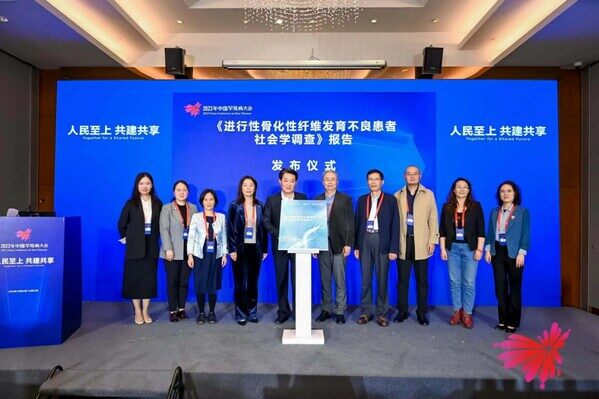
Release Ceremony Venue (Provided by the China Rare Disease Alliance)
Associate Professor He Xiaoning from the School of Pharmaceutical Science and Technology at Tianjin University interpreted the "Sociological Survey Report on Patients with Fibrodysplasia Ossificans Progressiva (FOP)": "This study collected a total of 67 patient questionnaires. FOP patients experience early onset, with the average age of first onset being 4.9 years. The current state of diagnosis is poor, with an average age at diagnosis of 8.0 years, leading to an average diagnostic delay of 3.1 years, with the longest delay reaching up to 18 years. The level of disability is high, with 98.5% of patients becoming disabled due to the disease. 95.5% of patients require care from family or friends. Currently, 59.7% of patients are not receiving drug treatment. In the past year, 61.2% of patients have neither visited outpatient clinics nor received inpatient treatment. Almost all patients (97.0%) currently exhibit heterotopic bone formation. As many as 92.5% of patients suffer from comorbidities or complications associated with FOP. Overall, the health-related quality of life for patients is poor."[4]The disease burden of FOP patients is extremely heavy. We hope to promote the research, development, and approval of innovative drugs, improve the medical security system for rare disease patients, and reduce the disease burden to improve the current survival status of FOP patients.
Li Lin Kang, Executive President of the China Rare Disease Alliance, stated that the release of "The Sociological Survey Report on Patients with Fibrodysplasia Ossificans Progressiva (FOP)" will raise public awareness about FOP patients, provide insights for improving diagnostic and treatment services for rare diseases, and offer reference for policy formulation. Accelerating drug approval processes and enhancing medical security systems will ensure that patients with rare diseases receive proper medical care and are adequately covered.
Professor Gu Xuefan, Director of the Department of Pediatric Endocrinology, Genetics and Metabolism at Xinhua Hospital affiliated with Shanghai Jiao Tong University School of Medicine, and Director of the Rare Disease Research Center, introduced that newborn screening is an important measure for preventing rare diseases. Over the past 20 years, with the gradual popularization of tandem mass spectrometry screening for multiple inherited metabolic disorders in China, more than 40 types of inherited metabolic disorders can now be screened and diagnosed.
Professor Xia Weibo, Chief of the Endocrinology Department at Peking Union Medical College Hospital, introduced that most rare endocrine diseases are related to genetics. Clinical awareness is low, diagnosis is difficult, and there is a lack of basic and clinical research as well as effective treatment drugs, resulting in very low cure rates. The Rare Disease Registry System is a crucial tool for understanding rare diseases, especially rare endocrine diseases. Patients with FOP experience heterotopic ossification, have high disability rates, and poor clinical prognosis. The release of this survey report can provide data references to assist in the formulation and implementation of national health policies.
Professor Wu Jing, Vice Dean of the School of Pharmaceutical Science and Technology at Tianjin University, stated that the report conducts a baseline survey and examination from multiple dimensions, including the basic characteristics of diseases, current status of diagnosis and treatment, sociology, and economics. It comprehensively understands the disease burden and living conditions of patients, thereby effectively promoting the development of various safeguard measures and providing empirical evidence for future policy adjustments.
Ipsen, as a mid-sized international biopharmaceutical company, focuses on innovative drugs in the fields of oncology, rare diseases, and neuroscience. The Ipsen Shanghai Innovation Center will continue to introduce innovative treatment solutions to meet the urgent medical needs of patients in China. With the release of the "Sociological Survey Report on Patients with Fibrodysplasia Ossificans Progressiva," Ipsen will continue to fully promote its efforts.Waving SelfLeverage the advantages in the rare disease field, exert corporate influence, provide innovative drugs and treatment solutions for rare disease patients, and improve the quality of life for patients.
Executive Chairman of the China Rare Disease Alliance, Li Lin kang, Chief Physician of the Pediatric Endocrinology and Genetic Metabolism Department at Xinhua Hospital affiliated to Shanghai Jiao Tong University School of Medicine and Director of the Rare Disease Research Office, Professor Gu Xue fan, Vice Dean of the School of Pharmaceutical Science and Technology at Tianjin University, Professor Wu Jing, Director of the Guangzhou Women and Children's Medical Center, Professor Liu Li, Chief of the Endocrinology Department at Peking Union Medical College Hospital, Professor Xia Wei bo, Chief Physician of the Endocrinology Department at Peking Union Medical College Hospital, Professor Zhu Hui juan, Director of the Endocrinology and Genetic Metabolism Department at Beijing Children's Hospital and Director of the Rare Disease Research Office, Professor Gong Chun xiu, Deputy Chief of the Endocrinology Department at the Second Hospital of Hebei Medical University, Professor Zhang Song yun, Associate Professor of the School of Pharmaceutical Science and Technology at Tianjin University, He Xiao ning, and Head of Angel’s Coral (FOP) Care Home, Mr. Zhang Jian peng, jointly attended the Endocrine Genetics and Metabolic Rare Diseases Sub-forum of this year’s conference and the release ceremony of the "Sociological Survey Report on Patients with Fibrodysplasia Ossificans Progressiva."
References
[1] Akesson LS, Savarirayan R. Fibrodysplasia Ossificans Progressiva. 2020 Jun 11. In: Adam MP, Ardinger HH, Pagon RA, et al., editors. GeneReviews® [Internet].
[2] Zhang, JM., Li, CF., Ke, SY. et al. Analysis of clinical manifestations and treatment in 26 children with fibrodysplasia ossificans progressiva in China. World J Pediatr 16, 82–88 (2020).
[3] Notice of the National Health Commission of China on Publishing the Second Batch of Rare Disease Catalog (No. 26 [2023] of the National Health Commission)
[4] "Sociological Survey Report on Patients with Progressive Osseous Heteroplasia"
About Ipsen
Ipsen is a mid-sized international biopharmaceutical company focused on innovative medicines in oncology, rare diseases, and neuroscience. In the 2022 fiscal year, Ipsen's total specialty care sales exceeded €3 billion, with a sales network covering more than 100 countries worldwide. In addition to its external innovation strategy, the company’s R&D activities are carried out on innovative and differentiated technology platforms located in leading biotechnology and life sciences hubs: Saclay (Paris), France; Oxford, UK; Cambridge, USA; and Shanghai, China. Ipsen (excluding Consumer Healthcare) has approximately 5,200 employees globally and is listed in Paris (Euronext: IPN) and the U.S. via a sponsored Level I American Depositary Receipt (ADR: IPSEY) program. For more information, please visit ipsen.com.
About Ipsen China
Ipsen Group entered China in 1992 and established an innovation center in Shanghai in 2019, which is one of the four global research and development centers. Ipsen set up its China headquarters in Shanghai in 2021, and in 2022, in line with the group's business changes, simultaneously divested its diversified healthcare business to focus on specialty care. Targeting three major disease areas (oncology, rare diseases, neuroscience) and six indications, Ipsen Shanghai Innovation Center will continue to introduce innovative treatment solutions to meet the urgent unmet treatment needs of Chinese patients.
Ipsen – Cautionary Statement Regarding Forward-Looking Statements
The forward-looking statements, objectives and targets contained in this document are based on the Group's management strategy, current views, and assumptions. Such statements involve known and unknown risks and uncertainties that could cause actual results, performance, or events to differ significantly from those anticipated in this document. All of these risks may affect the Group’s ability to achieve its financial targets in the future, which are set under reasonable macroeconomic conditions based on information available today. The use of terms such as "believe," "expect," and "anticipate" and similar expressions is intended to identify forward-looking statements, including the Group’s expectations regarding future events, such as regulatory filings and decisions. Moreover, the formulation of the targets described herein does not take into account external growth assumptions or potential future acquisitions, both of which could alter the indicators. The objectives are based on data and assumptions that the Group considers reasonable. These objectives depend on conditions or facts that may occur in the future and not solely on historical data. Given the occurrence of certain risks and uncertainties, actual results may differ significantly from these indicators, notably evidenced by products showing promise in early-stage research or clinical trials that may ultimately never reach the market or achieve their commercial objectives, particularly due to registration issues or competition. The Group must face, or may face, competition from generic drugs, which could translate into a loss of market share. Additionally, the R&D process involves multiple stages, each carrying significant risks, meaning the Group may fail to achieve its objectives and be forced to abandon efforts concerning products into which it has invested substantial resources. Therefore, the Group cannot guarantee that favorable results obtained in preclinical trials will be confirmed in subsequent clinical trials, nor can it ensure that clinical trial outcomes will sufficiently demonstrate the safety and efficacy of the relevant products. There is no assurance that products will receive the necessary regulatory approvals or prove commercially successful. If underlying assumptions prove inaccurate or if risks or uncertainties do materialize, actual results may differ significantly from those projected in the forward-looking statements. Other risks and uncertainties include, but are not limited to, general industry conditions and competition; general economic factors, including interest rate and currency exchange fluctuations; the impact of pharmaceutical industry regulations and healthcare legislation; global trends toward healthcare cost containment; competitors obtaining technological advances, new products, and patents; inherent challenges in developing new products, including obtaining regulatory approval; the Group’s ability to accurately predict future market conditions; production difficulties or delays; financial instability and sovereign risks in international economies; reliance on the validity of the Group’s patents and other protections for innovative products; and potential litigation, including patent litigation and/or regulatory actions. Furthermore, the Group relies on third parties to develop and market certain products that may generate substantial royalties; the actions of these partners could adversely affect the Group’s activities and financial results. The Group cannot guarantee that its partners will fulfill their respective obligations. The Group may derive no benefit from these agreements. Any failure by the Group’s partners to meet their obligations would result in lower-than-expected revenues. Such situations could negatively impact the Group’s business, financial condition, or performance. The Group expressly disclaims any obligation, unless required by applicable law, to update or revise any forward-looking statements, objectives, or assumptions contained in this press release to reflect any changes in the events, conditions, assumptions, or circumstances on which such statements are based, nor will it make any commitment to do so. The Group’s business is subject to the risk factors outlined in its Registration Document filed with the French financial markets authority (AMF). The risks and uncertainties listed in this document are not exhaustive, and readers are advised to refer to the Group’s most recent Universal Registration Document available on its website (www.ipsen.com).