

Hypertension Patients May Soon Ditch Daily Pills: RDN Device Emerges as Cross-Industry Disruptor in Antihypertensive Market

Medtronic
Medical Device Manufacturer
The "Internet-famous wonder drug" Semaglutide has recently drawn attention for its cross-industry impact on certain medical devices and consumables. It has shown great potential in treating chronic kidney disease, diabetes, and obesity, which may already pose a threat to manufacturers of related device consumables.
U.S. Medical Device Manufacturers Report in Q3 2023 Earnings and Conference Calls: Patient Interest in Weight-Loss Drugs Has Slowed the Growth of Bariatric Surgery Business Over the Past Six Months. Additionally, Semaglutide Can Effectively Lower Blood Sugar Levels, Reduce Proteinuria, and Protect Kidney Function, Thus Delaying or Preventing Renal Failure in Patients with Chronic Kidney Disease and Reducing the Demand for Dialysis Equipment.
But now, an opposite situation may be about to emerge:Through minimally invasive surgery inImplanting a device in the body can control hypertension. Will this have a significant impact on the antihypertensive drug market in the future?
01
Minimally Invasive Surgery May Address Challenges in Hypertension Control
Once diagnosed with hypertension, patients need to take antihypertensive drugs for life. Poor compliance leads to unsatisfactory results, and antihypertensive drugs often have side effects and drug resistance, which are all headache-inducing issues in the chronic disease management of hypertension.
In the future, there may be a new treatment method—implanting a device into the body that can help control high blood pressure.
On November 17, Medtronic announced that its radiofrequency ablation system, named Symplicity Spyral, received FDA approval for market release in the United States. The announcement stated that the system is an emerging minimally invasive treatment for hypertension based on RDN (renal denervation), which achieves long-term blood pressure reduction by blocking renal sympathetic nerves.
As of now, there are already 2 such products approved and marketed globally, and in China, there are over 10 similar therapies under research and development.
RDN is a minimally invasive surgery with a short operation time, no need for general anesthesia, and small wounds. Compared to antihypertensive drugs, RDN has various advantages. Specifically, antihypertensive drugs lower blood pressure by acting on multiple areas such as blood vessels, the heart, and kidneys, while RDN directly targets the renal sympathetic nerves, thereby reducing the secretion of renin by the kidneys and subsequently lowering blood pressure. Therefore, the blood pressure-lowering effect of RDN is more direct, with fewer side effects, long-term effectiveness, and no issues related to medication compliance or drug resistance.
Therefore, the potential demand for RDN is strong. According to Frost & Sullivan's forecast, the market size of such products in China is expected to reach RMB 10.5 billion by 2030, indicating broad development prospects.
In China, as early as April 2021, Boao Super Hospital successfully completed the first clinical application of renal artery sympathetic nerve radiofrequency ablation using the Symplicity SpyralTM catheter system.
Currently, this technology has not been widely used in the treatment of hypertension. It is only targeted at patients with resistant hypertension, i.e., those who still cannot achieve guideline standards for blood pressure after the reasonable use of four or more types of antihypertensive drugs (including one diuretic).However, with the continuous development of RDN technology, its scope of application is expected to expand further. Perhaps, the storyline of semaglutide crossing over to influence medical devices is about to be reversed.
02
Hypertension Medication FieldIn the past decade,Almost no major breakthrough R&D achievements.There are five common types of antihypertensive drugs.: Diuretics, represented by hydrochlorothiazide; Beta-blockers, represented by labetalol;Calcium ChannelCalcium Channel Blockers (CCB), represented by Nitrendipine; Angiotensin-Converting Enzyme Inhibitors (ACE), represented by Enalapril; Angiotensin II Receptor Blockers (ARB), represented by Valsartan.
According to data from Menet, in 2022, sales of multiple products in Chinese public medical institutions exceeded 1 billion yuan. Among them, Nifedipine Controlled-Release Tablets ranked first for four consecutive years, with sales exceeding 5.8 billion yuan, far ahead of the rest. However, the sales growth rate of Nifedipine Controlled-Release Tablets fell by 12.48%. Additionally, the sales growth rates of Valsartan and Amlodipine Tablets (I) and Irbesartan Tablets dropped by 16.80% and 25.35%, respectively.
The market size of antihypertensive drugs in retail outlets is comparable to that in tiered hospitals, with sales reaching billions of yuan. According to Xinkangjie, calcium channel blockers account for half of the market, followed by drugs acting on the renin-angiotensin system. Beta-blockers and alpha-blockers have relatively smaller sales compared to the former two.
Sales of Hypertension Subcategories from 2017-2022 (in Billion Yuan)
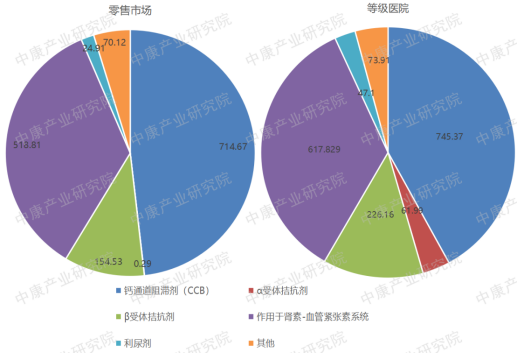
Source: Xinkangjie
As the patents for most original research-based antihypertensive drugs have expired, a large number of generic drugs have entered the market. All nine rounds of national centralized procurement in China have included antihypertensive drugs.
In the first eight batches of centralized procurement, a total of 37 antihypertensive drug varieties were included. Among them, the most included varieties were angiotensin-converting enzyme inhibitors and angiotensin II receptor blockers, both reaching 12 varieties.
Antihypertensive drugs involved in the first eight batches of centralized procurement
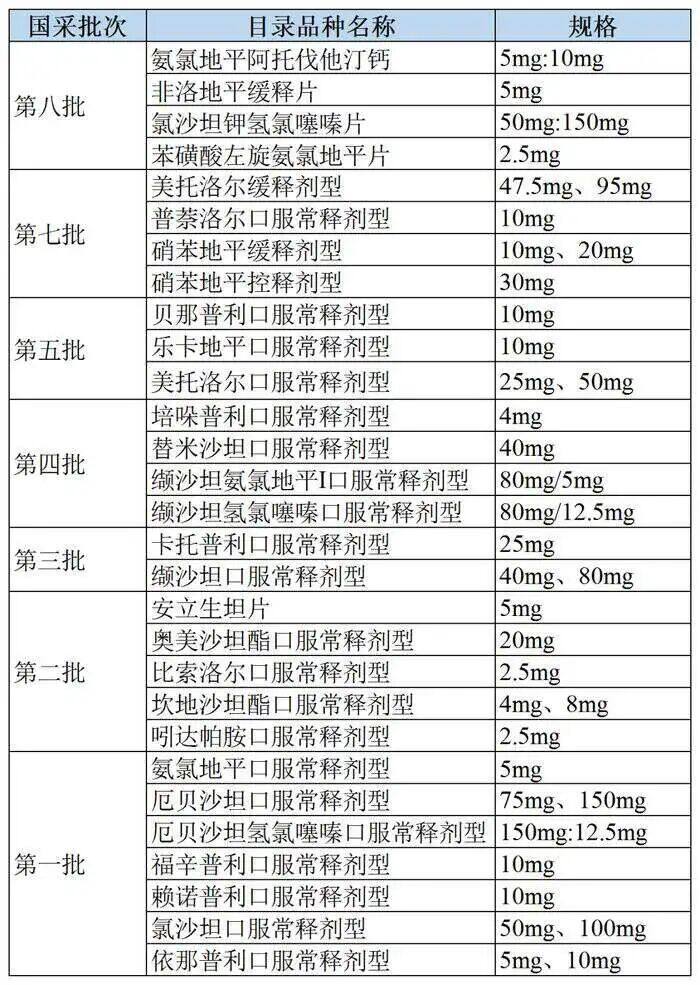
Source: PharmaDJ
In the recent ninth round of centralized procurement in China, several antihypertensive drugs were included. Among them, the winning bid price for Olmesartan Medoxomil and Amlodipine Oral Tablets (brand name: Amplicor) was 0.23 yuan per tablet, with a reduction of 93.3%; the winning bid price for Nifedipine Controlled-Release Tablets (brand name: Bepdor) was 0.042 yuan per tablet, with a reduction of 88.4%; and the winning bid price for Losartan Potassium and Hydrochlorothiazide Tablets (brand name: Losartan Potassium and Hydrochlorothiazide Tablets) was 0.056 yuan per tablet, with a reduction of 87.2%.
Among the major types of antihypertensive drugs, the new-generation drug Sacubitril Valsartan Sodium Tablets has not yet been included in the centralized procurement, becoming a key focus for development by many pharmaceutical companies.The original research manufacturer of Sacubitril Valsartan is Novartis, with the original research drug trade name Entresto. It was approved for the indication of chronic heart failure in China in 2017 and for hypertension in 2021.
Entresto is a key product in Novartis' cardiovascular portfolio, with sales surpassing the $1 billion mark in 2018. By 2022, global sales reached $4.644 billion, ranking second in Novartis' pipeline behind Cosentyx (secukinumab). Currently, Entresto has been included in China's national medical insurance catalog and has become a guideline-recommended drug. According to New Healthcare, in 2022, the sales of sacubitril/valsartan in China’s tiered hospitals and retail terminals were RMB 2.127 billion and RMB 743 million respectively, with a market size reaching tens of billions.
Such a heavyweight drug naturally attracted multiple pharmaceutical companies to compete for its generic production. On August 24, 2023,Nanjing Fangshenghe PharmaceuticalIt was announced that its Sacubitril Valsartan Tablets (trade name: Yixin Tan) have been approved for marketing by the NMPA. On the same day, CSPC Pharmaceutical Group announced that its subsidiary CSPC Ouyi's Sacubitril Valsartan Sodium Tablets had also received approval from the NMPA. By August 29,Zhengda TianqingThe product has also been approved. In October,Kelon Pharmaceutical, Salubris, Huahan PharmaceuticalTheSacubitril Valsartan Sodium has also been successively approved.
In addition, more than a dozen companies have submitted marketing applications for Sacubitril Valsartan Sodium Tablets, includingQilu Pharmaceutical, Baitai PharmaceuticalSeveral well-known pharmaceutical companies. In the field of antihypertensive drugs, this "must-contest territory" will see an increasing number of new entrants. Will it become the next "blockbuster drug"? A newRDN technology is still in its infancy and has limited use, but as it develops, could it impact the market for antihypertensive drugs in the future? Only time will tell.
Disclaimer
This article is a reprint and is only used for sharing purposes, and does not represent the platform's views. The copyrights of the images and articles belong to the original authors. If there is any infringement, please inform us, and we will handle it promptly.
------------------------------ 「Long press」Add Xiao Da via QR code「Join the group」
Explore Cutting-Edge Market Insights with More Industry Partners

Amida Medical Consulting IMED (Beijing) Pharmaceutical Information Consulting Co., Ltd., established in April 2014, is a professional pharmaceutical industry consulting service provider. The company is committed to deeply integrating industrial policy research with real-world data mining, gaining insights into the impact of industry policies on the market, and providing forward-looking market analysis through specialized research. It offers comprehensive solutions for market access after the launch of corporate products.
Disclaimer
This article is a reprint and is only used for sharing purposes, and does not represent the platform's views. The copyrights of the images and articles belong to the original authors. If there is any infringement, please inform us, and we will handle it promptly.
IMED (Beijing) Pharmaceutical Information Consulting Co., Ltd., established in April 2014, is a professional pharmaceutical industry consulting service provider. The company is committed to deeply integrating industrial policy research with real-world data mining, gaining insights into the impact of industry policies on the market, and providing forward-looking market analysis through specialized research. It offers comprehensive solutions for market access after the launch of corporate products.