


Interface News reporter |
Interface News Editor |Xie Xin
With the approval of more CAR-T products, this field, once considered as "astronomically expensive cancer drugs," seems to be showing signs of a price war.
On November 20, the STAR Market Daily reported that Juventas' CAR-T product had just been approved, priced at 999,000 yuan, making it the lowest-priced approved product in China. The latest report from Tianjin Radio and Television states that the CAR-T therapy (Najioluocai Injection) developed by Juventas for treating leukemia has issued its first prescription at the Institute of Hematology & Blood Diseases Hospital, Chinese Academy of Medical Sciences.
Previously, on November 8, the official website of the National Medical Products Administration announced that Juventas' CAR-T cell therapy drug product, Nacekloran Injection (formerly known as Herkloran Injection), which targets CD19, was approved for marketing. It is used to treat adult patients with relapsed or refractory B-cell acute lymphoblastic leukemia (r/r B-ALL). This is the first CAR-T therapy in China for this indication and also the first approved marketedFull AutonomyInnovative CD19-targeted CAR-T product.
As of now, four CAR-T products have been approved for marketing in China. In addition to Juventas, there are Fosun Kite's Axicabtagene Ciloleucel Injection and WuXi AppTec's Relmacabtagene Autoleucel Injection, which also target CD19; furthermore, IASO Biotherapeutics' Equecabtagene Autoleucel Injection targets BCMA.
Whether it is CD19 or BCMA, they are both targets. Generally speaking, a target refers to a tumor antigen, broadly defined as a newly emerged or overexpressed antigen substance during the occurrence and development of tumors, and is the key to targeted therapy. In CAR-T therapy (Chimeric Antigen Receptor T-Cell Therapy, abbreviated as CAR-T), the first step is to identify the key target of the target tumor, and then modify T cells accordingly to kill the tumor.
In the CAR-T product field, due to their prices exceeding one million Chinese yuan, the cost and commercialization of such products have always been a topic of discussion. The high price is because CAR-T cell therapy products are highly customized medicines. Their entire treatment process includes six main steps: collecting the patient’s peripheral blood mononuclear cells, T-cell separation and activation, T-cell gene modification in vitro, CAR-T cell expansion in vitro, CAR-T cell quality monitoring, and the reinfusion of CAR-T cells into the patient’s body. The price also includes the total sum of various costs such as operation, research and development, logistics, and more.
Previously, according to reports from multiple media outlets including Xinhua Finance, the unit prices of CAR-T products from Fosun Kite and Wuxi JWCAR were 1.2 million yuan and 1.29 million yuan, respectively. In August this year, I-Mab Biopharma reported by the healthcare industry media Yigoo stated that the price of their CAR-T product, Idecabtagene Vicleucel Injection, was 1.166 million yuan. Thus, compared with the three previously approved products, Juventas' CAR-T pricing has now dropped below one million yuan.
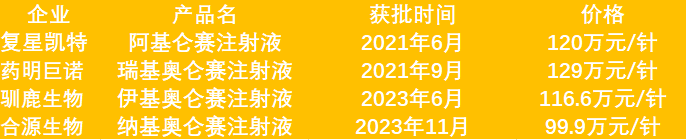
In terms of approval time, Fosun Kite's Axicabtagene Ciloleucel Injection is the first cell therapy product approved for marketing in China. Specifically, Axicabtagene Ciloleucel Injection is a CAR-T product introduced by Fosun Kite from Kite Pharma (a subsidiary of Gilead Sciences, referred to as "Kite"), which was the world’s first approved treatment for non-Hodgkin lymphoma. Originally named "Yescarta," it is a CD19-targeted autologous CAR-T cell therapy product that underwent technology transfer and received authorization for localized production in China.
In June 2021, Axicabtagene Ciloleucel Injection was approved for the treatment of adult patients with relapsed or refractory large B-cell lymphoma (r/r LBCL) who had received two or more lines of systemic therapy. On June 21 this year, the indication for Axicabtagene Ciloleucel Injection was expanded to include the treatment of adult patients with large B-cell lymphoma (LBCL) that is refractory to first-line immunochemotherapy or relapses within 12 months after first-line immunochemotherapy. Axicabtagene Ciloleucel Injection is also China's first and only CAR-T therapy with a second-line indication.
In addition, Relma-cel Injection is an autologous CAR-T cell immunotherapy product targeting CD19 developed by JW Therapeutics based on the CAR-T cell technology platform of Juno Therapeutics (a subsidiary of Bristol-Myers Squibb). As JW Therapeutics' first product, it was approved by the National Medical Products Administration in September 2021 for the treatment of adult patients with relapsed or refractory large B-cell lymphoma (r/r LBCL) after two or more lines of systemic therapy. In October 2022, its indication for the treatment of relapsed or refractory follicular lymphoma (r/r FL) was also approved.
According to the company's financial report, in 2022, JW Therapeutics' Relma-cel Injection was prescribed 165 times, with the company's total annual revenue reaching 146 million yuan. In the first half of this year, JW Therapeutics' revenue amounted to 87.74 million yuan.
Currently, Icarus Bio's Ixazomib Injection has also been launched, targeting BCMA. At the end of June this year, the National Medical Products Administration approved the new drug application for Ixazomib Injection to treat adult patients with relapsed or refractory multiple myeloma (MM) who have progressed after at least three prior lines of therapy (including at least one proteasome inhibitor and one immunomodulatory agent).
However, considering the "unspoken rule" of price restrictions in current medical insurance negotiations, even at the latest price drop to below a million, the much-discussed issue of "sky-high priced cell therapies entering medical insurance" still seems a long way off.