GE Healthcare and Sectra Announce Strategic Integration to Enhance Radiology Workflow Efficiency

Sectra
A company that creates and sells products in secure communications and healthcare information technology

GE Healthcare
Digital Solution Provider
Source:Instrument Family,Reproduction without authorization is prohibited, and reproduction is allowed 24 hours later.
Recently,International Medical Imaging IT Giant Sectra Announces Cooperation with Competitor GE Healthcare to Achieve Seamless Integration of Both Companies' ProductsTo provide more efficient medical imaging diagnostic solutions.
According to the agreement,Sectra will integrate its developed radiology imaging solutions into GE Healthcare's AW Family advanced visualization applications.This integration will cover every aspect from coordination and diagnosis to report generation and results distribution, supporting clinicians with precision care solutions at every step of the care pathway, improving work efficiency, saving time, and reducing the workload of healthcare professionals.
It is understood that,Sectra's radiology imaging solution is part of its enterprise imaging subscription software, focusing on providing efficient and accurate medical image diagnostic solutions.This application provides comprehensive image management functions, supporting various medical imaging data, including Computed Tomography (CT), Magnetic Resonance Imaging (MRI), X-ray, and images from other modalities. Moreover, third-party developers can create customized solutions to meet the specific needs of different medical institutions.
Notably, Sectra and GE Healthcare are both global leaders in medical imaging solutions.
Data shows that Sectra was founded in 1978, with its headquarters located in Linköping, Sweden. In the early stages of the company's establishment, it mainly engaged in research and development in the field of data communications, and later focused on the development of medical imaging and information technology.These products and services cover image storage and viewing, workstation applications, remote reading, medical imaging communication and collaboration, Radiology Information System (RIS), and Picture Archiving and Communication System (PACS), etc.
Currently,Sectra's medical imaging solutions have been widely applied in multiple fields such as radiology, pathology, gynecology, and orthopedics.The goal of this cooperation between the two parties is to integrate its radiology imaging solutions with GE Healthcare's solutions.

Sectra Medical Imaging Solutions
Sectra's medical imaging solutions feature industry-leading system stability, designed specifically for high-productivity environments where radiology services are critical.It can seamlessly integrate with surrounding IT solutions (such as EMR, RIS, and VNA), enabling operators to access complete patient records whenever and wherever needed. For radiologists, all daily tasks can even be performed through a single diagnostic application.
In addition, it can help users manage subspecialization, reduce report turnaround time, and improve the workflow for requests and result distribution. It also enhances communication and dialogue between radiology and referring units as well as other disciplines, such as pathology. Sectra handles all radiology workflows and is committed to supporting radiology in improving cancer care.
Similarly, as one of the world's leading medical device manufacturers, GE Healthcare has a very comprehensive layout in the field of digital healthcare solutions.PublicThe company has developed many software tools, including Picture Archiving and Communication Systems (PACS), Radiology Information Systems (RIS), as well as various tools for medical image management and analysis.These solutions are designed to enhance the efficiency of storing, accessing, and analyzing medical images.
AW Family is a series of advanced visualization and image analysis applications launched by the company, designed to support the processing, analysis, and diagnosis of medical images.This series includes multiple applications, covering different medical imaging fields such as radiology, cardiology, neurology, angiology, and oncology, with different solutions for each department. Among them,Cardiology is one of the most demanding clinical workflow environments, so this integration will initially focus on cardiology care pathways and the AW Family’s CardIQ suite.
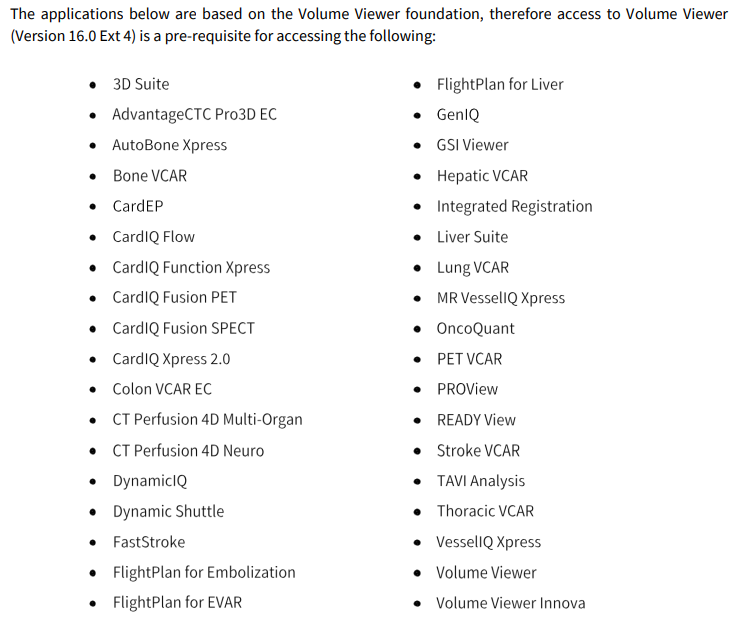
AW Family's Handling Tools
GE Healthcare CardIQ
According to reports,CardIQ is a set of integrated CT cardiac post-processing tools in the AW Family application portfolio, designed for automation and workflow efficiency.It can use deep learning to automatically identify the presence and location of coronary artery calcification, and provide overall and per-field scores within seconds after loading.
Jan Makela, President and CEO of GE Healthcare's Imaging division, pointed out that AW Family is an open application, which means third parties can integrate with it via API (Application Programming Interface) to create customized plugins, tools, or applications.This,When used in conjunction with Sectra's diagnostic applications, the efficiency of the CardIQ suite can be enhanced.Help clinicians achieve faster workflows, save more time, increase efficiency, and thereby streamline cardiology care pathways.
After the official announcement of the partnership by both parties, Torbjörn Kronander, CEO of Sectra, was interviewed by the foreign media outlet *Radiology Business*. During the interview,He revealed to reporters the reasons for collaborating with GE Healthcare and outlined more directions for future cooperation.

Torbjörn Kronander
What is the origin of the cooperative relationship?
Torbjörn Kronander: We have a lot of shared clients. In the United States, the work-life balance in radiology is terrible. It's like this globally, but I would say it's one of the worst in the U.S. It’s a very tough life.You might think that one click is not a problem, but when you have to do this 2,000 times a day, it becomes a real issue.At Sectra, we are always working to address this issue, and we hope to create an "efficient workflow."
In our provided general PACS workstation, doctors can handle about 95% of their work in the same workstation, but sometimes you need to switch to another program.However, for specialized applications from major suppliers like Siemens and GE, switching takes time. They need to switch to another application, log into another system, redownload images, and search for patients. This requires a significant amount of time.Therefore, we suggest to GE: Why not make it more efficient? We have some competition with GE. But when we have common customers in need of help, we say, "Why not join hands to help them?"

Why not advance this project independently at Sectra?
Torbjörn Kronander:Because we are unable to process some specialized measurements in the CT images provided by our primary supplier, running their software independently takes too much time.Moreover, for these professional measurements, you should not bring them back to the main workflow application. Instead, you should be able to see the measurements directly in PACS. We are able to automatically populate reports, which saves a lot of time. GE Healthcare fully supports us in this aspect, and we have come together for a common goal.
Why the initial focus on cardiology, considering its complex clinical workflow?
Torbjörn Kronander:Cardiology often requires users to switch to a CT workstation or other applications for special measurements. This is a good starting point, and we plan to add more applications in the future.We have now completed the interface, and in the future, we only need to add other applications. This will be easier than creating the first program.
What are the next steps? Do you plan to collaborate more with GE in other areas?
Torbjörn Kronander:Yes, cardiology is just the beginning for us. In the future, we will gradually expand into more specialized fields and jointly develop other applications. This is our shared vision with GE Healthcare.Of course, we also listen to customer feedback and formulate the next steps based on their opinions.

Can you briefly discuss the increasing specialization in radiology and the challenges this poses for the industry?
Torbjörn Kronander: Stanford University Professor of Diagnostics, Sam Gambhir, once told me that in 1950, the typical doubling time for all medical knowledge was 50 years. However, by 2000, this time had shortened to 15 years, and by 2005, it was 10 years. Today, the doubling time for global medical knowledge has been reduced to approximately 90 days. This means that doctors need to process an ever-increasing amount of information, leading to a growing demand for specialization across various fields of medicine.Today, surgeons are no longer just surgeons; they may specialize in the upper gastrointestinal tract or knee joints. This has increased the need for a collaborative environment where doctors can discuss images and consult with experts in specific fields.
Why is addressing these challenges and tackling the shortage issues in the radiology industry currently a top priority?
Torbjörn Kronander: This is a major driving force. If you ask hospital leaders in the U.S. today about their primary pain points, many times they will say "recruitment." Because even though doctors earn high salaries, they also want to have some time each week to spend with their children. Many doctors in the U.S. are experiencing extreme burnout or are dissatisfied with their lives.
Surveys show that,49% of doctors in the U.S. are considering leaving their current jobs, even if it might mean a pay cut. In this situation, we must help doctors. Otherwise, there won't be enough hands to take care of patients. Therefore, we need to improve efficiency. Our focus is entirely on workflows, dedicated to reducing the number of times doctors use a mouse each day.
In fact, competition and cooperation have never been opposites but rather a mutually reinforcing relationship. Regarding this powerful alliance between two world leaders in medical imaging solutions, both parties are leveraging their respective strengths to achieve greater accomplishments, injecting new vitality into their enduring brands. So, what kind of "innovation wave" will the collaboration between GE and Sectra create in the medical field? Medical Device News will wait and see.
More exciting content
Welcome to follow WeChat Video Channel


"Laparoscope Giant" Makes Another Acquisition
Fosun Group, This Company to Be Spun Off and Listed
RSNA Preview: GPS, United Imaging Healthcare, Canon...
Empowered by United Imaging Healthcare, China's First "Cancer-Fighting Wonder" Officially Begins Operation
Pediatrics Sees Over 10,000 Daily Visits! This Device Turns Out to Be the Key to Meeting the Challenge
Q3 Medical Device Industry Review: Layoffs, Weight Loss Drugs, Anti-Corruption...
SurgiPeak SP1000 Approved for Marketing! SurgiPeak Medical® Becomes the First Company in China with Both Multi-Port and Single-Port Approvals
Involving 1,000 Employees, GE Healthcare Makes Another Major Move
Supports Multiple Bone Age Assessment Methods! This Pediatric Bone Age Intelligent Imaging Product Approved for Class III Certificate
Breaking! Listed Medical Device Company Suspends Trading, Chairman Resigns


BusinessBusiness cooperation email: qxzj@landianyiliao.com