

BMS Strikes $2.275 Billion Deal with Avidity to Advance Cardiovascular AOC Therapies

Avidity Biosciences
Antibody Oligonucleotide Conjugates Developer
Bristol-Myers Squibb
Biopharmaceutical and Nutritional Product R&D and Sales
On November 28, Bristol-Myers Squibb (BMS) announced a global licensing and research collaboration agreement with Avidity Biosciences (hereinafter referred to as Avidity). BMS will utilize Avidity's Antibody Oligonucleotide Conjugate (AOC) technology platform to discover, develop, and commercialize up to five innovative drugs targeting cardiovascular indications.
According to the agreement, Avidity will receive an upfront payment of $100 million, including $60 million in cash and $40 million in equity investment. Avidity is also eligible to receive up to $1.35 billion in development milestone payments, up to $825 million in commercial milestone payments, as well as sales royalties, with the total amount of the collaboration reaching up to $2.275 billion. Bristol-Myers Squibb will be responsible for funding all future clinical development, regulatory, and commercialization activities under this collaboration.
Avidity stated that this collaboration with BMS is distinct from its other internal research pipelines, and the company will continue to advance its internal R&D programs for rare cardiac indications.
Avidity Biosciences, Inc. was founded in 2013 and is an innovative company that started developing AOC drugs relatively early. Its developed AOC antibodies combine the tissue selectivity of monoclonal antibodies with the precision of oligonucleotide therapies, overcoming barriers that have hindered oligonucleotide delivery and targeting the genetic drivers of diseases, thereby addressing the treatment of targets and diseases that previous RNA therapies could not reach.
Based on its proprietary AOC platform, Avidity currently has six pipeline programs under development, targeting rare muscle diseases and other serious conditions. Among them, three rare disease drugs are at more advanced stages of development: AOC 1001 for the treatment of Type 1 Myotonic Dystrophy (DM1), AOC 1020 for Facioscapulohumeral Muscular Dystrophy (FSHD), and AOC 1044 for Duchenne Muscular Dystrophy (DMD) with exon 44 skipping mutations. All three are in Phase 1/2 clinical trials.
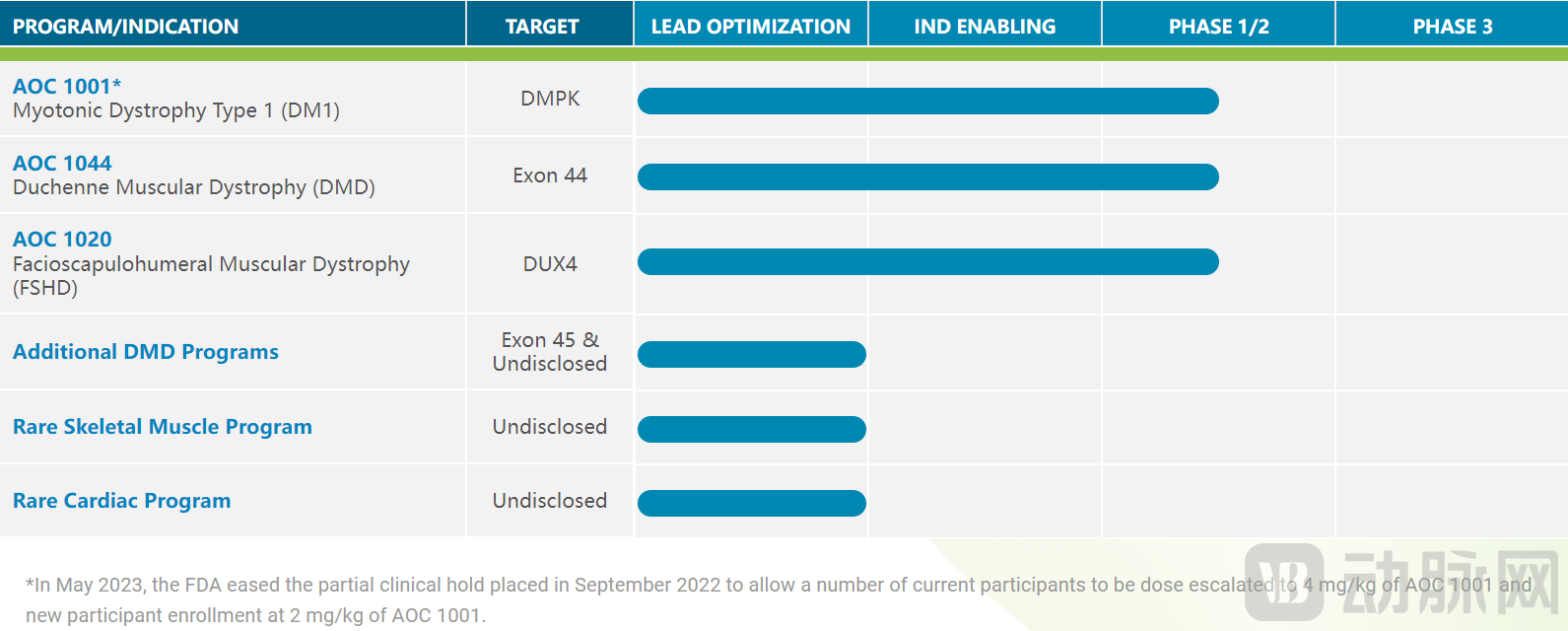 AvidityR&D pipeline
Image Source: Avidity Official Website
Among them, AOC 1001 is the first investigational drug to successfully deliver siRNA to muscle tissue.
AOC 1001 is Avidity's lead candidate drug developed using its AOC platform, aimed at treating DM1 by reducing the levels of dystrophia myotonica-protein kinase (DMPK) mRNA in skeletal, cardiac, and smooth muscles. It consists of a proprietary monoclonal antibody targeting transferrin receptor 1 (TfR1) and an siRNA capable of targeting DMPK mRNA.
The results of its preclinical trials showed that AOC 1001 successfully delivered siRNA to muscle tissues, inducing a sustained, dose-dependent reduction in DMPK mRNA levels in skeletal, cardiac, and smooth muscles.
In December last year, Avidity announced the results of the Phase 1/2 clinical trial of AOC 1001. The data showed that DMPK mRNA levels were significantly reduced in all DM1 patients who received treatment. After a single dose of 1mg/kg or two doses of 2mg/kg of AOC 1001 via injection, DMPK mRNA levels in DM1 patients decreased by an average of 45%.
In October this year, Avidity once again announced positive results of AOC 1001 in the Phase 1/2 clinical trial MARINA and the open-label extension trial MARINA-OLE. The MARINA-OLE trial enrolled 37 patients who had completed all trials in MARINA, as well as 10 patients who received placebo treatment in the MARINA trial.
New long-term safety data from over 200 administrations, totaling 46.2 patient-years, shows improvement in multiple additional functional endpoints for DM1 patients. AOC 1001 continues to demonstrate favorable safety and tolerability, with most adverse events (AEs) being mild to moderate. The most common adverse reactions are procedural pain (22%), limb pain (16%), and headache (16%). No anemia-related AEs were reported, and there were no instances of treatment discontinuation.
With impressive clinical data, AOC 1001 has been granted Orphan Drug Designation by the US FDA and the European Medicines Agency (EMA), and the FDA has also awarded it Fast Track Designation.
This transaction between BMS and Avidity builds upon the previous collaboration between Avidity and its cardiovascular disease therapeutic developer, MyoKardia.
In November 2020, BMS acquired MyoKardia for $13.1 billion. In 2021, Avidity Biosciences and MyoKardia announced a research collaboration to leverage MyoKardia's hereditary cardiomyopathy platform, including its target discovery engine and proprietary cardiac disease models, to demonstrate the efficacy of AOC in cardiac tissue, thereby expanding its application scope in skeletal muscle.
Prior to this, BMS had already increased its investment in the cardiovascular disease sector. In October this year, BMS spent $350 million to repurchase Mavacamten, a drug for treating hypertrophic cardiomyopathy developed by MyoKardia, from LianBio, obtaining exclusive rights to develop and commercialize Mavacamten in markets such as China, Singapore, and Thailand.
However, compared with the "good news" of BMS continuously spending heavily to acquire new products, the company's revenue performance is "unsatisfactory." According to BMS's Q3 2023 financial report, the company's revenue in Q3 2023 was $11 billion, a 2% decrease from the same period last year. This marks the fifth consecutive quarter of revenue decline for BMS, leading the company to lower its full-year 2023 earnings guidance.
BMS stated that the decline in revenue for the quarter was due to the decrease in sales of the multiple myeloma drug Revlimid. With the entry of generic versions of Revlimid into the U.S. market in 2022, its sales in Q3 reached only $1.43 billion, below expectations and representing a 41% drop compared to Q3 2022.
But Revlimid achieved sales of $12.891 billion in 2021, contributing 27.8% of Bristol-Myers Squibb's revenue in 2021, and is one of the key pillars of Bristol-Myers Squibb's performance growth. In addition, two other core drugs of Bristol-Myers Squibb — PD-1 antibody Nivolumab (Opdivo) and blood thinner Eliquis — are also major drivers of Bristol-Myers Squibb’s revenue growth, with their sales in 2022 reaching $8.249 billion and $11.789 billion, respectively.
However, they will also face the issue of patent expiration. Opdivo's patent is set to expire in 2028, and Eliquis' patent will expire in 2031, at which point they will face significant competition from generic drugs. Geoffrey Porges, an analyst at investment bank SVB Leerink, stated that by 2030, Bristol-Myers Squibb (BMS) could lose up to 47% of its projected revenue for 2025 due to generic drug competition.
To address the challenges of the patent cliff and declining revenue, BMS has responded by changing leadership and adjusting its pipeline strategy. In April this year, BMS announced the appointment of Dr. Chris Boerner as the company's new CEO. In September this year, at BMS’s R&D event in New York, the company stated that one of its key future initiatives is to expand its product pipeline in the fields of oncology, hematology, cardiovascular, immunology, and neuroscience. Additionally, within the next 18 months, BMS plans to increase its number of registered assets from six to twelve.
"Buy, buy, buy" has become one of BMS's strategies to enrich its pipeline and increase revenue. According to BMS estimates, starting from the $74 billion acquisition of Celgene in 2019, approximately 50% of revenue will come from acquisitions by 2030.
According to incomplete statistics, as of now, BMS carried out a total of 9 collaboration and acquisition deals in 2023, with a total transaction value exceeding 9.4 billion US dollars.
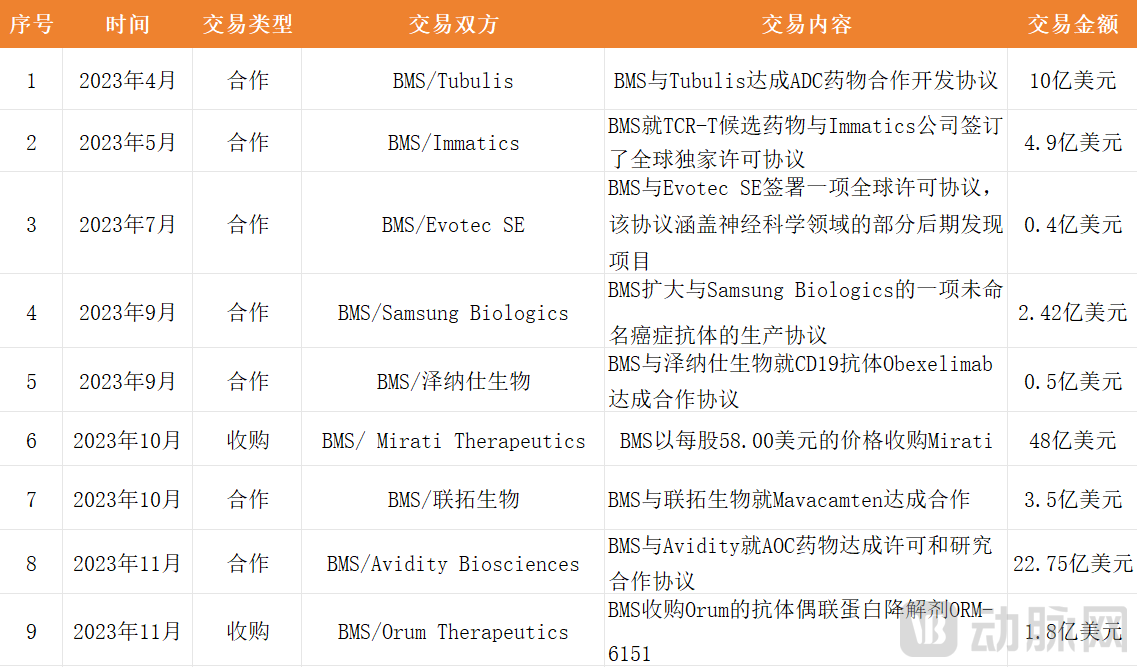
BMS 2023 BD Deals
Data source: collation of public data, chart produced by VCBeat
This collaboration with Avidity will open up the "blue ocean" market of AOC drugs for BMS. Apart from Avidity, the main companies currently researching AOC drugs globally include innovative pharmaceutical companies such as Dyne Therapeutics, Tallac Therapeutics, and Denali Therapeutics, but their overall drug development is still in the early stages.
With BMS's increased investment, Avidity may become the "first winner" in this AOC competition.