Roche's Mosunetuzumab, the World’s First CD20×CD3 Bispecific Antibody, Submitted for Marketing Approval in China

Roche
Oncology Drug Research, Development, and Manufacturing
On November 30, Roche (China) Investment Co., Ltd. (hereinafter referred to as "Roche") submitted Mosunetuzumab (RO7030816) for marketing authorization in China, and it was proposed by the CDE for priority review. This product is indicated for the treatment of adult patients with relapsed or refractory follicular lymphoma (FL) who have received at least two prior systemic therapies.
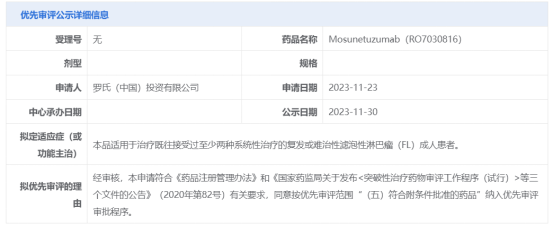
Image Source: CDE Official Website
The World's First CD20/CD3 Bispecific Antibody
Submit for Marketing Approval in China
Mosunetuzumab, a CD20/CD3 bispecific antibody developed by Roche, received conditional marketing approval in the EU in June 2022 for the treatment of adult patients with R/R FL who have received at least two prior systemic therapies, becoming the world's first approved CD20/CD3 bispecific antibody. In December of the same year, Mosunetuzumab also received FDA approval.
The marketing approval of Mosunetuzumab is based on the phase 2 GO29781 study (NCT02500407), a multicenter, open-label, dose-escalation and expansion study designed to evaluate the efficacy and safety of Mosunetuzumab in patients with relapsed or refractory B-cell non-Hodgkin lymphoma.
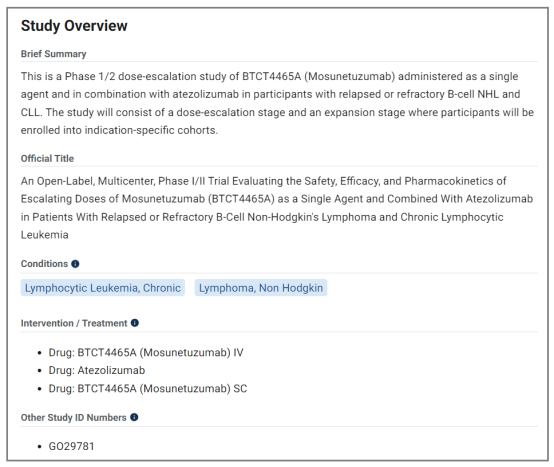
Image Source: ClinicalTrials.gov
At the 2022 ASH Conference, multiple research data on Mosunetuzumab in the field of B-cell lymphoma treatment were presented. Studies showed that Mosunetuzumab achieved an ultra-high CR rate of 60% (ORR 78%) in treating heavily pretreated R/R FL patients, and most patients maintained their responses during a median follow-up of over two years; as a monotherapy for elderly and frail DLBCL patients in the first-line setting, it reached a best ORR of 56% and a CR rate of 43%, with good tolerability.
In addition, Roche registered a clinical study of Mosunetuzumab (RO7030816) on the Drug Clinical Trial Registration and Information Disclosure Platform as early as 2021. This study is an open-label, multi-center, Phase I trial evaluating the pharmacokinetics, safety, and efficacy of Mosunetuzumab monotherapy in patients with relapsed or refractory follicular lymphoma.
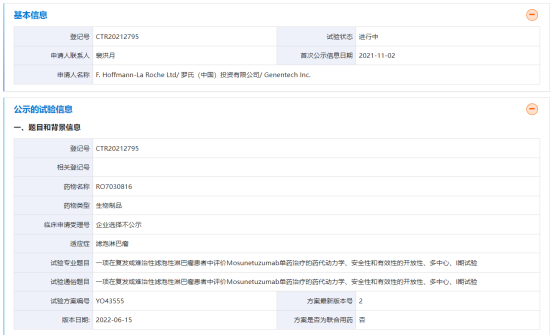
Source of the image: Drug Clinical Trial Registration and Information Disclosure Platform
Yesterday, the marketing application of Mosunetuzumab in China was accepted by the CDE and proposed for priority review.
Roche's Bispecific Antibody Pipeline
Lymphoma, Macular Edema…
Roche's R&D strength is formidable, and it has developed a diversified and differentiated product pipeline based on its proprietary core technologies such as small molecules, monoclonal antibodies, fusion proteins, and bispecific antibodies. Among these, the bispecific antibody pipeline, represented by Gavreto and Mosunetuzumab, has become one of Roche's most important strategic focuses.
Glofitamab is a CD3/CD20 bispecific antibody and the second CD3/CD20 bispecific antibody approved by Roche after Mosunetuzumab. Glofitamab features a novel "2:1" structural format (with two Fab regions binding to CD20 and one Fab region binding to CD3), which exhibits stronger cytotoxic effects compared to Mosunetuzumab, which has a "1:1" structure targeting the same sites.
In June this year, Glofitamab received accelerated FDA approval for marketing, indicated for adult patients with relapsed or refractory diffuse large B-cell lymphoma (R/R DLBCL) or large B-cell lymphoma (LBCL) caused by follicular lymphoma who have previously received at least two lines of systemic therapy. Earlier this month, China's National Medical Products Administration (NMPA) granted conditional approval to the marketing of Glociclib Injection for adult patients with relapsed or refractory diffuse large B-cell lymphoma who have previously undergone at least two lines of systemic treatment.
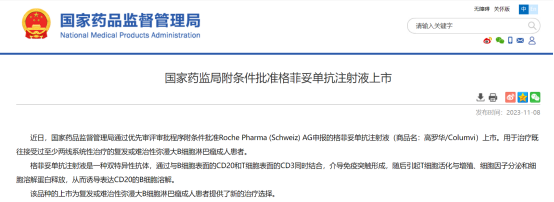
Image Source: NMPA Official Website
Although Glevitamab and Mosunetuzumab both target lymphoma, the former is aimed at aggressive and refractory lymphoma, while the latter focuses on indolent lymphoma, effectively achieving differentiation in indication layout.
In addition, Roche also has multiple bispecific antibodies outside the oncology field, such as the world's first ophthalmology bispecific antibody drug — Faricimab. This drug targets vascular endothelial growth factor A (VEGF-A) and angiopoietin-2 (Ang-2). It was first approved for marketing by the U.S. FDA at the end of January 2022 and has currently been approved for treating diabetic macular edema, wet age-related macular degeneration, and macular edema following retinal vein occlusion.
Relevant reports show that faricimab has been approved in more than 70 countries and has completed over 2 million clinical injections. In addition, multiple clinical trials of faricimab have been conducted in China, involving indications such as neovascular age-related macular degeneration and diabetic macular edema.
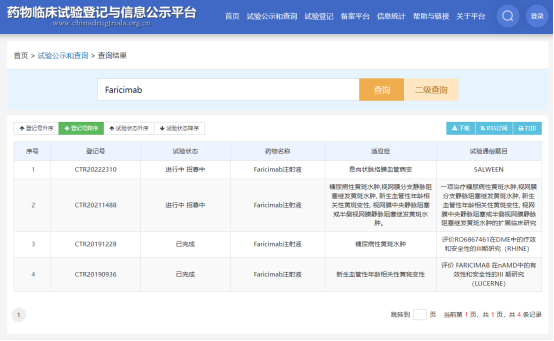
Source of the image: Drug Clinical Trial Registration and Information Disclosure Platform
Summary
In addition to Gaptuzumab, Mosunetuzumab, and Faricimab, Roche has multiple bispecific antibody drugs under development. As the product research and development progresses, Roche's bispecific antibody pipeline will further expand.

Editor: Muyan
Disclaimer: The views expressed in this article are solely those of the author and do not represent the position of Pharma Intelligence. We welcome discussions and additional insights in the comment section; for reprints, please be sure to credit the author and source. If there are any issues regarding the content, copyright, or other aspects of the work, please leave a message on this platform, and we will address it promptly.