

DeJin Medical's DragonFly Transcatheter Mitral Valve Clip Receives NMPA Approval as China's First Indigenous Femoral Venous Approach System

Valgen Medtech
Minimally Invasive Interventional Device Developer
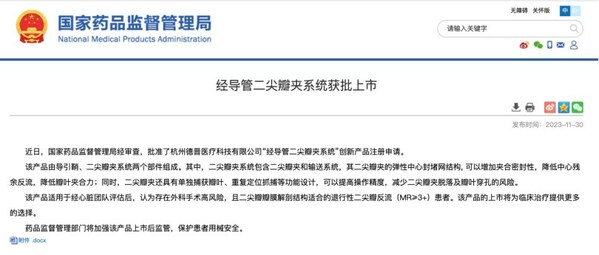
HangzhouDecember 1, 2023 PR Newswire -- November 29, 2023, Valgen Medtech Co., Ltd. ("Valgen Medtech") announced that its self-developed DragonFly Transcatheter Mitral Valve Clip System ("DragonFly") has officially received approval from the National Medical Products Administration (NMPA) for market launch. This is the first domestically produced transvenous mitral valve clip product approved in China.
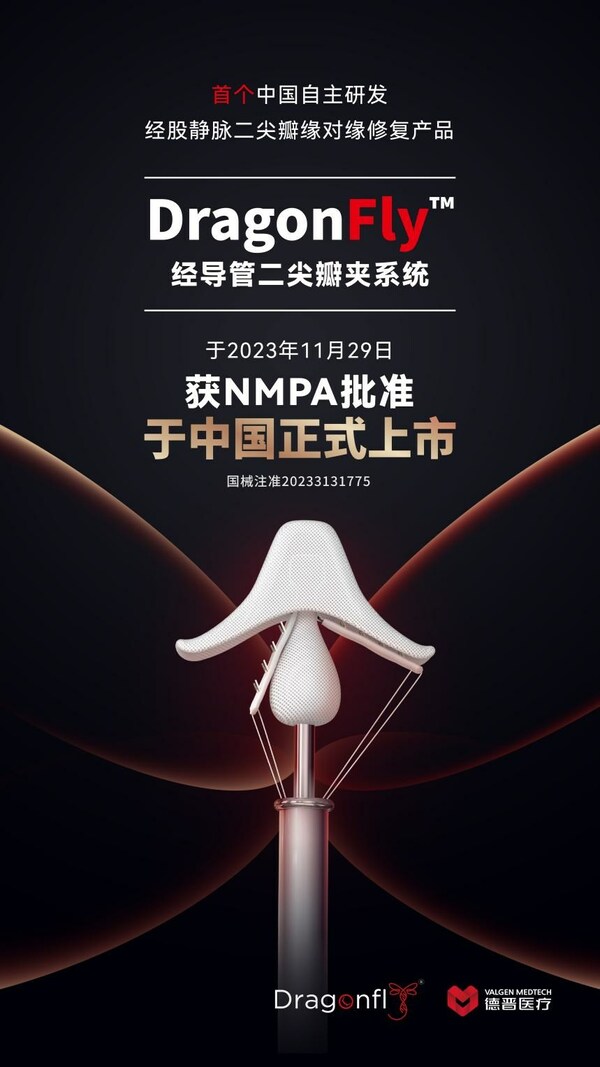
DragonFly, jointly developed by Valgen Medtech, the team of Academician Jian'an Wang from the Second Affiliated Hospital of Zhejiang University School of Medicine, and the team of Academician Xingdong Zhang from the National Engineering Research Center for Biomaterials at Sichuan University, was brought to fruition after nearly a decade of research and development. It has received support from China's "14th Five-Year Plan" key research and development program.
First DragonFly Implantation in China in 2020
The Opening Chapter of China's Narrative
Mitral Regurgitation (MR) is the most common heart valve disease. Severe mitral regurgitation (MR) occurs in up to a quarter of patients with heart failure and reduced ejection fraction. If left untreated, the 3-year mortality rate is 40-50%, and the rate of heart failure rehospitalization (HFH) within 5 years is 90%. The incidence of mitral regurgitation significantly increases with age, with nearly half of the cases associated with high-risk factors for surgical intervention. In 2003, the world's first transcatheter mitral valve edge-to-edge repair procedure (referred to as TEER) was performed globally, and as of 2022, the cumulative number of global TEER implants has exceeded 200,000 cases.
In China, according to the "Clinical Pathway for Transcatheter Mitral Valve Edge-to-Edge Repair (According to the "2022 Full Text Edition", there are approximately 7.5 million patients with MR in China who require interventional treatment. The incidence of MR significantly increases with age: it is 0.3% in the population aged 35-50, 0.9% in those aged 51-64, and 2.2% in people aged ≥65. In individuals over 65 years old, the incidence of MR in moderate to severe valvular heart disease is as high as 19.1%. More than two-thirds of these patients cannot undergo surgical treatment due to risk factors such as advanced age and complications, resulting in a 5-year mortality rate as high as 50%.
On July 23, 2020, the team of Academician Wang Jian'an from the Second Affiliated Hospital of Zhejiang University School of Medicine successfully completed a transcatheter mitral valve repair surgery for an elderly patient using DragonFly. This marked the beginning of treating valve regurgitation with a domestically developed transvenous mitral valve edge-to-edge repair system in China.
Clinical Research and Dedicated Development
Lay a Reliable Foundation for the Product
DragonFly Successfully Conducted the First Implant Surgery in China in 2020, and Clinical Trials Have Been Carried Out in 27 Centers Across the Country. To Date, More Than 300 Implants Have Been Performed. Clinical Data Shows That the System Has Good Operability and Long-Term Safety and Effectiveness.
From May 2021 to January 2022, the DragonFly-DMR trial enrolled and treated a total of 120 patients in China. Follow-up data showed that the immediate postoperative surgical success rate and device implantation success rate among the 120 patients were both 99.2%. The treatment success rate at 12 months post-operation was 87.5% (95% confidence interval: 80.1%, 92.2%). Follow-up results at 12 months post-operation indicated significant improvements in cardiac function and quality of life for the patients. This pivotal clinical trial successfully achieved its pre-specified primary efficacy and safety endpoints with remarkable treatment outcomes.
During the surgical procedure,In the DragonFly device group, 52.5% of subjects successfully received one valve clip, and 42.5% of subjects successfully received two valve clips. The mean mitral transvalvular pressure gradient (TMPG) immediately post-procedure and at 12 months was 2.88±1.34mmHg and 3.19±1.38mmHg, respectively. The performance data of the DragonFly device shows comparable results to the latest clinical trial outcomes of leading overseas counterparts, MitraClip and PASCAL.
At the same time, postoperativelyThe 12-month follow-up results showed that the patients' cardiac function and quality of life were significantly improved. The proportion of subjects with NYHA Class I/II heart function increased from 32.4% at baseline to 93.6% at 12 months (P<0.001). The improvement in the Kansas City Cardiomyopathy Questionnaire (KCCQ) score relative to baseline was as high as 30.64±18.35 points (P<0.001).
DragonFly-DMR trial results show that the DragonFly system has good safety, effectiveness, and controllability for treating degenerative mitral regurgitation (DMR), offering a better treatment option for DMR patients at high surgical risk.
Rapidly Expand into the Mitral Valve Repair Field
LeadNew Horizons in TEER Treatment
The key to the development of transcatheter mitral valve treatment devices lies in technological innovation.Currently, there are only two CE/FDA-approved TEER products: Abbott's MitraClip and Edwards' PASCAL, both of which use a transvenous approach. Reviewing the product iterations from overseas giants, three major trends in technological innovation in this field can be summarized:
DragonFly Product Features the Following Four Innovative Designs, enabling safer and more effective clamping, adapting to a wider range of patients, with overall operation being more intuitive and convenient, and treatment effects precise and accurate.
DragonFly has independent intellectual property rights. By September 2023, it had applied for more than 150 patents domestically and internationally related to the product's basic principles, core solutions, and key innovations, including 95 invention patents, 28 PCT applications, and 30 authorized patents. Three technical achievements were published in renowned international journals such as "JACC: Asia."
Evaluation by Academician Jian'an Wang from the Second Affiliated Hospital of Zhejiang University School of Medicine:“The DragonFly Transcatheter Mitral Valve Clip System is a prime example of the powerful promotion of medical device R&D and innovation through the collaboration of medicine and engineering. In August 2019, we successfully completed the world's first animal experiment. In 2020, the team applied DragonFly to complete the world’s first clinical application in humans. By 2022, the last patient was enrolled in the DMR confirmatory clinical trial. Throughout this journey, we have collectively witnessed the progress and strength of China’s independently developed medical devices. While breaking through technological bottlenecks in China, it also signifies the potential for reverse technology export in the near future. Moving forward, we will continue to align with clinical needs, constantly refine our efforts, and strive to provide better treatment options for mitral regurgitation patients worldwide.
Mr. Zhang Tingchao, General Manager of Valgen Medtech, stated"All that we have done is for the patients we serve, to make healthcare more accessible and bring benefits to society. Valgen Medtech has years of technical expertise in the transcatheter mitral valve repair treatment field, as well as abundant experience in industrialization, providing more valuable services to patients worldwide."
The diagnostic and treatment technology for structural heart disease is currently at the forefront of global advancements. In recent years, China has seen rapid development in its structural heart disease treatment technologies, driven by the rise and continuous progress of local scientific research capabilities and innovations. Today, the domestically produced trans-femoral venous mitral valve clip systemThe approval of DragonFly marks another milestone breakthrough following the approval of China's first transcatheter aortic valve replacement (TAVR) in 2017. As China takes the lead globally in the diagnosis and treatment of structural heart disease, looking back today, the approval of DragonFly will be remembered as a significant highlight in the history of China's structural heart disease development.