

AbbVie to Acquire ImmunoGen for $10.1 Billion, Gaining First-in-Class FRα-Targeted ADC ELAHERE®

AbbVie
Innovative Drug Developer
On November 30, AbbVie and antibody-drug conjugate (ADC) developer ImmunoGen announced a definitive agreement under which AbbVie will acquire ImmunoGen for a total of approximately $10.1 billion, gaining access to its ADC drug ELAHERE, approved for platinum-resistant ovarian cancer (PROC).®。
According to the terms of the agreement, AbbVie will acquire all outstanding shares of ImmunoGen for $31.26 per share in cash, representing a 95% premium over ImmunoGen's closing price on Wednesday. Prior to AbbVie’s offer being disclosed, the stock had already reached its highest level since 2015. The transaction is expected to be completed by mid-2024.
AbbVie Chairman and CEO Richard A. Gonzalez stated, "This acquisition accelerates AbbVie's commercial and clinical operations layout in the solid tumor field, and ImmunoGen's remaining ADC pipeline further complements AbbVie's ADC platform and existing oncology portfolio."
ImmunoGen, founded in 1981 and successfully IPO'd in 1989, is a pioneer in developing next-generation anti-cancer ADCs and was once known as one of the "Big Three" in the ADC field alongside Seagen and Roche.
ImmunoGen has built a proprietary camptothecin ADC drug development platform and an ADC toolkit that integrates target screening, antibody development, toxin library, and linker library. Currently, the company's pipeline includes potential projects for the treatment of various solid tumors and hematologic malignancies. Among them, ELAHERE®It is the ADC with the fastest progress.
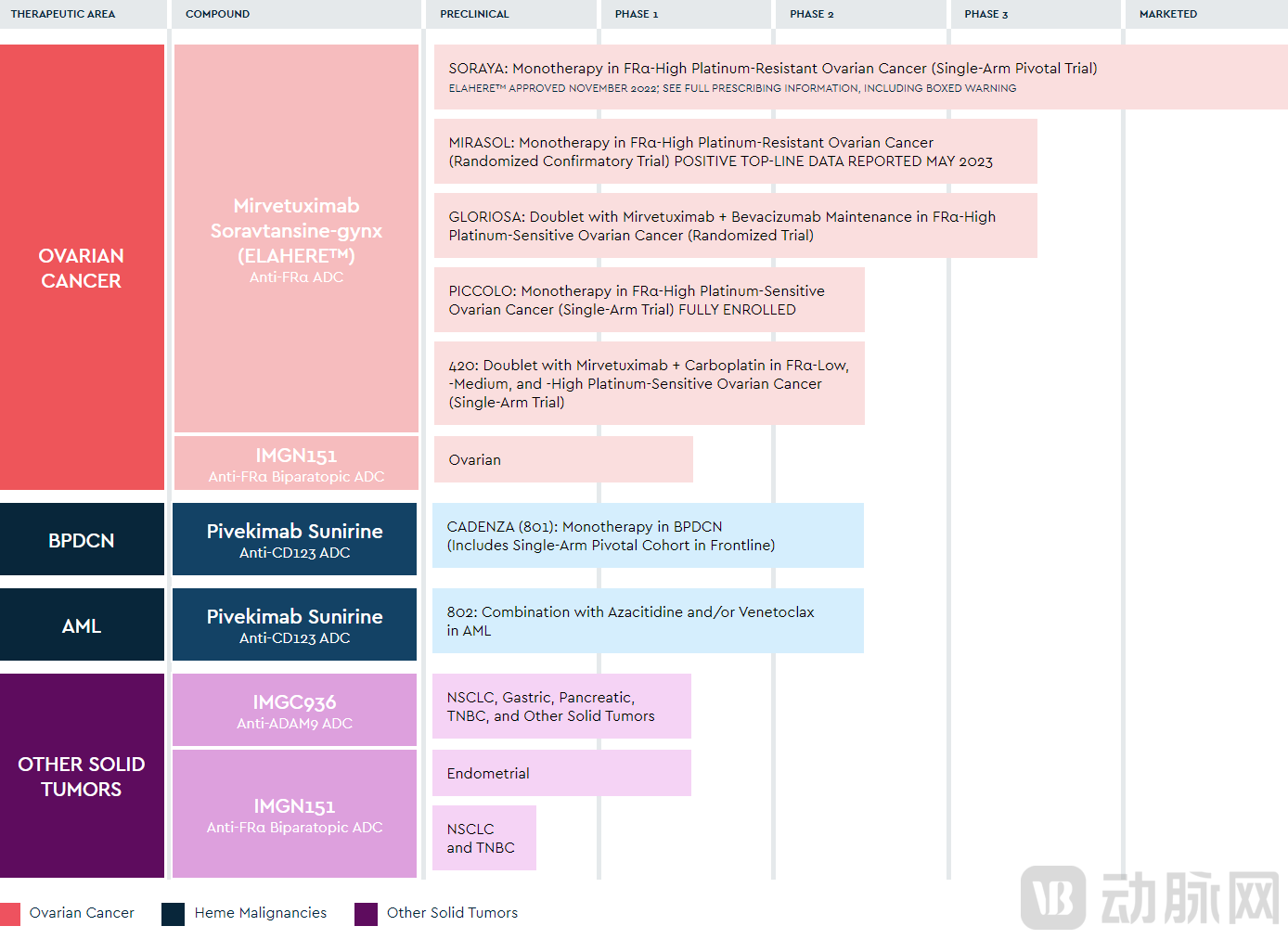 ImmunoGen's R&D Pipeline
Image Source: ImmunoGen Official Website
ELAHERE®It is an ADC targeting folate receptor α (FRα), consisting of three parts: M9346A, a humanized monoclonal antibody against FRα of the IgG1 subtype, DM4 (a maytansine derivative) as a microtubule inhibitor, and a linker.
When ELAHERE®After binding to FRα, FRα is able to internalize and transfer it into the cell, where the cytotoxic molecules carried by the ADC inhibit tumor cell mitosis, ultimately leading to cell cycle arrest and death. Meanwhile, after the death and rupture of tumor cells, DM4 and its derivatives can diffuse into the surrounding tumor tissue, further exerting a "bystander effect" that damages neighboring tumor cells.
ImmunoGen Presented ELAHERE at the 2023 American Society of Clinical Oncology (ASCO)®The phase 3 clinical trial results, which evaluated the safety and efficacy of Elahere® in combination with chemotherapy in FRα-positive PROC patients who had received one to three prior lines of therapy.
Data show that patients receiving ELAHERE®The median progression-free survival (PFS) was 5.62 months for patients treated with Elahere® (n=227) and 3.98 months for those receiving chemotherapy (n=226). The median overall survival (OS) was 16.46 months in the Elahere® group and 12.75 months in the chemotherapy group. Additionally, the objective response rate (ORR) was 42% in the Elahere® group compared to 16% in the chemotherapy group.
In November 2022, the FDA granted accelerated approval to ELAHERE.®Launched for the treatment of adult patients with FRα-positive, platinum-resistant epithelial ovarian cancer, fallopian tube cancer, or primary peritoneal cancer who have received one to three prior systemic therapy regimens. This is currently the world's first and only FDA-approved ADC drug targeting FRα.
In addition, in October 2020, Huadong Medicine acquired ELAHERE for an upfront payment of $40 million and milestone payments of up to $265 million.®Exclusive development and commercialization rights in Greater China. In October this year, ELAHERE®The marketing authorization application (MAA) has been accepted by the Center for Drug Evaluation (CDE) of the National Medical Products Administration (NMPA). Moreover, ELAHERE®The MAA in the EU was also accepted by the European Medicines Agency (EMA).
With its good efficacy, ELAHERE®A Strong Start Upon Launch: According to ImmunoGen's Q3 2023 financial report, the net sales of Elahere® in the U.S. for the third quarter were $105.2 million, with total sales for the first three quarters reaching $212 million.
This is not the first time AbbVie has spent heavily to lay out its presence in the ADC field.
In 2016, AbbVie acquired Stemcentrx, an oncology drug company, for $5.8 billion, obtaining its key ADC investigational drug Rova-T. Rova-T is an ADC targeting Delta-like ligand 3 (DLL3) and was once considered a potential drug for treating small cell lung cancer (SCLC).
However, the $5.8 billion ultimately went down the drain, with the failure of Rova-T following soon after. In 2018, AbbVie halted the Phase 3 trial of Rova-T for SCLC patients, and in 2019, AbbVie announced the complete termination of Rova-T's development.
Following this "blow," a series of abandoned ADC pipelines ensued. As of now, AbbVie has dropped a total of 7 ADC pipelines.
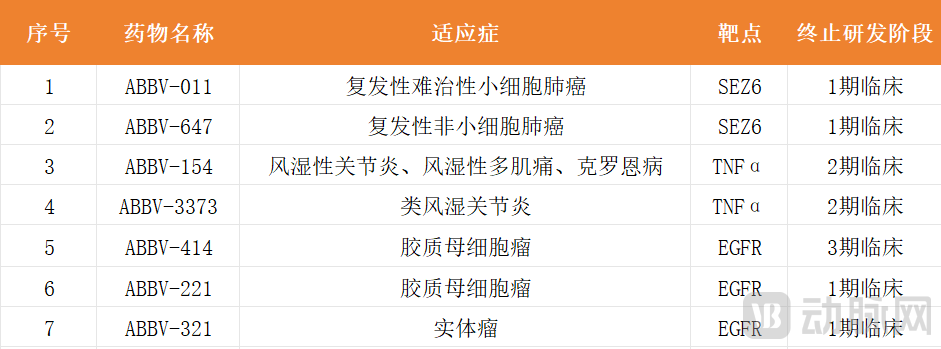 AbbVie's Abandoned ADC Pipeline
Data source: Collation of public data, chart by VCBeat
As one of the pharmaceutical giants that entered the ADC track early, AbbVie's "ADC journey" can be traced back to 2008. Over the past 15 years, AbbVie's development of ADC has mainly followed two main lines—autoimmune diseases and the oncology field. After adjustments in its strategic layout, AbbVie currently focuses its ADC development on the oncology sector, with four ADC projects currently in the clinical stage.
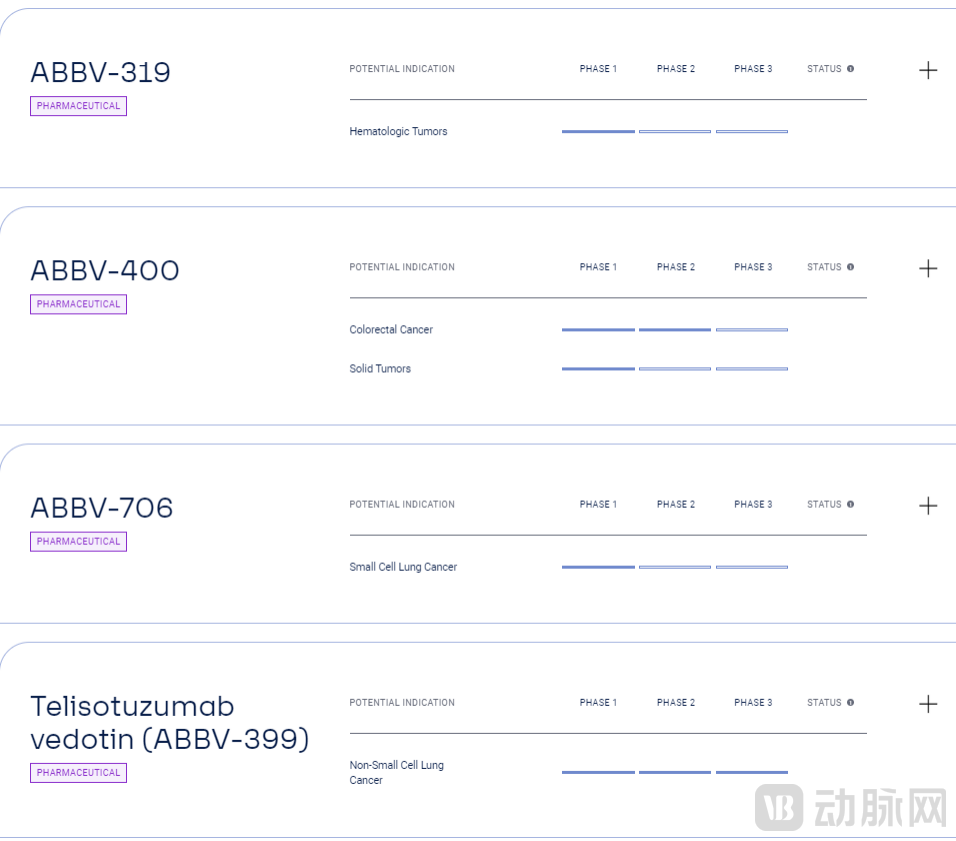 AbbVie's ADC Pipeline in Development
Image Source: AbbVie Official Website
Among them, the most notable is undoubtedly ABBV-399, which is in Phase 3 clinical trials. In January 2022, ABBV-399 was granted Breakthrough Therapy Designation by the FDA for the treatment of patients with advanced or metastatic c-Met overexpressing EGFR wild-type non-squamous NSCLC who have progressed after platinum-based therapy.
Moreover, according to VBInsight data, as of March this year, there are 15 c-MET ADC targeted drugs under research globally, with 9 having entered clinical stages. However, ABBV-399 is currently the world's only c-Met targeted ADC to have advanced to Phase 3 clinical trials.
Currently, AbbVie has initiated the Phase 3 M18-868 study of ABBV-399 for the treatment of NSCLC patients. This study aims to evaluate the efficacy and safety of ABBV-399 in combination with docetaxel in previously treated c-Met overexpressing EGFR wild-type locally advanced/metastatic NSCLC patients. The study is expected to be completed in June 2025. By then, AbbVie may become a game-changer in the c-Met ADC field.
Before entering the ADC track, AbbVie had already held the "king of drugs," Humira. From 2012 to 2022, Humira contributed over $200 billion in sales to AbbVie and also claimed the throne of the top-selling drug for eleven years. However, with the expiration of Humira's patent, AbbVie is now facing the steepest patent cliff in history.
With the emergence of biosimilars, the subsequent market will continue to be eroded, and Humira may step down from its position as the top-selling drug. In the first three quarters of 2023, Humira's sales were $11.1 billion, a year-on-year decrease of 29.1%. Meanwhile, Merck's leading anti-tumor drug Keytruda (K-drug) achieved sales of $18.4 billion during the same period, making it the best-selling drug globally in the first three quarters of 2023. It is highly likely to replace Humira as the top-selling drug of 2023.
Entering the ADC track has become one of AbbVie's strategies to offset the patent cliff. Although Rova-T did not allow AbbVie to catch the ADC development train, it still hopes to tap into potential blockbuster drugs through mergers and acquisitions. Through this transaction, AbbVie has gained the already marketed ELAHERE.®, which means that the failure similar to Rova-T may not be repeated. ELAHERE® is currently the only ADC product launched by AbbVie, becoming AbbVie's true "entry ticket" into the ADC market.
However, in the past two years, the ADC drug track has been exceptionally火热, with global innovative pharmaceutical companies纷纷 entering the field. In March this year, Pfizer announced a $43 billion acquisition of Seagen, a pioneer in ADC; in October, Merck and Daiichi Sankyo reached a $22 billion ADC research and development collaboration... According to statistics from VCBeat, as of January 2023, there are 15 approved ADC drugs globally. Additionally, there are over 400 ADC drugs in development worldwide, with more than 200 entering clinical stages.
In the highly competitive ADC market, AbbVie, which failed to seize the early advantage, needs to break through technical barriers in areas such as targets, antibodies, payloads, linkers, toxicity, and indications in order to stand out among numerous players. Apart from spending money to acquire pipelines, it must also create innovative products with differentiated advantages.