XtalPi Files IPO Prospectus: The Rise of the First "AI + Robotics" Stock
XtalPi
Computation-Driven Innovative Drug R&D Provider
Follow and join the community of "Gazelle Society" above immediately.
Focusing on High-Growth Projects, 80,000+ Investment Elites Are Watching Together
The 18C sector has finally ushered in a new face.
On November 30, XtalPi submitted its prospectus to the Hong Kong Stock Exchange. When it comes to China's AI pharmaceuticals industry, XtalPi is a company that cannot be ignored.
Relying on its unique technical advantages, XtalPi has gained favor from the world's top pharmaceutical companies, providing drug discovery solutions services to major pharmaceutical companies such as Pfizer, Eli Lilly, and Johnson & Johnson, which has driven the company’s performance to continue explosive growth. The prospectus shows that the company's revenue in 2020, 2021, and 2022 was 35.6 million yuan, 62.8 million yuan, and 133 million yuan respectively, with a compound annual growth rate from 2020 to 2022 as high as 93.4%.
Thanks to its success in the AI pharmaceuticals field, XtalPi has become highly sought after in the primary market. Since its establishment, XtalPi has completed eight rounds of financing; in 2021, the company's valuation soared to $1.968 billion, making it one of the highest-valued AI startups in China.
However, defining XtalPi as an AI pharmaceutical company is too narrow.
Developing technology platforms based on AI to "empower all industries" was the vision of many companies during the AI boom triggered by AlphaGo in 2016. Although this super vision has not yet been fully realized, there is a glimmer of hope. XtalPi is now starting with AI pharmaceuticals to "expand its reach":
By leveraging the underlying technology platform that combines "AI + robotics," it empowers more new fields such as new materials and new energy.
This platform has withstood the rigorous challenges and tests of the biopharmaceutical industry and has been successfully migrated to the discovery field of bio-based new materials. Currently, XingTai, a joint venture subsidiary of XtalPi, has achieved proof-of-concept in this field.
Entering the new materials field marks the first step for "XtalPi Intelligent Medicine" to expand into "XtalPi Intelligent Manufacturing," enabling its "AI + robotics" strengths to create commercial and social value in a broader market space. In other words, XtalPi is forging a new growth curve, which, if commercially expanded successfully, will bring new increments.
This is a new milestone in XtalPi's development, and perhaps also the reason why the company has chosen to go public through a Hong Kong IPO at this time.
In the nascent "AI + Robotics" era of opportunity, all companies must respond as never before; XtalPi, which is among the first to embrace the technological wave, is no exception.
01
Three Key Elements to Understanding XtalPi
To fully understand XtalPi, we must start with its three key elements: "quantum physics, artificial intelligence, and robotics."
In AI pharmaceutical models, AI can mine valuable insights from vast amounts of biomedical data to obtain molecules, crystals, and others with complex key characteristics, thereby reducing costs and increasing efficiency in the drug research and development process.
XtalPi's self-developed intelligent and automated drug discovery platform incorporates a series of computational tools that combine quantum physics and artificial intelligence, including general molecular force fields, molecule generation, virtual screening, ADMET prediction, and free energy perturbation calculations.
However, the empowerment of AI is not without foundation. In the real world, AI drug discovery is generally plagued by data challenges. Significant differences in data collection, uneven quality, and the difficulty in obtaining data on failed outcomes are among the many challenges that limit the development of AI in pharmaceuticals.
The question of whether the egg or the chicken came first has puzzled countless AI pharmaceutical companies. In response, XtalPi's solution is to first use physical methods as a starting point, namely, calculations based on the first principles of quantum physics.
Returning to the most fundamental conditions of things, transforming the complex multi-objective drug research and development into quantum physics problems at the microscopic level, and precisely simulating and predicting the physical, chemical properties, and biological behaviors of specific molecular structures based on first principles (intermolecular and atomic forces), achieving a breakthrough from "0 to 1".
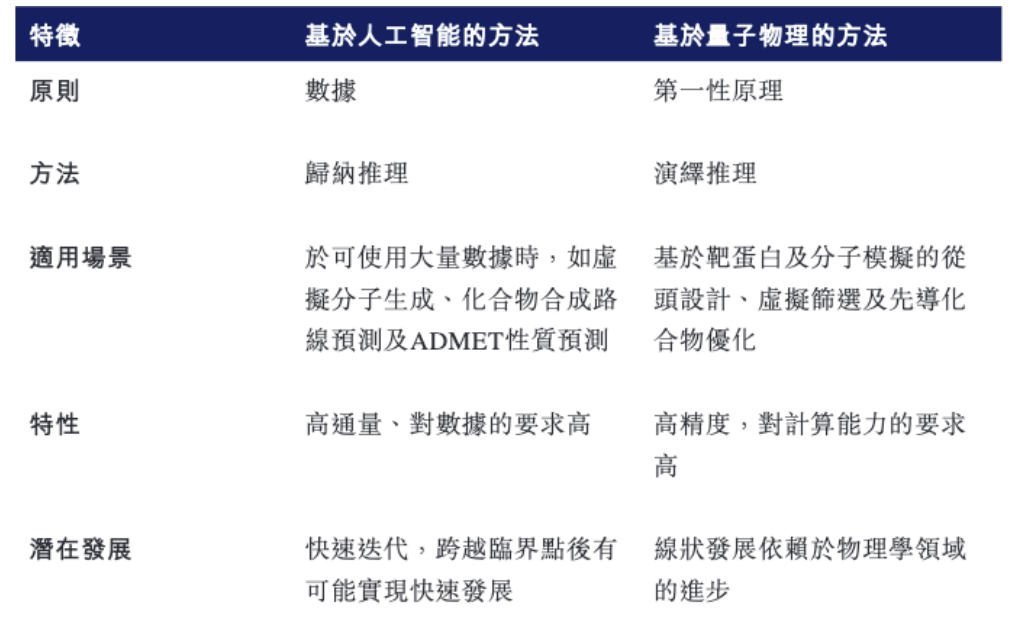
High-performance scientific computing based on quantum physics can generate high-precision virtual data without any training sets, overcoming the data scarcity issue that often arises in the early stages of artificial intelligence application.
Based on precise but expensive quantum physics calculations, the empowerment of AI algorithms allows XtalPi to significantly reduce computational load and time, while continuously generating innovative molecular structures.
Simply put, XtalPi's computational tools consist of two key elements: "quantum physics models and AI algorithms," which continuously accumulate high-precision data to optimize and iterate algorithms through reinforcement learning, thereby creating a virtuous cycle of "the more calculations are performed, the more accurate they become."
On the basis of the above, the company has completed the construction of an intelligent robot wet lab, which will form another distinctive core competitiveness.
The so-called wet lab is relative to dry lab. Dry lab analyzes data and performs simulation predictions in the cloud using bits, while wet lab involves actual laboratory operations to verify predictions in the real world. In terms of function, dry lab is similar to drawing blueprints, and wet lab is similar to actual construction on a building site.
In the field of AI-driven drug discovery, a complete process is only achieved when molecules designed by "computational tools" are validated in wet labs.
Logically, only by achieving a closed-loop of dry and wet experiments, synthesizing and testing the new drug and new material structures obtained from dry experiments through wet experiments, and then feeding the data back into the model, can the model be continuously iterated and optimized step by step to approach the target candidate molecules.
This is exactly the origin of XtalPi's intelligent robotic wet lab. By replacing manual operations with a robot-driven approach, XtalPi has not only achieved the goal of reducing costs and increasing efficiency but also enabled the generated data to serve as feedback for training computational tools, acting like a data mine that continuously provides standardized R&D data to nurture AI and enhance the innovative capabilities of human scientists.
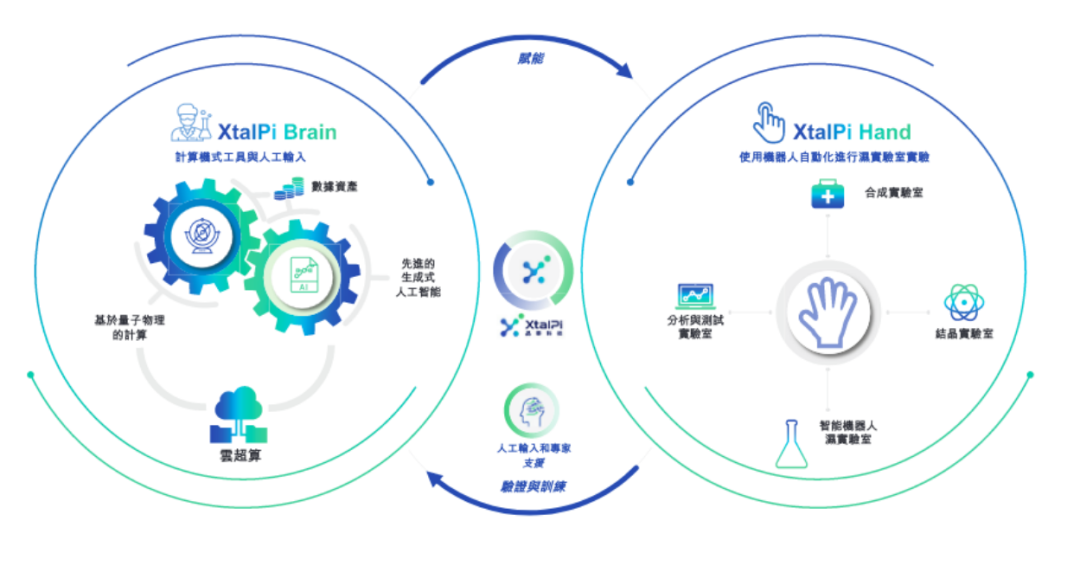
Thus, these three key elements jointly construct XtalPi's "AI + Robotics" "flywheel." Theoretically, as the flywheel spins faster and faster, XtalPi, as an innovative R&D platform, accumulates more data, and the accuracy and coverage of its models continue to improve. Another advantage of this combination is that even when faced with entirely new research systems and topics, the pairing of quantum physics and automated experiments can quickly provide sufficient reliable data to build models and get the wheel turning.
02
From AI Drug Discovery to AI Innovation Platform
Emphasizing Both Research and Commercialization: The Common Choice of All Major AI Startups Today
What sets XtalPi apart is its strong belief that building a robust underlying platform and technology can unlock significant commercial and social value.
The multiple key components of XtalPi's innovative R&D platform all possess monetization capabilities and have currently entered the monetization phase.
For instance, the company's "computer-aided tools" have been applied in the field of new drug development. To date, the company has provided services to over 100 biotechnology and pharmaceutical companies and research institutions worldwide, contributing to more than 500 projects cumulatively. A typical example is during the 2020 pandemic, when, empowered by XtalPi, Pfizer's Paxlovid completed the mutual verification and accurate matching of drug polymorph prediction and experimental results within six weeks.
If following the traditional methods, this work would take at least several months to complete. This has undoubtedly accelerated the arrival of this blockbuster drug, demonstrating the commercial and social value of this platform.
In terms of customer composition, the company serves 15 of the top 20 global biotechnology and pharmaceutical companies by revenue in 2022, including Pfizer, Johnson & Johnson, and Eli Lilly, indirectly demonstrating that its technical capabilities are recognized by the industry.
This is also reflected at the company's revenue level. In 2020, the revenue from this business was only 12.66 million yuan, but by 2022, it had grown to 87.66 million yuan.
But this does not mean that XtalPi is only an AI pharmaceutical company. In fact, the company has expanded its business to the new materials field. Currently, its joint venture subsidiary, Shengtai, has achieved proof of concept in the bio-based new materials sector.
In collaboration with the Guangdong Academy of Sciences Institute of Chemical Engineering, XtalPi successfully identified two highly competitive bio-based surfactants in just four months, which were experimentally validated by the institute, significantly reducing the time and cost of new material discovery.
In the field of new energy batteries, in July this year, XtalPi also reached a deep cooperation with "Yan Yi New Materials," a leading company in lithium battery functional materials. Both parties will fully leverage their respective advantages in technology research and development to jointly promote the research and development of new materials for the next generation of lithium batteries. As a hidden champion in the field of lithium battery functional materials, Yan Yi New Materials has been highly recognized by top customers in the industry and top investment institutions. Its customers include CATL, BYD, and others.
Like new drug development, the core purpose of new material development is also to discover molecules with specific properties, such as greater strength or higher conductivity. Therefore, XtalPi's "computational tools" can also be empowered by "quantum physical models and AI algorithms."
Compared to the market prospects of new drug development, the new materials research market is equally noteworthy. In recent years, driven by demand, the market's need for the development of new materials has been growing. Moreover, since new materials do not require cumbersome and lengthy processes such as biological activity verification in the human body, their growth potential is even greater.
According to a Frost & Sullivan report, the global market size reached $14.8 billion in 2022 and is expected to grow to $58.5 billion by 2030.
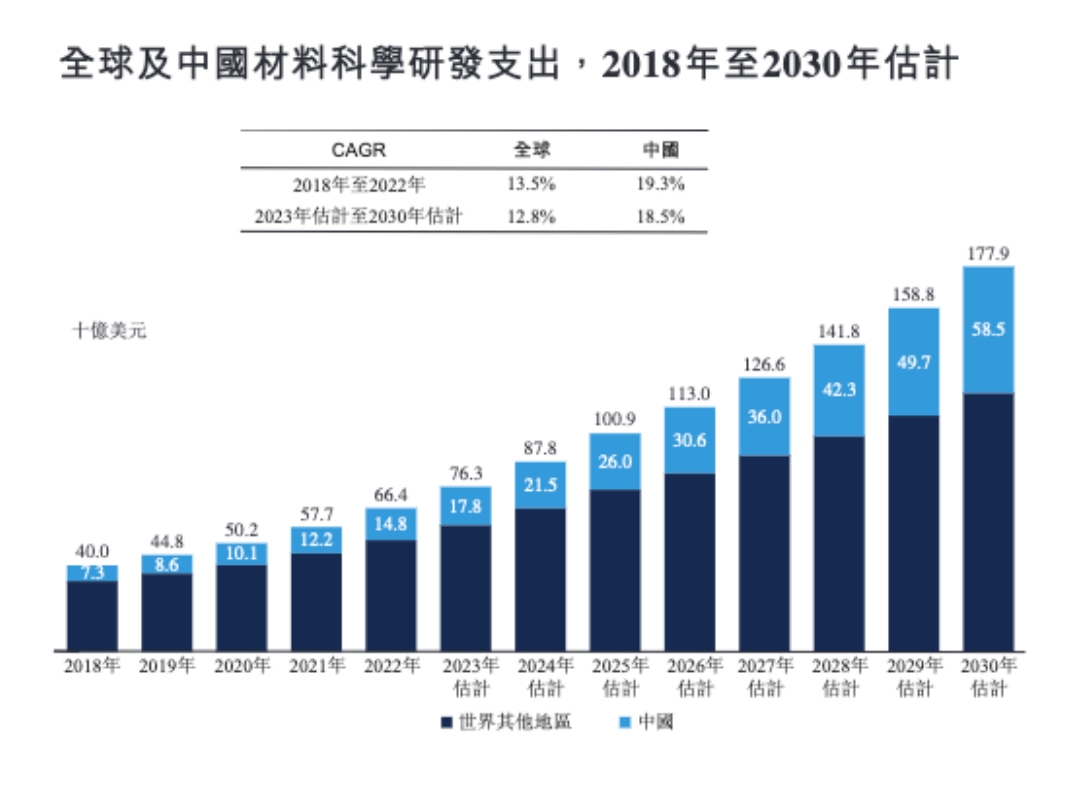
In a market with significant growth, if XtalPi's "computational tools" can break new ground, it may bring new performance increments.
At the same time, the company has formed an intelligent automation solutions business based on its smart robot wet lab, which can greatly help customers improve operational efficiency and reduce operating costs—what the company refers to as its "intelligent manufacturing" business.
XtalPi's "computational tools" business itself can channel traffic to its "intelligent manufacturing" business. Coupled with the fact that cost reduction and efficiency enhancement are the main themes in industries such as pharmaceuticals, the company's business has experienced rapid growth in recent years. In the first half of 2023, the revenue from this business reached 43.87 million yuan, close to the total for the whole year of 2022.
In fact, the "intelligent manufacturing" business has stronger versatility and generalization capabilities. Among the company's already implemented and operational projects are industries such as petrochemicals, new materials, new energy, biomedicine, and food and drug testing.
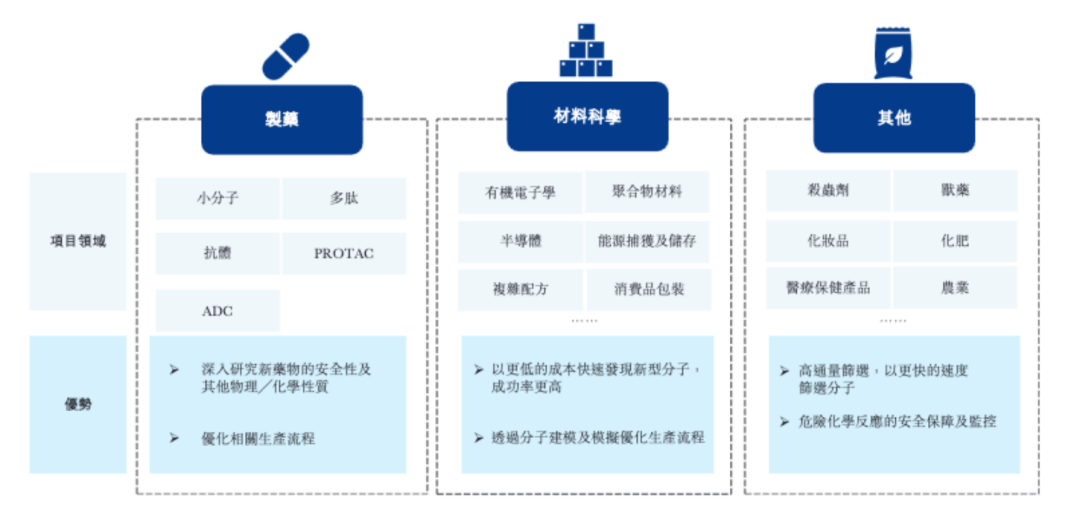
This also means that the potential growth of XtalPi's business might not be underestimated.
Overall, with its unique "AI + robotics" model, XtalPi has the potential to make significant inroads in various fields. Both its AI and robotics businesses are core pillars of the company, and if commercial expansion proceeds smoothly, XtalPi's future growth ceiling will continue to rise.
03
Can the Performance Flywheel Accelerate?
The greatest charm of technology innovation companies has always been following a leapfrog development pattern: from 0 to 1, then from 1 to 10, from 10 to 50… with the growth flywheel spinning faster and faster.
In the past few years, XtalPi has achieved a similar leapfrog development model at the business level. That is, after being rigorously tested and proven in the biopharmaceutical industry, completing the model validation from 0 to 1, it has already expanded into new material discovery fields such as power battery design, with more areas to be explored in the future.
Next, whether XtalPi can achieve this growth trajectory at the performance level is undoubtedly the focus of market attention.
In the early stage of commercialization, technology innovation enterprises need to invest huge amounts of R&D funds and marketing expenses, which may result in revenue growth alongside increased R&D investment, rising sales costs, and expanding losses. This is the current development stage of XtalPi. Due to heavy R&D investment, the company's operating losses for 2020, 2021, and 2022 were 126 million yuan, 299 million yuan, and 525 million yuan respectively, with an operating loss of 435 million yuan in the first half of 2023.
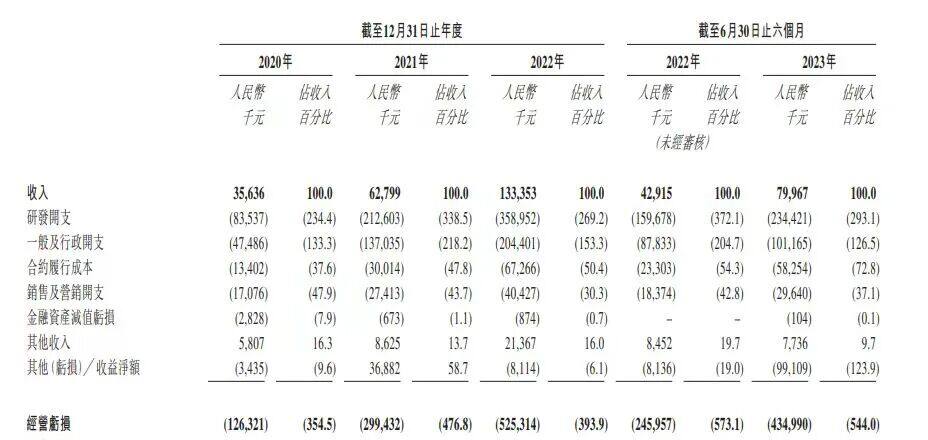
But the company still has an extremely high safety margin. As of June 30, 2023, XtalPi had cash and cash equivalentsCurrent assets including items, the liquid portion of term deposits, the liquid portion of financial assets measured at fair value through profit or loss, and restricted cash amounted to 3.211 billion yuan, indicating a relatively abundant cash reserve. Once the company's products become relatively stable, R&D investment and expense ratios are under control, and revenue continues to grow, the company will gradually enter a profitable cycle.
Logically speaking, after a long period in the educational market and extended investment in research and development, it is highly probable that XtalPi's costs will be controlled; furthermore, its revenue also has the logic for continuous growth.
On the one hand, as mentioned above, from biopharmaceuticals to new materialsFrom "Intelligent Drugs" to "Intelligent Manufacturing," the company has multiple revenue streams, and the market size of related fields is enormous; on the other hand, the company's diversified revenue model seems to provide further potential for growth.
At the core pillar business level, XtalPi mainly adopts a "service model," generating revenue through services and steadily contributing to cash flow. In addition, the company often generates income by empowering through technology, such as strategic cooperation.
Under a strategic cooperation model, companies typically gain subsequent milestone payments. For instance, the small-molecule new drug discovery collaboration reached with Eli Lilly in June of this year could bring total earnings from upfront and milestone payments to $250 million.
In some more valuable areas, the company holds equity in the latter by providing services or through investment, while earning from drug R&D achievements and stock price appreciation. So far, XtalPi has incubated many star enterprises such as JiTai Pharmaceuticals and LymaBio.
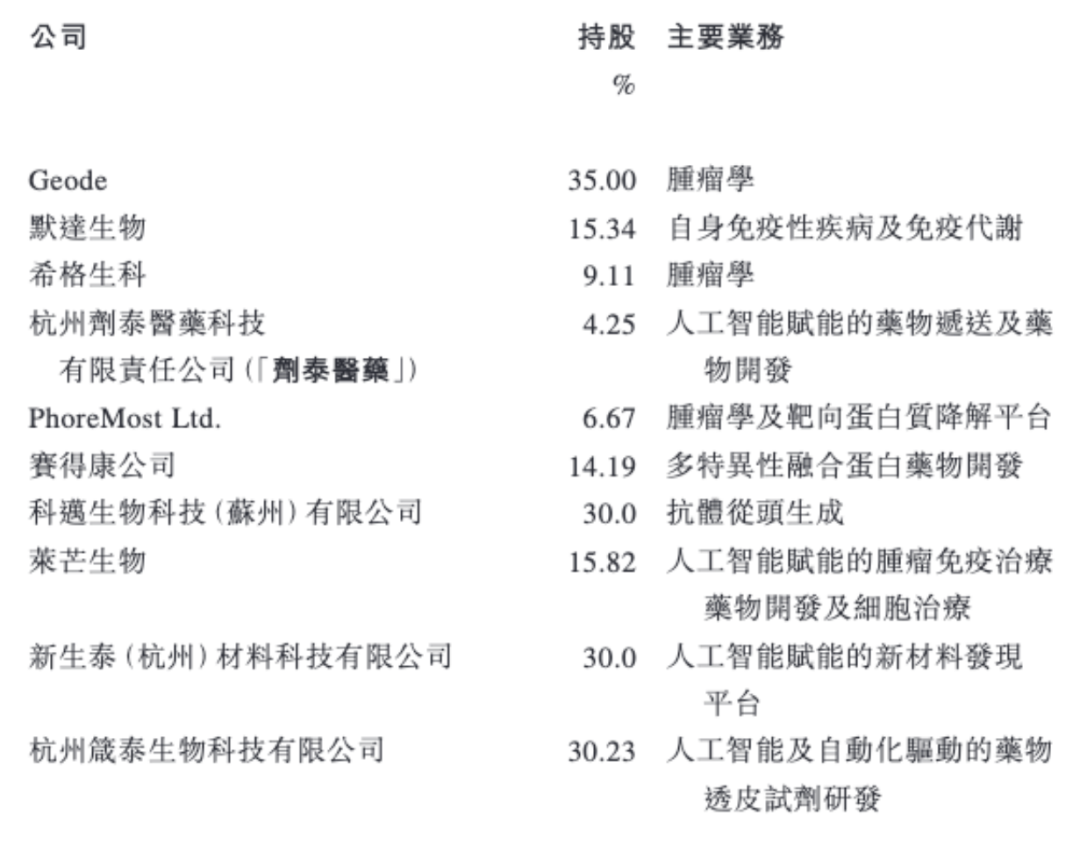
Overall, the company's service revenue will be the underlying logic supporting steady revenue growth; while investment incubation and long-term milestone payments have laid "hidden surprises" for XtalPi's subsequent growth potential.
In essence, if XtalPi can successfully "fission," it will most likely embark on a trajectory of sustained high growth, becoming a "new species" in the Hong Kong stock market. After all, the characteristics of high extensibility and high growth driven by underlying technologies are unparalleled by other business models.
Although everything remains to be verified by time. However, judging from the number and composition of cornerstone investors, the market is also full of expectations for it. According to the Hong Kong Stock Exchange regulations, for unprofitable 18C companies to go public, they must have at least two cornerstone investors with investments greater than or equal to 3% or HKD 450 million.
XtalPi's prospectus shows that it has five leading investment institutions, namely Sequoia, Image Frame (Tencent in the company), Five Source Capital, China Life Chengda, and PICC Health Pension Fund.
The appearance of five top-tier investment institutions actually sends a signal: In the capital winter, an increasing number of forward-thinking, long-term-oriented investors are willing to support technology companies with solid underlying logic.
In the long term, XtalPi has a clear and robust implementation plan for the application expansion of its "AI + robotics" technology platform. As AI-powered achievements continue to emerge, XtalPi's capabilities are being continuously expanded.
Don't worry, let the bullet fly a little longer.
Friends who like our articles, please click "Like", otherwise, due to the change of WeChat push rules, you might miss us every day~
Gazelle Investment Research Planet:To become an excellent investor, having a tool to improve integration efficiency is very important. The editor integrates research reports in the medical and health field from various channels, key company research summaries from brokerages and investment institutions, and industry research reports from third-party organizations. Regularly, we provide trusted friends of瞪羚社 with selected valuable materials within our community, saving time and effort for enterprises and investor friends on investment research. Additionally, we will share some insights and highlight potential investment opportunities based on industry events and selected research reports. Those interested can show their support.