

Three MIT Physicists’ AI Drug Discovery Startup, XtalPi, Files for IPO After Raising Over $7.3 Billion
XtalPi
Computation-Driven Innovative Drug R&D Provider
On November 30, 2023, XtalPi filed its prospectus, planning to go public in Hong Kong by leveraging the new Rule 13C for specialized technology companies.
In the eight years since its establishment, XtalPi has raised $7.32 billion from top investment institutions such as Tencent, ZhenFund, and Sequoia, making it the undisputed "fundraising king" in the global AI-driven drug discovery field.
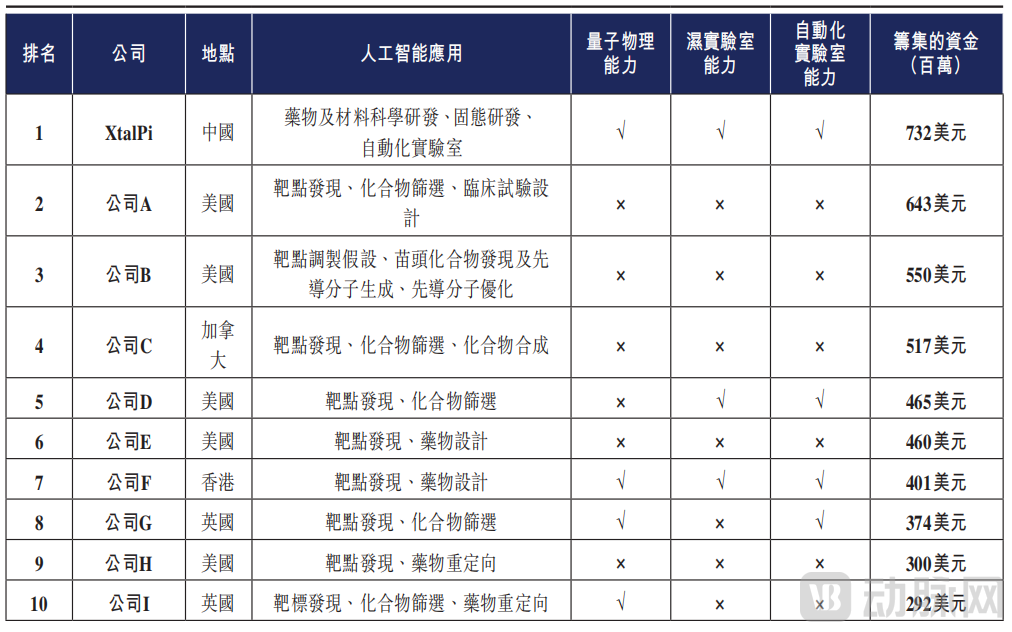
Total Financing and Technical Capabilities of the Top Ten AI Drug Discovery Companies (Data Source: XtalPi Prospectus)
In July 2021, XtalPi's final round of financing totaled $380 million, with a post-investment valuation reaching $1.968 billion. Now, on the eve of its IPO, this leading company in China’s AI-driven new drug development sector, which is "not short of money," has the immediate task of maintaining its valuation and striving for further growth.
Unlike today's AI drug discovery startups that easily secure hundreds of millions in seed funding, when XtalPi started, AI in drug discovery was still in its infancy. The three physicists from MIT traveled between the U.S. and China and only managed to secure a RMB 24 million Series A round led by Tencent.
A turning point occurred at the end of 2016. At that time, Pfizer held a blind test for crystal form prediction involving three internal drugs, without providing any external data. They invited institutions and teams from around the world specializing in crystal structure prediction to conduct experimental evaluations separately, which were then compared with the stable crystal forms already synthesized in the laboratory.
XtalPi was fortunate to become one of the participants in this global competition. At that time, the company had a total of more than thirty employees. To complete this test, they mobilized almost all of their resources and spent over a month to finish the crystal form prediction analysis for three drugs.
Similar to many plots in inspirational novels, XtalPi made a stunning debut in this competition with a 100% prediction success rate, outperforming numerous top-tier institutions. Compared to laboratory synthesis, their algorithm significantly reduced the time required for predictions and even helped optimize molecular structures.
Pfizer was equally satisfied with XtalPi's prediction results. In early 2017, XtalPi initiated its first collaboration with Pfizer, providing drug polymorph prediction services, becoming the first AI-driven new drug company in China to reach a partnership with a world-leading pharmaceutical enterprise. In April 2018, Pfizer directly signed a decade-long strategic research collaboration agreement with XtalPi, leveraging hybrid physics and AI-driven technologies to accelerate drug discovery.
With Pfizer's endorsement, XtalPi has finally been able to make significant strides in the capital market. Over a span of six years, the company has raised funds eight times, repeatedly breaking the record for the largest single-round financing amount in China's medical artificial intelligence field.
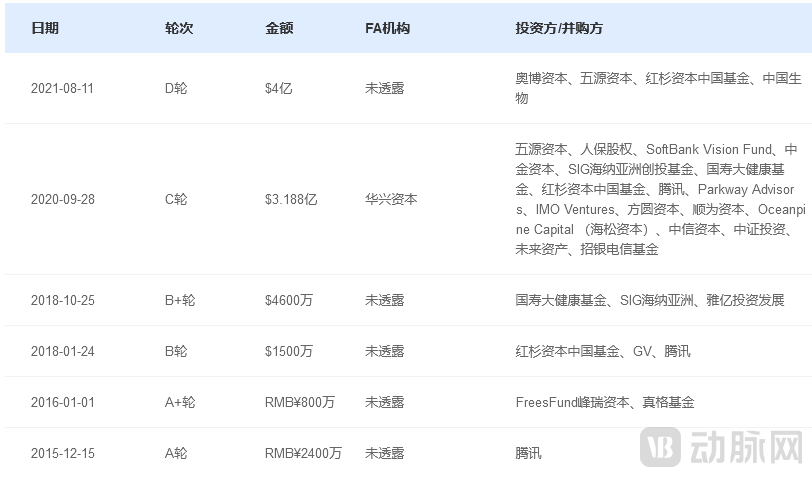
XtalPi Financing History (Data Source: VCBeat Database)
Today, XtalPi is no longer the startup that had to strain every nerve just to make predictions. After securing financing, the MIT-based founding team further integrated AI drug discovery with their expertise in physics, creating an innovative R&D platform that combines quantum physics, artificial intelligence, and robotics.
According to XtalPi, unlike common artificial intelligence methods (which require sufficient experimental data to train AI models), their AI technology can autonomously generate scalable data based on first-principles calculations from quantum physics. This not only overcomes the issue of data scarcity in the early stages of AI-based drug discovery but also significantly improves prediction accuracy, providing more relevant models for chemical and biological objects and their interactions.
Moreover, quantum physics-based computations can calculate molecular features that surpass existing industry knowledge and data without any training set, significantly improving early drug discovery. Related algorithms can also guide generative artificial intelligence to efficiently discover innovative candidate drugs on a large scale in a faster and more accurate manner.
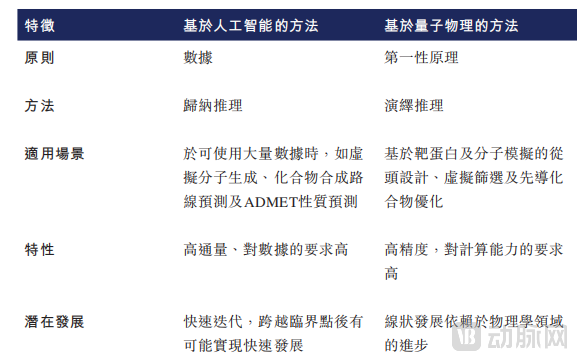
Differences Between AI Prediction and Quantum Logistics Prediction (Data Source: XtalPi Prospectus)
In response to the emerging large language models, XtalPi also quickly launched its research and development. According to the prospectus, the phage display platform XpeedPlay is capable of utilizing LLM to generate lead antibodies at ultra-high speed. When studying the structure of VHH antibodies (a type of naturally occurring light chain-deficient antibody found in camel serum, used for cancer treatment and not existing in nature), the platform helped XtalPi obtain 100 billion of the most promising new VHH antibody sequences by simultaneously optimizing various drug properties.
At the same time, the average expression level of AI-generated sequences was 59.6 mg/L, significantly surpassing the positive control group's average expression level of 37.1 mg/L. Researchers randomly selected 26 sequences for testing and found that 25 sequences were successfully expressed in vitro recombinants, achieving an expression success rate of 96.1%, much higher than the industry average.
Based on the aforementioned foundational technologies, XtalPi has integrated the service models of pharmaceutical and medical device companies to establish three core businesses: drug discovery solutions, solid-state research and development services, and automated R&D laboratories, forming a trinity R&D platform that either develops proprietary drugs or provides diverse CRO services to clients.
Among them, XtalPi's drug discovery solutions involve providing target validation, hit identification, lead generation, lead optimization to preclinical candidate recommendation, covering multiple types of drugs such as small molecules, antibodies, peptides, ADCs, and PROTACs.
Currently, XtalPi has built up 10 pipelines through self-developed or collaborative R&D efforts. XBD-101, XBB-202, and XBD-207 have passed IND and are about to enter the clinical trial phase.
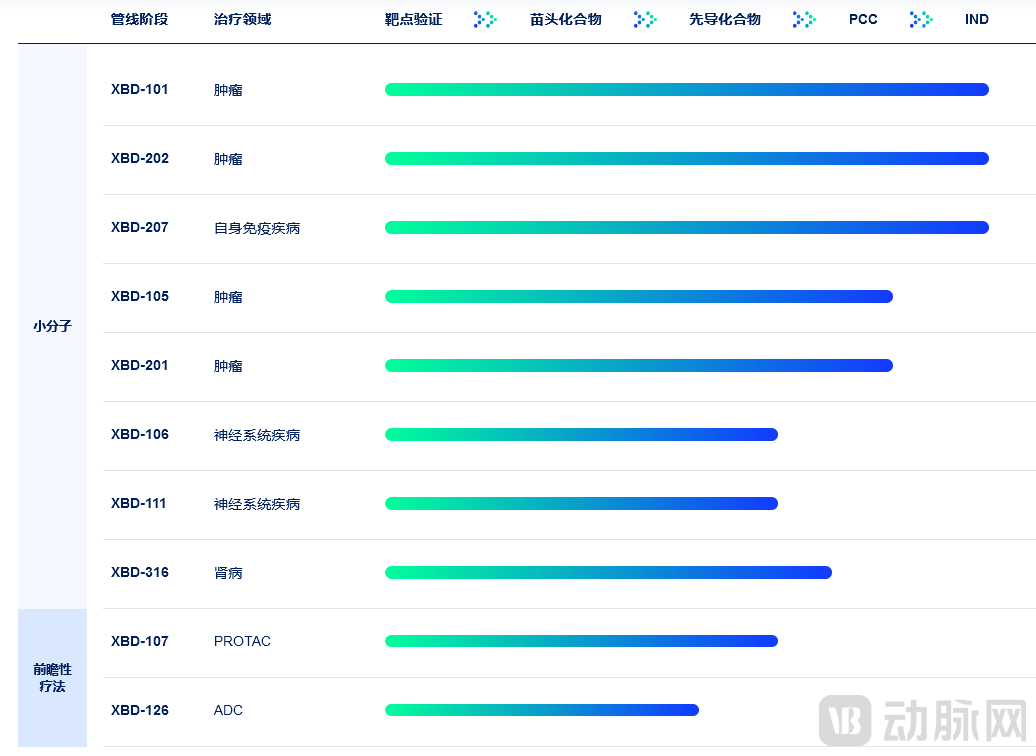
XtalPi Pipeline (Data Source: XtalPi Official Website)
Solid-state R&D services and automated chemical synthesis services serve customers in the pharmaceutical and materials science industries, as well as other sectors, by providing standard or customized automation solutions. This is currently XtalPi's most stable source of revenue.
With multi-faceted investments, XtalPi has seen a sharp increase in both employee numbers and collaborative users. According to the prospectus, XtalPi currently has 989 employees and has served over 200 clients. In specific services, XtalPi typically assigns a team of 3-5 people, utilizing its proprietary AI technology platform to support client project development, generating revenue in the process.
Among these clients are top players from MNCs. Of the top 20 global biotechnology and pharmaceutical companies by revenue in 2022, 16 are currently or have previously collaborated with XtalPi. In 2020, 2021, and 2022, as well as in the six months ended June 30, 2023, XtalPi's customer retention rates were approximately 53.8%, 67.5%, 51.4%, and 51.4%, respectively, significantly higher than the industry average.
Despite multiple indicators being above industry standards, XtalPi still has a long way to go before achieving profitability.
The prospectus data shows that the revenues of XtalPi in 2020, 2021, 2022, and January-June 2023 were RMB 35.636 million, RMB 62.799 million, RMB 133.353 million, and RMB 79.967 million, respectively, showing a year-on-year increase. However, after deducting various expenses, the operating losses for the same periods were RMB 126.321 million, RMB 299.432 million, RMB 525.314 million, and RMB 246.957 million, growing in the same direction as the revenue.
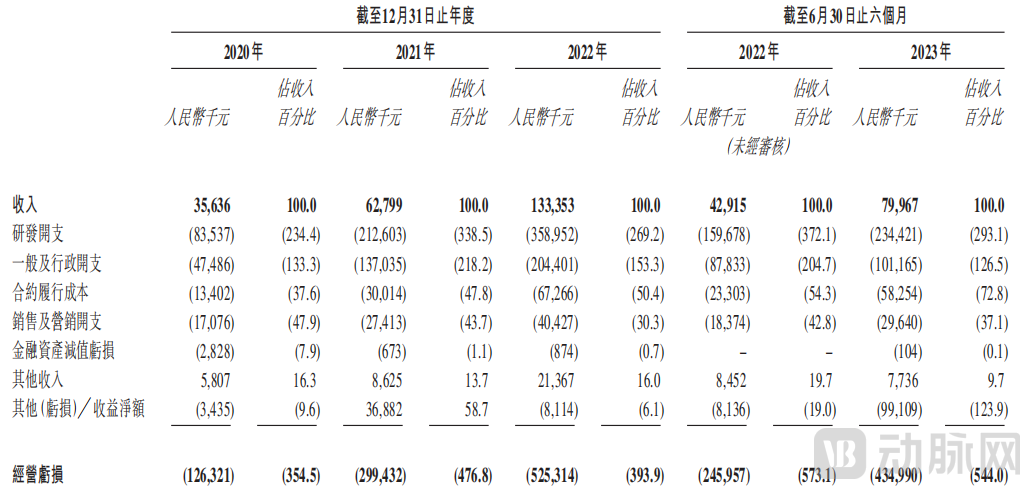
XtalPi Consolidated Income Statement (Source: XtalPi Prospectus)
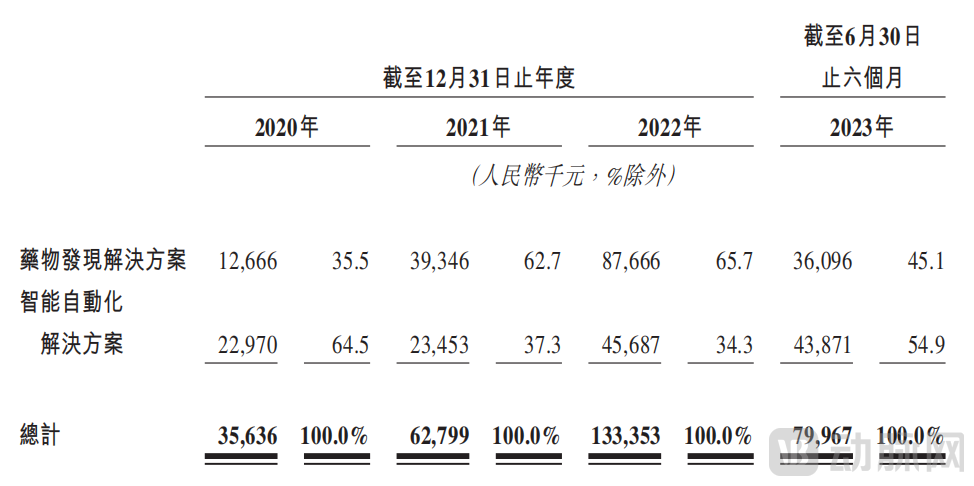
Specifically, in terms of solutions, the revenue from drug discovery solutions during the reporting period was 12.666 million yuan, 39.346 million yuan, 87.666 million yuan, and 36.096 million yuan, accounting for 35.5%, 62.7%, 65.7%, and 45.1% of the total income, respectively.
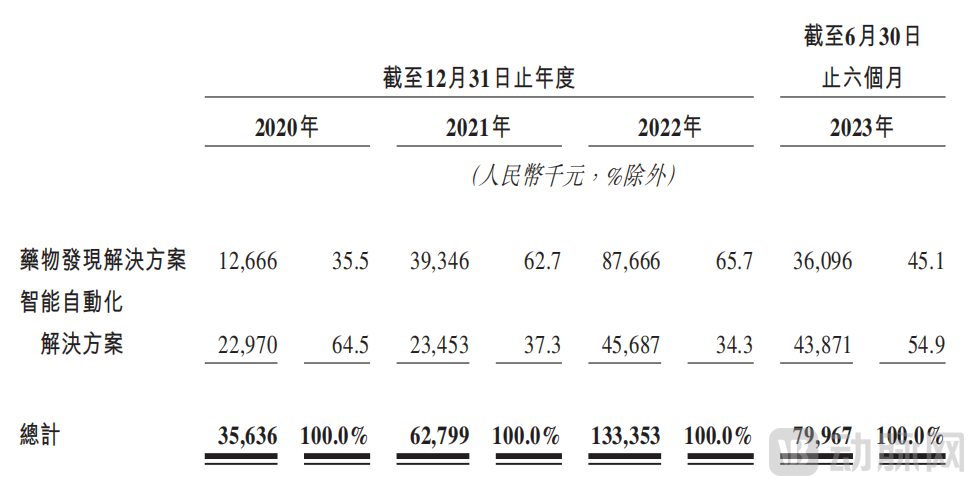
Revenue Distribution of XtalPi's Various Businesses (Data Source: XtalPi Prospectus)
Looking at the numbers alone, XtalPi's performance may not seem impressive, but when viewed in the context of the entire industry, XtalPi's data ranks among the leading levels globally.
Revenue and Profit Comparison Between XtalPi and Listed AI Drug Companies
(Source: VCBeat; Unit: Billion USD; Converted using the April 2023 exchange rate, 1:6.8)
The only profitable company in the table, AbCellera Biologics, is an antibody development company. The main factor supporting the company's dual growth in revenue and profit in 2022 was "royalties," contributing $443 million in income, a year-on-year increase of 35%. The vast majority of this came from royalties shared with partner Eli Lilly for the sales of Bebtelovimab.
However, the outstanding performance of AbCellera Biologics failed to stop the sharp decline in its market value. Having lost the important revenue-generating asset Bebtelovimab, AbCellera's revenue in the fourth quarter was only $21.5 million, accounting for 4% of its total revenue in 2022.
Another company with a business similar to XtalPi and performing better than XtalPi is Schrödinger. Last year, this company's total revenue was $181 million, of which $135.6 million was related to AI-driven new drug R&D. However, Schrödinger has a history of over 30 years and has only seen some improvement in revenue in recent years.
The funds on XtalPi's account can still support its rapid development for many years. Based on its current performance, XtalPi is highly likely to overtake competitors in the future development.
Perhaps because it "doesn't lack money," or perhaps because XtalPi wants to further expand its business scope. After the COVID-19 pandemic, this company adopted a strategy similar to WuXi AppTec — using investments to enhance production line capabilities.
According to data from the VCBeat database, from March 2020 to March 2023, XtalPi conducted a total of nine venture capital investments, all within its field of expertise. Eight of these were pre-Series A investments, with the only mid-stage project being PhoreMost, a UK-based target discovery company, in which XtalPi participated in a $46 million Series B funding round.
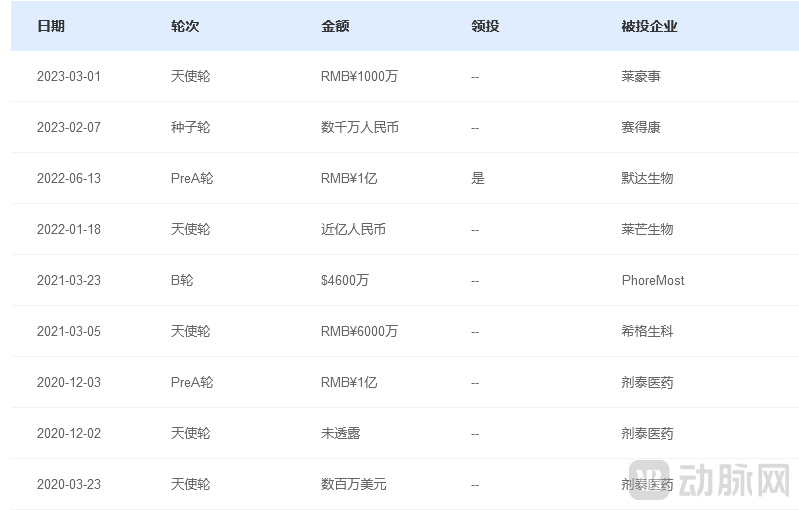
XtalPi Investment Journey (Data Source: VCBeat Database)
Among these investments, XtalPi is particularly keen on internal incubation and collaboration with invested clients to enhance business complementarity. METiS Therapeutics, the first startup internally incubated by XtalPi, has now completed four rounds of financing, with the latest Series A round raising an impressive $86 million.
In terms of customer investment, XtalPi's top five clients over the years have included SigTuple, Metis Medicine, and Moda Bio. SigTuple accounted for 25.2% and 24.0% of XtalPi’s revenue in 2020 and 2021, respectively.
From the performance of the invested projects, XtalPi is obviously a successful investor. Today, both Signet Therapeutics and Metis Pharmaceutical have completed multiple rounds of financing. In particular, Metis Pharmaceutical, whose valuation has now exceeded 1 billion yuan.
In other industries, becoming one of the top global companies usually means leading the trend in the industry. However, across the entire AI pharmaceuticals sector, from technical approaches to business models, no company has yet provided a sufficiently evidence-based answer to guide others forward.
Ultimately, the only way for AI in the life sciences to generate significant revenue is by independently developing or assisting MNCs in obtaining approved drugs for market, but so far, no drug meeting these criteria has advanced beyond clinical Phase II.
However, the value of AI technology for the pharmaceutical industry still needs time to be validated. Although it may not reach the 80%-90% R&D success rate expected by many, if the average success rate of 7.9% (data from BIO, Informa Pharma Intelligence, and QLS reports, research period from 2011 to 2020) can be increased to 10%, it would effectively accelerate the output of new drugs and unleash value sufficient to match the current investment scale.
This is precisely where the value of XtalPi and other AI companies lies. As a listed company, XtalPi may be able to more effectively leverage its technological and financial advantages to lead China's pharmaceutical industry onto the global stage.