Pfizer Halts Development of Oral GLP-1 Agonist Danuglipron Despite Efficacy in Phase 2b Obesity Trial

Pfizer
Pharmaceutical R&D Developer
Recently, Pfizer announced preliminary data from the Phase 2b clinical trial (NCT04707313) of its oral glucagon-like peptide-1 receptor agonist (GLP-1RA) candidate drug Danuglipron. The trial targeted adults with obesity who did not have type 2 diabetes. The study met its primary endpoint, showing a statistically significant change in body weight compared to baseline.
But Pfizer stated externally that it does not plan to advance the Phase III clinical development of Danuglipron.
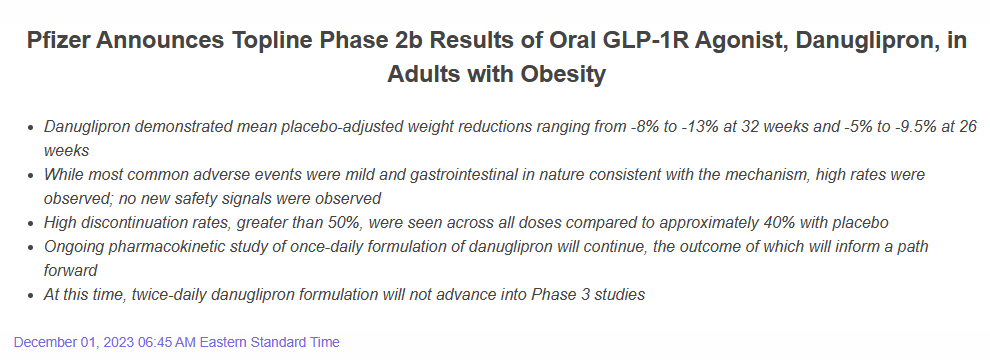
Image Source: Pfizer Official Website
Poor safety data
Danuglipron is an oral GLP-1RA formulation developed by Pfizer and has not yet received any approvals. Danuglipron works by increasing insulin release and reducing glucagon release, maintaining blood glucose at normal levels. Danuglipron also slows the digestion of food and enhances post-meal satiety.
Danuglipron is administered twice daily. Study data show that by Week 32, all doses of Danuglipron resulted in a statistically significant reduction in body weight compared to baseline, with an average decrease of 6.9%-11.7%, compared to only 1.4% for the placebo group. By Week 26, the average weight loss in the Danuglipron group was 4.8%-9.4%, while the placebo group showed a 0.17% decrease.
However, in terms of safety, the results shown by Danuglipron are somewhat concerning. The study results indicate a relatively high incidence of gastrointestinal adverse reactions related to the mechanism of action (nausea: 73%; vomiting: 47%; diarrhea: 25%). The discontinuation rate for all doses was higher than 50%, compared to about 40% for the placebo. No new safety signals were reported, and treatment with Danuglipron was not associated with an increased incidence of elevated liver enzymes compared to the placebo. The data from this study will be presented at future scientific conferences or published in peer-reviewed journals.
Perhaps due to safety considerations, Pfizer decided not to proceed with the Phase III clinical development of Danuglipron.
In response, Mikael Dolsten, Chief Scientific Officer and President of Pfizer's R&D division, stated that Pfizer will improve the dosing frequency of Danuglipron, focusing on the development of a once-daily formulation. Mikael Dolsten noted that the improved once-daily dosing of Danuglipron could play a significant role in the treatment paradigm for obesity. The related study results will provide a basis for potential future developments, thereby improving tolerability and optimizing study design and execution.
It is worth mentioning that the termination of Danuglipron's development plan is not Pfizer's first setback in the GLP-1赛道.
GLP-1 Stumbles Again
The popularity of GLP-1 goes without saying, as it has been highly sought after by pharmaceutical companies worldwide. While the GLP-1 drugs developed by the two giants, Eli Lilly and Novo Nordisk, are leading the market, Pfizer is attempting to enter this field by developing small-molecule GLP-1R drugs.
In addition to Danuglipron, Pfizer has also developed another GLP-1R agonist, Lotiglipron. Lotiglipron is an optimized molecule based on Danuglipron, with a longer half-life, allowing patients to take it orally once a day, whereas Danuglipron requires twice-daily oral administration. Although Danuglipron and Lotiglipron differ in dosing frequency, their ultimate fate is the same.
On June 26, Pfizer announced the termination of Lotiglipon's development.
Lotiglipron (PF-07081532) in Phase 1b Clinical Trials in Patients with Type 2 Diabetes and Obesity Showed That After 6 Weeks of Treatment, Fasting Blood Glucose Levels in Type 2 Diabetes Patients Treated with Lotiglipron Significantly Decreased, Approaching the Threshold of Normal Levels. Meanwhile, Lotiglipron Dose-Dependently Reduced Body Weight in Patients with Type 2 Diabetes and Obesity. After 4-6 Weeks of Treatment, Patients in the Highest Dose Group Experienced an Average Weight Loss of Approximately 10 Catties.
From the research data of the two drugs, both Danuglipron and Lotiglipron have demonstrated promising potential for lowering blood sugar and reducing weight. Given the convenience of Lotiglipron’s once-daily dosing, Pfizer had previously indicated a preference for launching Lotiglipron, all else being equal. However, due to issues such as elevated liver enzymes, Pfizer had to halt the development of this drug and instead focus entirely on advancing the research of Danuglipron.
But Pfizer never expected that Danuglipron, which they had high hopes for, would also meet with misfortune.
Source: Pfizer Official Website

Editorial Responsibility: Pea Shooter
Disclaimer: This article is an integrated content and does not represent the views of this platform. If it involves issues related to the content, copyright, or other problems, please leave a message on this platform, and we will handle it promptly.