

Amgen Announces Positive Phase 2 Results for BiTE Therapy Tarlatamab in Heavily Pretreated Small Cell Lung Cancer

Amgen
Developer of Treatment Drugs for Serious Diseases
Disclaimer: Due to limited expertise, errors are inevitable, and some information may not be the most up-to-date. Comments pointing out any inaccuracies are welcome. This article is solely for the introduction of drugs related to healthcare and is not a recommendation of treatment plans (if involved). This article does not constitute any investment advice.
On November 30, 2023, the New England Journal of Medicine (NEJM) published the results of a pivotal large-scale lung cancer clinical trial, evaluating the BiTE developed by Amgen, Inc.TarlatamabEfficacy in Extremely Malignant Lung Cancer - Small Cell Lung Cancer (NCT05060016).
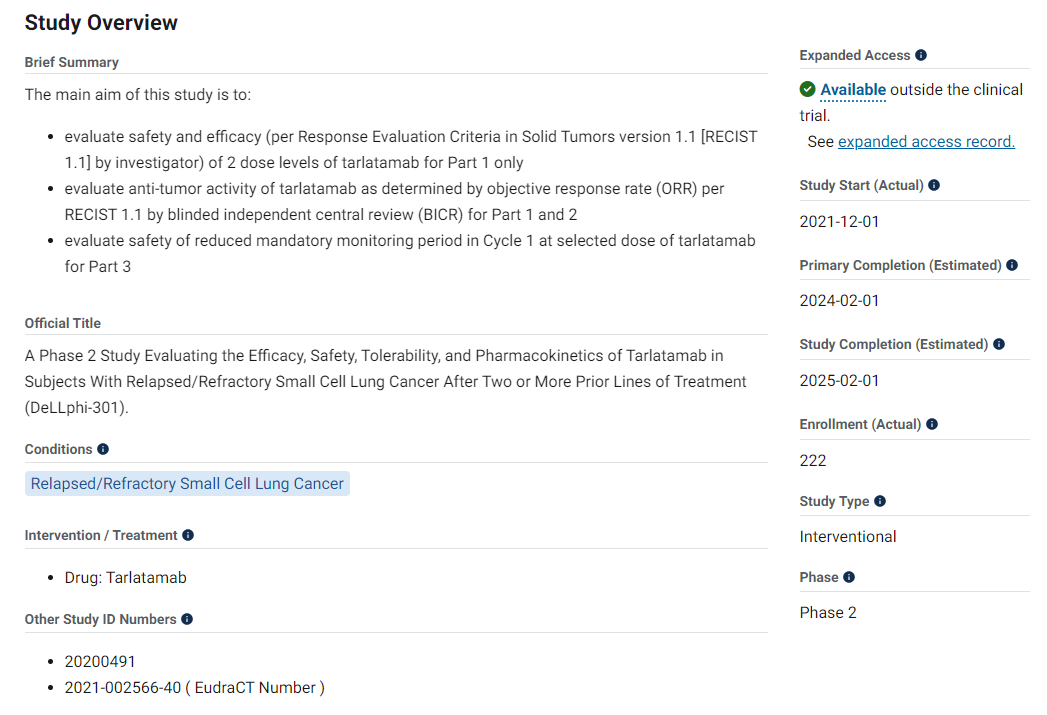
The study objective is to evaluate only 2 dose levels in Part 1.TarlatamabSafety and efficacy (assessed by the investigator according to Response Evaluation Criteria in Solid Tumors version 1.1 [RECIST 1.1],Through blinded independent central review (BICR), objective response rate (ORR) was assessed according to RECIST 1.1 in Part 1 and Part 2.TarlatamabThe anti-tumor activity, finallyEvaluation of Shortening Part 3 Selected in Cycle 1DoseTarlatamabSafety During the Mandatory Monitoring Period.

This study enrolled 220 patients with SCLC who had received at least two prior regimens. They were administered Tarlatamab (aDLL3 x aCD3, DLL3 being a tumor antigen expressed in SCLC and various neuroendocrine tumors) at doses of 10 or 100 mg every two weeks. The two dose groups were followed up for 10.6 months and 10.3 months, respectively, with a final total of 188 patients receiving Tarlatamab.