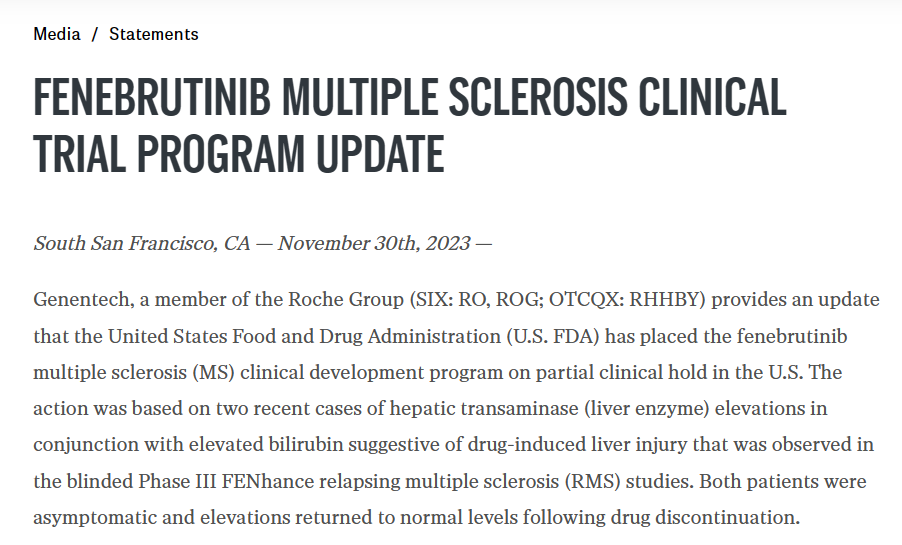
Recently, Genentech, a subsidiary of Roche, announced that the FDA has placed a partial clinical hold on its non-covalent BTK inhibitor fenebrutinib for the clinical development program in multiple sclerosis (MS) in the United States. This action follows the observation of two cases of elevated liver transaminases (liver enzymes) accompanied by increased bilirubin in the Phase III FENhance study for relapsing multiple sclerosis (RMS), indicating a potential risk of liver injury. Both patients were asymptomatic, and their levels returned to normal after discontinuation of the drug.
The new enrollment for the Phase III FENhance I trial for RMS in the United States has been suspended; enrollment continues in countries/regions outside the U.S. The Phase III trials, FENhance II (RMS) and FENtrepid (Primary Progressive Multiple Sclerosis, PPMS), have completed full enrollment.In all studies, U.S. participants who have been receiving the study drug for more than 70 days will continue treatment. A small number of U.S. participants who have been receiving the study drug for 70 days or less will discontinue treatment.In May this year, the Phase II FENopta study of fenebrutinib for the treatment of RMS achieved positive results. The primary endpoint was the number of new gadolinium-enhancing T1 lesions detected by brain magnetic resonance imaging (MRI) at week 12. Secondary endpoints included the number of new or enlarging T2 lesions detected by brain MRI at weeks 4/8/12, the proportion of patients with new T1 lesions or new or enlarging T2 lesions at weeks 4/8/12, etc. (T1 lesions are markers of active inflammation, and T2 lesions represent disease burden or lesion load.)The results showed that, compared with the placebo group, the number of new T1 lesions in the fenebrutinib group was significantly reduced (P=0.0022), and the number of new or enlarging T2 lesions was also significantly reduced. Moreover, the proportion of patients with new T1 lesions or new or enlarging T2 lesions was lower in the fenebrutinib group than in the placebo group.Genentech stated in the press release: "Patient safety is the company's top priority, and we are working closely with the Independent Data Monitoring Committee and researchers worldwide. To date, fenebrutinib has been studied in 2,500 people across Phase I, II, and III clinical programs for various diseases, including MS and other autoimmune conditions. Genentech remains committed to evaluating the potential of fenebrutinib for treating RMS or PPMS patients."Copyright © 2023 PHARMCUBE. All Rights Reserved.
Welcome to forward, share, and reasonably cite. When citing, please clearly indicate the source of the article.For reprint, please leave a message to the WeChat Official Account backend or send a message, and indicate the name and ID of the official account.
Disclaimer: The information in this WeChat article is for general reference only and cannot be directly used as decision-making content. PharmaCube assumes no responsibility for any loss incurred by any party due to the use of the content herein.