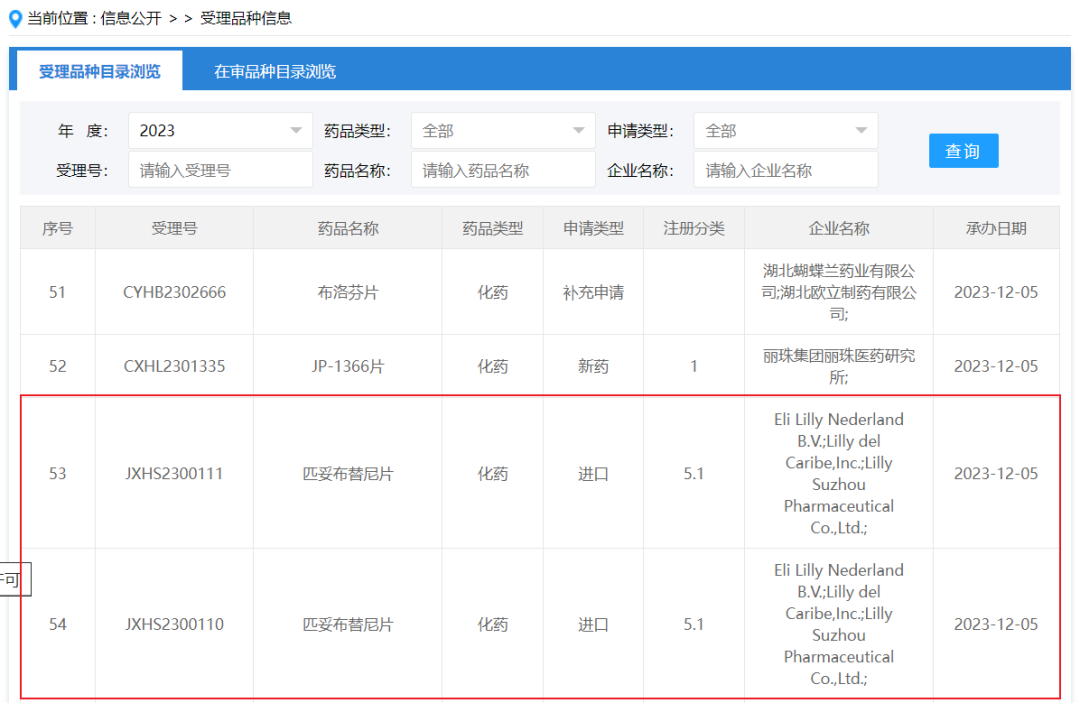
On December 5, the CDE website showed that Eli Lilly's reversible BTK inhibitorPirtobrutinib (pirtobrutinib)Filed for marketing authorization in China, with the indication beingAdult patients with relapsed or refractory mantle cell lymphoma (MCL) who have previously received BTK inhibitor treatment.Pirtobrutinib was originallyPirtobrutinib, an orally available, highly selective and reversible BTK inhibitor developed by Redx Pharma, demonstrates inhibitory effects on both wild-type BTK and the C481S acquired resistance mutation. Therefore, Pirtobrutinib can address the drug resistance issue associated with first-generation irreversible BTK inhibitors.In July 2017, Loxo Oncology acquired Pirtobrutinib, which was then in the preclinical stage, for $40 million. Later, Loxo Oncology was acquired by Eli Lilly for $8 billion, and the product was incorporated into Eli Lilly's R&D pipeline. In March 2022, Innovent Biologics obtained the priority negotiation rights for the commercialization of Pirtobrutinib in China with an upfront payment of $45 million (as well as the exclusive commercialization rights for Ramucirumab and Selpercatinib).In January this year,Pirtobrutinib with I/II phasePositive Results of BRUIN Study Recognized by FDAAccelerated ApprovalLaunched for the treatment ofAdult patients with relapsed or refractory MCL who have previously received at least two lines of systemic treatment (including BTK inhibitors). This product has also becomeThe world's first reversible BTK inhibitor approved by the FDA.InIn the BRUIN study, participants receivedAmong 120 MCL patients treated with Pirtobrutinib (200mg, once daily)HalfAchieved objective response, with 15 cases of complete response.
Recently, Pirtobrutinib once again gained FDA approval based on the results of the chronic lymphocytic leukemia or small lymphocytic lymphoma (CLL/SLL) cohort in the BRUIN study.Accelerated ApprovalExpanded Indications. Among 108 CLL/SLL patients treated with Pirtobrutinib (200mg, once daily), 78 cases (72%) achieved objective response (all partial responses).Currently, Eli Lilly and Company is conducting a global Phase III clinical trial for the MCL population and four global Phase III clinical trials for the CLL/SLL population.- BRUIN-MCL-321 Study (n=500): A comparison study of investigator-selected BTK inhibitors (Ibrutinib/Acalabrutinib/Zanubrutinib) Treatment of previousHave received at leastASystemic TreatmentEfficacy and safety in MCL patients who have not received BTK inhibitor treatment.
- BRUIN-CLL-313 Study (n=250): ComparisonBendamustine Combined with RituximabTreatmentInitial TreatmentEfficacy and safety in patients with CLL/SLL.
- BRUIN-CLL-314 Study (n=650): ComparisonIbrutinibTreatmentFirst-line TreatmentEfficacy and safety in patients with CLL/SLL.
- BRUIN-CLL-321 Study(n=250):ComparisonIdelalisib/Bendamustine Combined with RituximabTreatment HistoryHave received BTK inhibitor treatmentOfEfficacy and safety in patients with CLL/SLL.
- BRUIN-CLL-322 Study (n=600): CombinationVenetoclax and RituximabComparisonVenetoclax in combination with RituximabTreatmentPast HistoryHave received at leastASystemic treatment (with or without BTK inhibitor)Efficacy and safety in patients with CLL/SLL.
BTK has long become one of the highly competitive fields, with 6 BTK inhibitors already approved for marketing globally and another 6 in Phase III clinical trials. Apart from...Apart from Pirtobrutinib,All marketed BTK inhibitors are first-generation BTK inhibitors, which inevitably face the issue of acquired resistance caused by the C481S mutation, significantly diminishing their efficacy.
However, the emergence of acquired resistance has also created new competitive opportunities for later entrants in the BTK inhibitor field, similar to the "four generations coexisting" situation seen in the EGFR inhibitor field. Among the six Phase III BTK inhibitors under development, two target the C481S mutation, respectively.Fenebrutinib (Roche) andNemtabrutinib (MSD). The issue of drug resistance persists, and the protracted market competition battle to overcome it will not cease; more competitors are expected to emerge in the future.In addition to the transformation of binding reversibility, later BTK inhibitors have another path to break through —— differentiation of indications, targeting the market.From Hematological Tumors to Autoimmune DiseasesThe BTK inhibitors from Sanofi, Novartis, and Roche are representative examples.SinoPhilippines Holds Two BTK Inhibitors Targeting the Autoimmune Market:RilzabrutinibAndTolebrutinib. The former first attackImmune thrombocytopenia, the latter strikes multiple sclerosis (MS) and myasthenia gravis. In Novartis's handsRemibrutinib has recently successfully completed two Phase III studies, and the application for the chronic spontaneous urticaria indication will be submitted next year. It is expected to become the first "breakthrough" BTK inhibitor. Roche'sFenebrutinibEli LillyJoined the BTK inhibitor team targeting MS, and although its progress is slightly behind that of Sanofi,AlreadyPioneering the Challenge of Best-Selling Biologics in the MS FieldHead-to-Head Study of Ocrelizumab. Unfortunately,The Phase III clinical trial of Fenebrutinib inRecently, it was partially suspended by the FDA due to the risk of liver damage. If the safety obstacles can be eliminated,,FenebrutinibThe competitive strength cannot be underestimated.Sit back and wait for everyone to show off their "flower moves"~Copyright © 2023 PHARMCUBE. All Rights Reserved.
Welcome to forward, share, and reasonably cite. When citing, please clearly indicate the source of the article in a prominent position;For reprint, please leave a message or send a message to the WeChat Official Account backend, and indicate the name and ID of the official account.
Disclaimer: The information in this WeChat article is for general reference only and should not be directly used as decision-making content. PharmaCube assumes no responsibility for any loss incurred by any party due to the use of the content herein.