Novartis Unveils R&D Strategy Driven by Three Breakthrough Technologies for Future Growth

Novartis
Drug Development and Manufacturing
Today, Novartis introduced its latest R&D strategy and technology platform layout at the company’s annual R&D Day event. Dr. Vas Narasimhan, CEO, noted that the company will focus on four core therapeutic areas and make full use of five technology platforms, with the potential to submit approximately 15 significant regulatory applications between 2024 and 2027. During the R&D Day, Novartis highlighted,Three Breakthrough Technologies Unlock Novartis' Mid-term and Long-term Potential: Radioactive Ligand Therapy for Solid Tumors, CAR-T Therapy for Immune Diseases, and siRNA for Neuroscience and Cardiovascular Diseases.Today, the WuXi AppTec content team will share exciting content from the R&D Day with readers.
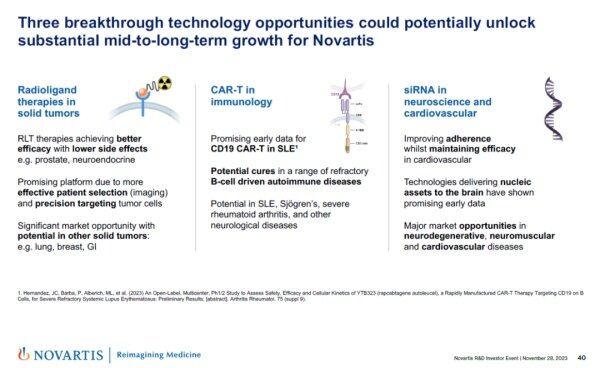
Radioligands are a key platform technology developed by Novartis. They deliver radioactive isotopes to the vicinity of tumor cells, potentially offering benefits in efficacy and safety compared to traditional radiotherapy.. The company's Pluvicto is a radioligand therapy targeting prostate-specific membrane antigen (PSMA), in a Phase 3 clinical trial named PSMAfore,Pluvicto significantly improves radiographic progression-free survival (rPFS) in patients with PSMA-positive metastatic castration-resistant prostate cancer (mCRPC), offering these patients a treatment option that may delay the need for chemotherapy.
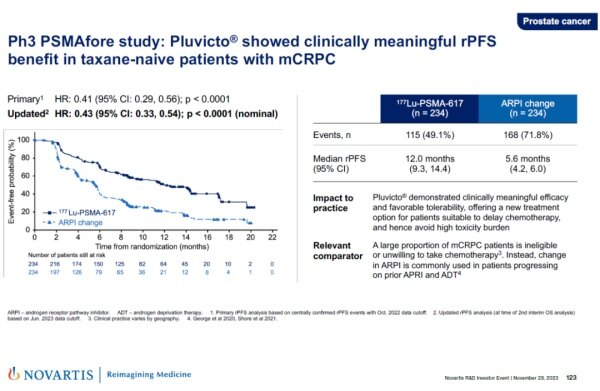
▲Pluvicto'sResults of the PSMAfore Clinical Trial (Source: Novartis Official Website)
In terms of innovation in radioligands, Novartis will further innovate in the components of radioligands, including targets, carriers, linkers, and payloads.
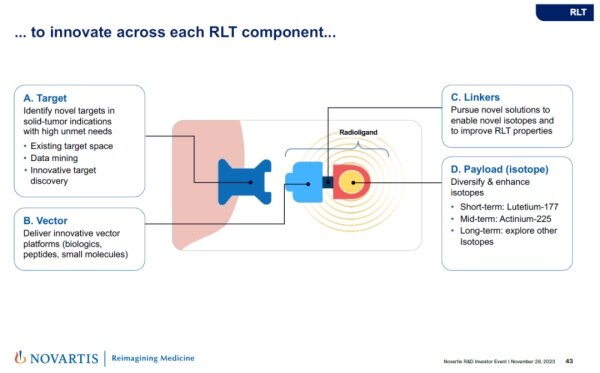
▲ Innovation of Novartis in Radioligand Technology (Image Source:Novartis official website)
In the field of cell therapy,Novartis' T-Charge technology platform is a second-generation rapid CAR-T cell production platform that preserves the stem cell properties of young cells, enhances CAR-T cell expansion in vivo, and reduces production time to within 2 days.
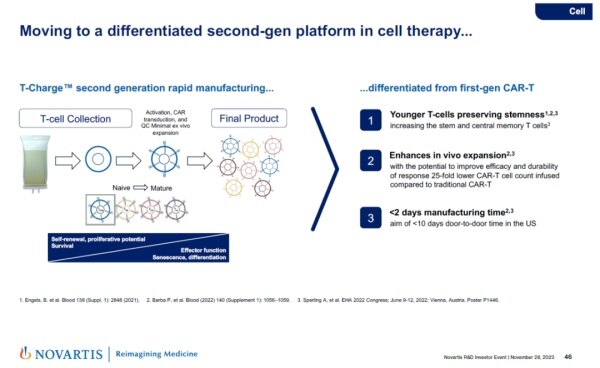
▲Introduction to the T-Charge Cell Production Platform (Image Source:Novartis Official Website)
Cell therapies produced on this platform can not only be used to treat blood cancers but also have the potential to treat immune disorders and neuroscientific diseases.The company's CAR-T therapy YTB323 is one such autologous CAR-T therapy. This CD19-targeted CAR-T therapy has already shown potential in treating severe refractory autoimmune diseases in academic research. Results from the phase 1/2 clinical trial for treating severe refractory systemic lupus erythematosus (SLE) indicate,Patients treated with YTB323 showed a sustained reduction in SLE disease activity indicators., similar to the data obtained in academic research. The company is currently preparing to conduct a Phase 2b/3 clinical trial to treat patients with severe refractory SLE and lupus nephritis.
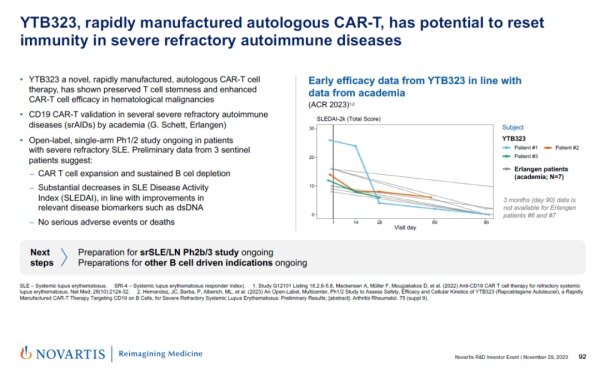
▲Introduction to YTB323 Therapy (Image Source:Novartis Official Website)
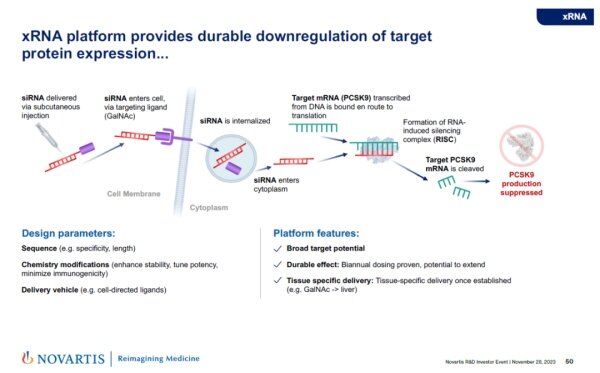
siRNA and antisense oligonucleotide (ASO) therapies have been clinically validated to durably reduce the expression of target proteins.This platform has the potential to target a wide range of targets, and its efficacy is long-lasting, requiring administration only twice a year or less to maintain effectiveness.Novartis' PCSK9-targeted siRNA therapy Leqvio is currently being tested in multiple Phase 3 clinical trials for the prevention of cardiovascular disease.
In addition, pelacarsen, an ASO therapy jointly developed by the company and Ionis, also achieved positive results in the Phase 2b clinical trial.This ASO therapy targeting apo(a) brought Lp(a) levels to guideline-recommended target levels in 98% of cardiovascular disease patients at high doses.
Pelacarsen is currently being evaluated in the Lp(a)HORIZON trial, a global, double-blind, placebo-controlled pivotal Phase 3 trial conducted by Novartis. The study has completed enrollment of participants and data is expected by 2025.
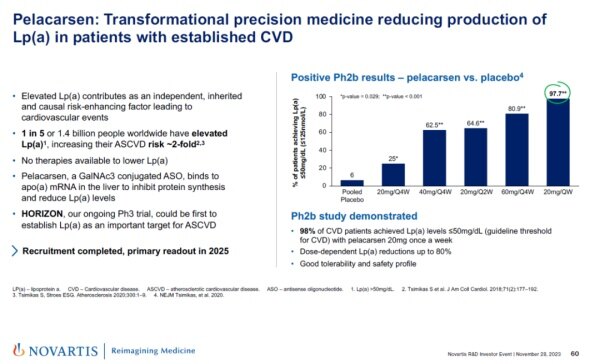
▲Introduction to Pelacarsen (Image Source:Novartis Official Website)
At the R&D day, Novartis executives also introduced several therapies in late-stage development. Among them,Atrasentan is a selective potent ETA receptor inhibitor that reduced proteinuria levels in IgA nephropathy patients by an average of 54.7% in Phase 2 clinical trials.The Phase 3 clinical trial of this therapy also met the primary endpoint,Novartis Expected to Submit New Drug Application in the First Half of 2024。
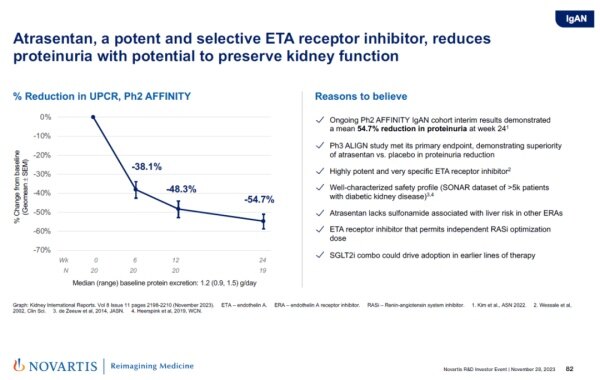
▲Atrasentan significantly reduces proteinuria and has the potential to preserve renal function (Image Source:Novartis official website)
In the field of immunology,Ianalumab is an antibody therapy that blocks the BAFF receptor., while blocking BAFF signal transduction, it can eliminate B cells through enhanced antibody-dependent cellular cytotoxicity (ADCC), with the potential to bring about more sustained disease remission.
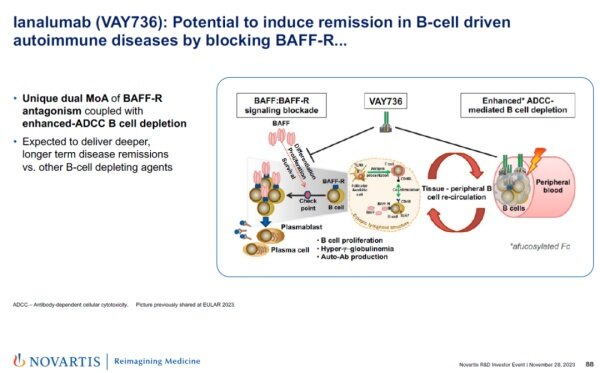
▲Introduction to Ianalumab (Image Source:Novartis official website)
Ianalumab has achieved positive results in Phase 2 clinical trials for the treatment of Sjögren’s syndrome and SLE and is currently being tested in Phase 3 clinical trials.
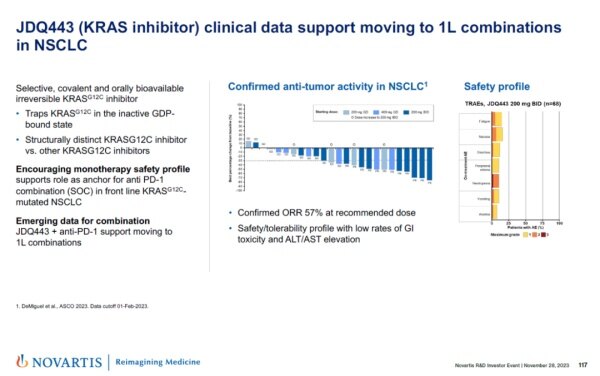
JDQ443 is a KRAS G12C inhibitor with a unique structure. In clinical trials for the treatment of non-small cell lung cancer (NSCLC) patients,The confirmed objective response rate of JDQ443 at the recommended dose was 57%. Safety data support the combination of JDQ443 with anti-PD-1 antibodies for first-line treatment of NSCLC.