On December 5, Bristol-Myers Squibb (BMS) announcedNivolumab (The supplemental Biologics License Application (sBLA) for Opdivo (O-medicine) in combination with cisplatin chemotherapy as a first-line treatment for adult patients with unresectable or metastatic urothelial carcinoma (UC) has been accepted by the FDA for priority review, with a PDUFA date set for April 5, 2024. Previously, Opdivo was approved as a monotherapy for UC patients who experienced disease progression during or after platinum-based chemotherapy and as a monotherapy adjuvant treatment for UC patients at high risk of recurrence.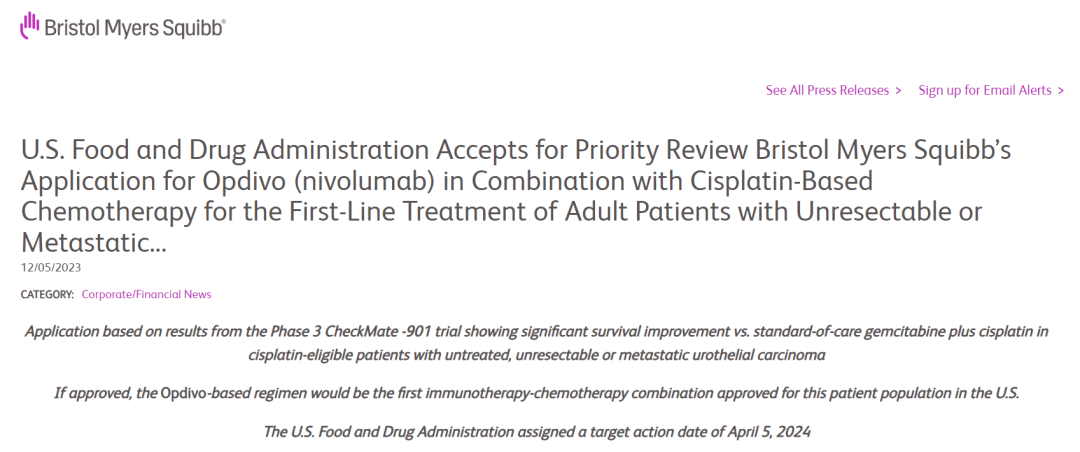 This sBLA is primarily based on the positive results of the Phase III CheckMate-901 study.The studyIs aRandomized, Open-label ClinicalTrial,Included 608 cases that had not been previously treatedIn patients with unresectable or metastatic UC,EvaluatedO Drug+ Ipilimumab (main study) orO Drug+ Chemotherapy (Sub-study) Compare the efficacy and safety of standardized chemotherapy.Main Research SectionThe primary endpoints are overall survival (OS) in cisplatin-ineligible patients and OS in PD-L1 positive (≥1%) patients.InMain Research SectionIn China,O Drug + Ipilimumab vs. ChemotherapyFailed to significantly prolong OS in PD-L1 positive patients.InSub-study SectionIn China,For patients with unresectable or metastatic UC who are eligible for cisplatin chemotherapy, Opdivo + chemotherapy(FirstO-medicine + Chemotherapy, followed by O-medicine alone)Compared with chemotherapy, it can significantly prolong patients' OS and progression-free survival (PFS). In addition, the combination of O drug + chemotherapy for urothelial carcinomaFirst-line Treatment RegimenIt has good safety and tolerability, and no new safety signals were found.UC is the tenth most common cancer worldwide, with more than 573,000 patients diagnosed annually.UCIt usually originates from the cells inside the bladder and accounts for about 90% of bladder cancers. Apart from the bladder,UCIt may also occur in other parts of the urinary tract, including the ureters and renal pelvis. MostUCCan be diagnosed early, but approximately 50% of patients who undergo surgery will experience disease progression and recurrence within 2-3 years after the operation. About 20%-25% ofUCPatients will develop metastatic disease. The therapeutic effect of chemotherapy alone as a first-line treatment is not lasting enough, which is not conducive to the treatment of metastatic UC, and in advanced stages...UCThe patient has limited second-line treatment options.
Copyright © 2023 PHARMCUBE. All Rights Reserved.
Welcome to forward, share, and reasonably cite. When citing, please clearly indicate the source of the article in a prominent position;For reprint, please leave a message to the WeChat Official Account backend or send a message, and indicate the name and ID of the official account.
Disclaimer: The information in this WeChat article is for general reference only and should not be directly used as decision-making content. PharmaCube assumes no responsibility for any loss incurred by any party due to the use of the content herein.