

Qilu Pharmaceutical Presents Phase II Trial Results of Iparomlimab (QL1604) in Advanced dMMR/MSI-H Solid Tumors at ESMO Asia 2023

Qilu Pharmaceutical
Specialty Formulations and Active Pharmaceutical Ingredients (API) Developer
JinanDecember 6, 2023PR Newswire -- December 1-3, at the 2023 European Society for Medical Oncology Asia (ESMO Asia) Congress, Qilu Pharmaceutical presented the latest results of a single-arm, Phase II pivotal clinical study on its Class 1 new drug, Aipalolimab (QL1604), as monotherapy for unresectable or metastatic dMMR/MSI-H solid tumors in the form of a poster. The principal investigators were Professor Wei-Jian Guo from Fudan University Shanghai Cancer Center and Professor Feng Bi from West China Hospital, Sichuan University.
Aipalolizumab is a highly selective humanized monoclonal antibody that binds to PD-1. Study results show that Aipalolizumab monotherapy has demonstrated favorable efficacy in unresectable or metastatic dMMR/MSI-H solid tumors, with an Objective Response Rate (ORR) assessed by the Independent Radiology Review Committee (IRRC) of 45.8% (95% CI, 36.7-55.2) across the entire population, surpassing the pre-specified primary endpoint.
I.Research Background
DNA Mismatch Repair Deficiency (dMMR) or High Microsatellite Instability (MSI-H) is a Unique Phenotype of Solid Tumors[1]During DNA replication, microsatellite sequences are most prone to mismatches, requiring mismatch repair. Deficient mismatch repair (dMMR) can lead to frameshift mutations, causing microsatellite instability (MSI). dMMR/MSI-H solid tumors respond well to immune checkpoint inhibitor therapy. Treatment with programmed death receptor-1 (PD-1) or programmed death ligand-1 (PD-L1) inhibitors for dMMR/MSI-H solid tumors demonstrates a high objective response rate (ORR) and prolonged duration of response.[2-3]。
Phase I Study of Aipalolimumab in Advanced Solid Tumors Demonstrates Good Safety and Antitumor Activity, with an ORR of 20% in All Patients Receiving Aipalolimumab 0.3-3 mg/kg Q3W[4]This pivotal study aims to evaluate the efficacy and safety of Ipilimumab monotherapy in unresectable or metastatic dMMR/MSI-H solid tumors.
2.Research Design and Methods
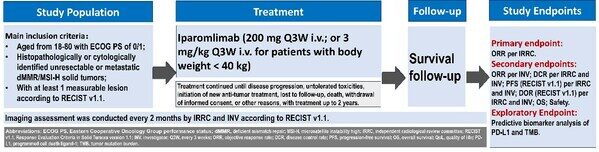
This study is a single-arm, Phase II pivotal clinical trial enrolling patients with unresectable or metastatic dMMR/MSI-H solid tumors confirmed by histopathology or cytology. Patients will receive monotherapy with Aipalolizumab at a fixed dose of 200mg (if the subject's weight is <40kg, the dose will be 3mg/kg), administered intravenously every 3 weeks. Patients will continue to receive Aipalolizumab treatment until disease progression, intolerable toxicity, initiation of new anti-tumor therapy, death, withdrawal of informed consent, or other reasons, with a maximum treatment duration of no more than 2 years. After the end of treatment, patients will undergo survival follow-up. The primary endpoint of the study is the ORR assessed by the IRRC according to the Response Evaluation Criteria in Solid Tumors (RECIST version 1.1). The study design is shown in the figure below.
3.Research Results
From June 2020 to January 2023, the study enrolled a total of 120 patients with dMMR/MSI-H solid tumors, including 80 patients (66.7%) with colorectal cancer, 18 patients (15.0%) with gastric cancer, and 22 patients (18.3%) with other solid tumors; 97.5% of the patients had stage IV disease at enrollment, with a median number of treatment lines being 2.0 (range, 0–6).
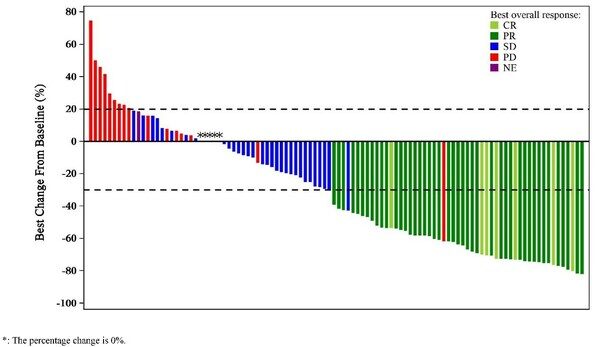
In terms of efficacy, as of July 20, 2023, the median follow-up time was 13.6 months, with 11 patients achieving complete response (CR) and 44 patients achieving partial response (PR). The overall response rate (ORR) was 45.8% (95% CI: 36.7%–55.2%), and the disease control rate (DCR) was 77.5% (95% CI: 69.0%–84.6%). In colorectal cancer patients, the ORR and DCR were 42.5% (95% CI: 31.5%–54.1%) and 77.5% (95% CI: 31.5%–54.1%), respectively. The median duration of response (DoR) has not yet been reached, with 6-month and 12-month DoR rates being 100% and 97.4%, respectively; the median progression-free survival (PFS) and median overall survival (OS) have not been reached. The best changes in target lesions among responding patients are shown in the figure below.
IV.Summary
Epalumab monotherapy shows good efficacy and safety in unresectable or metastatic dMMR/MSI-H solid tumors. The marketing application for Epalumab from Qilu Pharmaceutical Co., Ltd. has been accepted by the CDE this September.
References:
1. Bhamidipati D, Subbiah V. Tumor-agnostic drug development in dMMR/MSI-H solid tumors. Trends Cancer. 2023;9(10):828-839.
2. Le DT, et al. PD-1 Blockade in Tumors with Mismatch-Repair Deficiency. N Engl J Med. 2015;372(26):2509-20.
3. Li J, et al. Subcutaneous envafolimab monotherapy in patients with advanced defective mismatch repair/microsatellite instability high solid tumors. J Hematol Oncol. 2021;14(1):95.
4. Huang Z, et al. A first-in-human, open-label, dose-escalation and dose-expansion phase I study to evaluate the safety, tolerability, pharmacokinetics/pharmacodynamics, and antitumor activity of QL1604, a humanized anti-PD-1 mAb, in patients with advanced or metastatic solid tumors. Front Immunol. 2023;14:1258573.