

AbbVie to Acquire Cerevel Therapeutics for $8.7 Billion, Gaining Late-Stage CNS Pipeline Including Tavapadon and Emraclidine

AbbVie
Innovative Drug Developer

Cerevel
Biopharmaceutical Manufacturer
Pfizer
Pharmaceutical R&D Developer
On December 7, AbbVie announced that it had reached a definitive agreement with Cerevel Therapeutics to acquire all outstanding shares of Cerevel for $45 per share in cash, with a total equity value of approximately $8.7 billion. The acquisition includes Cerevel's neuroscience pipeline system, comprising multiple clinical-stage and preclinical candidate products with potential treatments for schizophrenia, Parkinson’s disease, and mood disorders.
According to Cerevel's announced third-quarter results, a follow-on public offering of common stock was completed in October, raising approximately $498.7 million in net proceeds.Its cash, cash equivalents, and marketable securities are expected to support all planned data reads in 2024 and fund operations through 2026.
At the time of the earnings release, Cerevel was scheduled to hold an investor webcast four days later (December 11), focusing on its late-stage pipeline candidate Tavapadon (for Parkinson's disease). Today’s announcement mentioned that due to the transaction not being finalized, Cerevel will no longer host the previously arranged investor live stream discussion. Instead, AbbVie will hold an investor conference call at 8:00 AM EST today (December 7).
Is the speed of this transaction process really because AbbVie offered too much?
On August 2, Cerevel announced its second-quarter financial results and business updates. On the same day, stock research platform The Motley Fool reported that after Cerevel announced its second-quarter earnings, the company's stock price fell more than 14%. Year to date, the company’s stock price has fallen more than 17%.
Like most Biotechs, Cerevel reported a loss per share (EPS) of $0.63 in the second quarter, compared to a loss per share of $0.61 in the same period last year, with no revenue reported. In contrast, Cerevel has strong financial backing, with $825.1 million in cash on hand, sufficient to support operations until 2025.
The issue is that Cerevel's two Phase 2 clinical trials for the treatment of schizophrenia have been delayed.Cerevel stated that this was due to slower-than-expected enrollment in the U.S. and delays at some clinical trial sites. Data from both trials are expected to be read out in the second half of 2024.
This is not the first time Cerevel has been plagued by trial delays.According to Seeking Alpha, Cerevel promised multiple data readouts in 2022 and 2023, but this announcement has been postponed again, now delayed until the second half of 2024.For a pharmaceutical company positioning itself as "changing the possibilities of neuroscience" and "the leading neuroscience company," aiming to deliver groundbreaking drugs, repeated delays in clinical trials and data readouts could not only erode investor confidence but also mean falling behind in the race for CNS-targeted therapies.
Seeking Alpha also noted that Cerevel's valuation fell by approximately $350 million within nine months (from July 2022 to March 2023). The analysis suggested that the reason for the valuation not plummeting further is that the majority of Cerevel's equity is held by Pfizer and Bain Capital.According to Cerevel's 2022 annual report, Pfizer and Bain Capital then owned more than 56% of the common stock.
Back to the establishment of Cerevel in 2018, Pfizer decided to cut back on neuroscience research and spin off a set of neuroscience assets. The announcement noted that Pfizer would provide a series of compounds at different clinical research stages and several compounds at the preclinical development stage, covering treatment areas including Parkinson's disease, Alzheimer's disease, epilepsy, schizophrenia, and addiction disorders. Bain Capital Private Equity and Bain Capital Life Sciences invested $350 million and are also able to provide additional capital if needed.
At its inception, Pfizer retained a 25% stake in Cerevel, with two executives, Dr. Morris Birnbaum (Senior Vice President and Chief Scientific Officer of Internal Medicine) and Doug Giordano (Senior Vice President of Global Business Development), serving on the Cerevel board.
In July 2020, Cerevel was listed on Nasdaq due to its merger with Arya Sciences Acquisition Corp II, a special purpose acquisition company (SPAC). A SPAC is essentially a shell company or a blank-check company, established for the purpose of merging with one or more businesses through mergers, share exchanges, asset acquisitions, share purchases, reorganizations, or similar business combinations.
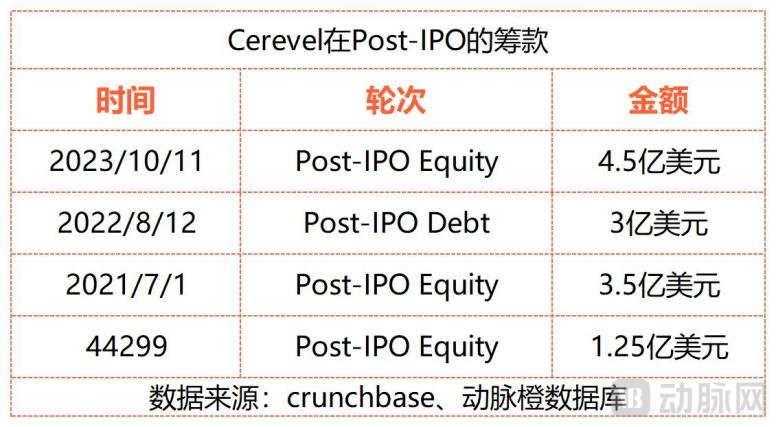
However, with several strong pipelines from Pfizer's spin-off, one of Cerevel's major advantages lies in its sufficient funding chain and robust cash flow. Cerevel raised $445 million through its merger and IPO, becoming one of the top ten public transactions in the biotechnology industry that year. After the IPO, Cerevel conducted four rounds of fundraising through additional share issuance or other forms, totaling approximately $1.225 billion. On the expenditure side, as clinical trials for various pipelines progress, R&D spending has also been gradually increasing.
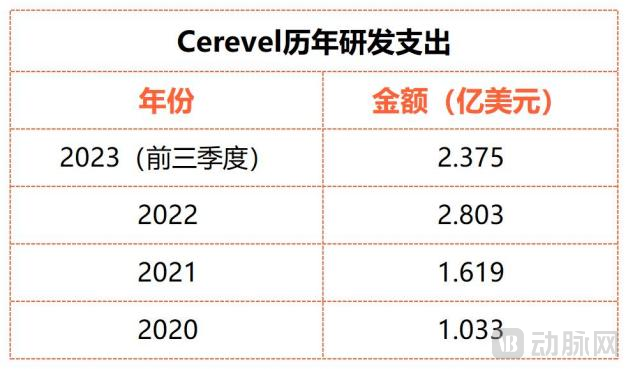
Data source: Cerevel Annual Performance Reports
The turning point occurred in May this year, when Cerevel appointed its current President and CEO, Ron Renaud. Prior to taking on this role, Renaud had served as a Bain Capital Life Sciences partner for less than a year. With years of experience in leading company operations and mergers and acquisitions, Renaud has overseen deals including the $3.85 billion acquisition of Idenix by Merck and the $3.2 billion acquisition of Translate Bio by Sanofi.
Within a month, Cerevel successively announced the appointments of a new Chief Financial Officer and a new Chief Business Development and Strategic Operations Officer. Less than half a year after Renaud took office, Cerevel secured this $8.7 billion acquisition.
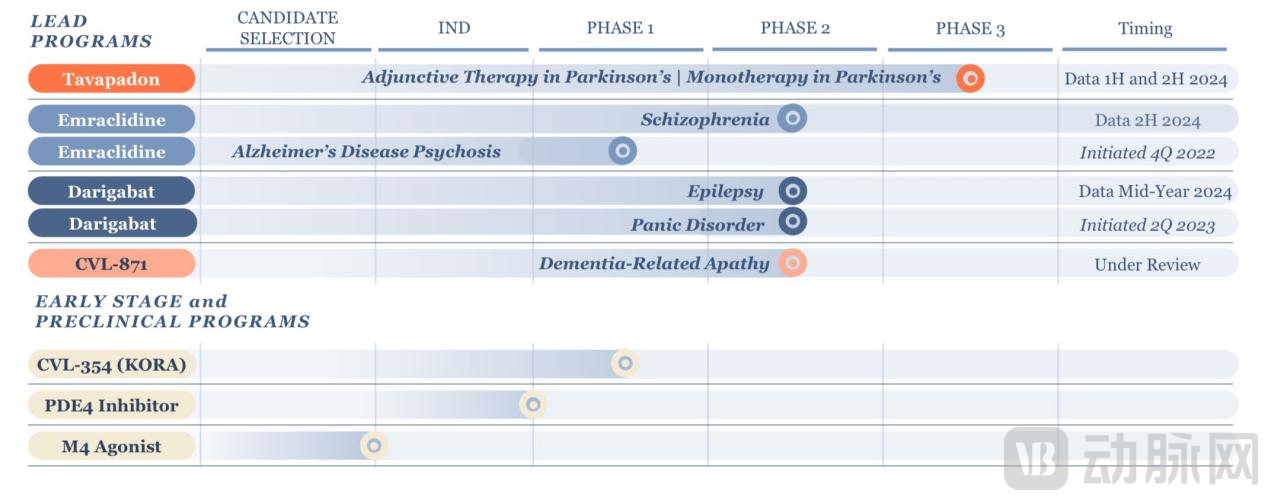
Source: Cerevel 2023 Q3 Earnings Report
Cerevel's main late-stage asset, Emraclidine, is a highly selective muscarinic m4 positive allosteric modulator (PAM), considered a potential Best-in-class drug and next-generation antipsychotic that may be effective in treating patients with schizophrenia.
In the Phase 1b clinical study, Emraclidine demonstrated promising efficacy and safety in the treatment of schizophrenia, supporting once-daily oral administration without the need for dose titration. Two EMPOWER trials are currently being completed. Additionally, Emraclidine has shown potential efficacy in Alzheimer's disease, Parkinson's disease, and dementia-related psychosis. A multiple ascending dose study in elderly healthy volunteers has been initiated to evaluate safety, tolerability, and pharmacokinetics.
Tavapadon is a partial agonist of the dopamine D1/D5 receptor and has the potential to become a First-in-class drug for the treatment of Parkinson's disease. It is currently in Phase 3 clinical trials. Ongoing trials include monotherapy (early-stage) for Parkinson's disease, adjunctive therapy (late-stage) trials, and corresponding open-label extension studies.Tavapadon’s efficacy and safety/tolerability profile may allow it to play a role in early Parkinson’s disease, serving as a complementary asset to AbbVie’s existing symptomatic treatments for advanced Parkinson’s disease.
Darigabat is a selective α2/3/5 GABAA receptor positive allosteric modulator being developed for the treatment of refractory epilepsy and panic disorder, currently in Phase II clinical trials. CVL-871 is a dopamine D1/D5 receptor partial agonist intended for the treatment of dementia-related apathy and is currently undergoing a Phase 2a exploratory trial for dementia-related apathy. CVL-354 is a potential Best-in-class kappa opioid receptor (KOR) antagonist currently in Phase I clinical trials. Compared with existing therapies for major depressive disorder (MDD), CVL-354 has the potential to significantly improve efficacy and tolerability.
In this announcement, Richard A. Gonzalez, Chairman and Chief Executive Officer of AbbVie, stated: "Our existing neuroscience portfolio, along with the joint pipeline with Cerevel, represents a significant growth opportunity for the next decade.AbbVie will leverage its deep commercial capabilities, international infrastructure, and regulatory and clinical expertise to bring significant shareholder value and multi-billion-dollar sales potential to Cerevel's portfolio of assets."
Neuroscience is one of the key disease areas that AbbVie focuses on, with migraine being the most prioritized subfield within AbbVie's neuroscience portfolio, including Ubrelvy for acute treatment and Qulipta for migraine prevention. This acquisition will bring multiple pipeline assets with strong clinical potential to AbbVie in one go.
However, the immediate issue is how AbbVie will accelerate Cerevel's existing clinical pipeline after completing the acquisition to ensure it stays on track for 2024, otherwise it risks losing the race in CNS drug development.
References:
https://seekingalpha.com/article/4586627-cerevel-therapeutics-cns-specialist-delayed-readouts-potential-red-flag
https://www.fool.com/investing/2023/08/02/why-shares-of-cerevel-therapeutics-are-dropping-we/
https://www.biopharmadive.com/news/cerevel-spac-perceptive-public-neuro-drug/582602/