Medtronic Terminates $738 Million Acquisition of EOFlow Amid Breach Allegations and Patent Disputes

Medtronic
Medical Device Manufacturer

Pioneer in Medical Device Media Reports
Share Professional Medical Device Knowledge
Source:Instrument Family,Reproduction without authorization is prohibited, and reproduction is allowed 24 hours later.
Recently, Medtronic, the leading medical device company, announced,Termination of the $738 million (approximately 5.28 billion RMB) acquisition deal for wearable insulin patch manufacturer EOFlow.The company revealed in a filing with the U.S. Securities and Exchange Commission that the cancellation of the transaction was due toEOFlow has committed multiple breaches of contract., but the specific details of the breach were not disclosed.
It was reported that the deal had been rumored by the media three months ago, and in May, both parties officially announced the signing of the final agreement. According to the agreement, Medtronic will pay per share24,359 KRWat the price to purchase new shares, in order to meet EOFlow's ongoing operations and R&D needs.In addition, Medtronic will also conduct a public tender offer toKRW 30,000 per shareThe price to acquire all outstanding public sharesShares.
In the case of all public share participation in the tender offer, the total consideration for the acquisition of EOFlow shares is 971 billion Korean won, equivalent to 738 million US dollars at the current exchange rate.
However, EOFlow has been plagued by lawsuits since its establishment in 2011. This year, Insulet, the leader in continuous glucose monitoring, accused it of using technology derived fromStolen Trade Secrets。Although Medtronic was not involved in the lawsuit, it has been closely following the progress of the case.
In October,A U.S. district court has issued an injunction against EOFLow, prohibiting it from manufacturing or selling any products developed based on Insulet technology.However, at that time, Medtronic still proceeded with this transaction.
According to the plan, Medtronic intends toComplete the acquisition of EOFlow by the end of this year to enter the patch pump market. After the termination of this transaction, the company may need to reassess its strategy for entering this field.
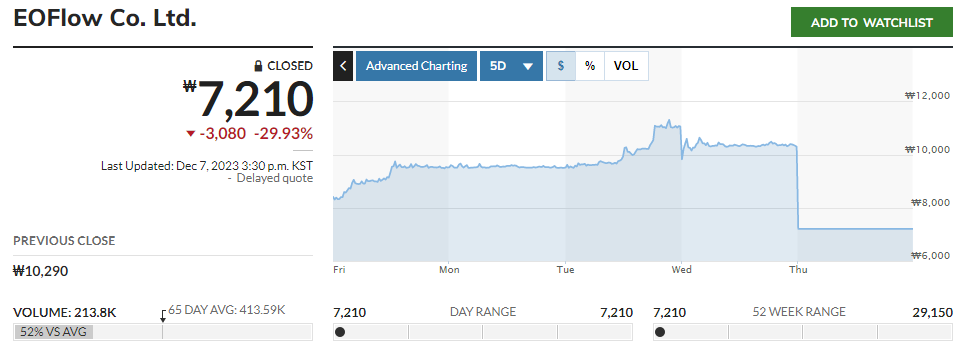
Affected by the news,EOFlow (KOSDAQ: 294090) plunged to its lowest price this year at the opening, hitting a limit down at 7,210 KRW per share, marking a 29.93% decline from yesterday's closing price.The total market value is 219.3 billion Korean won (approximately 1.18 billion Chinese yuan), while at the beginning of March when the acquisition news just broke, the company's market value was 683.1 billion Korean won (approximately 3.69 billion Chinese yuan).
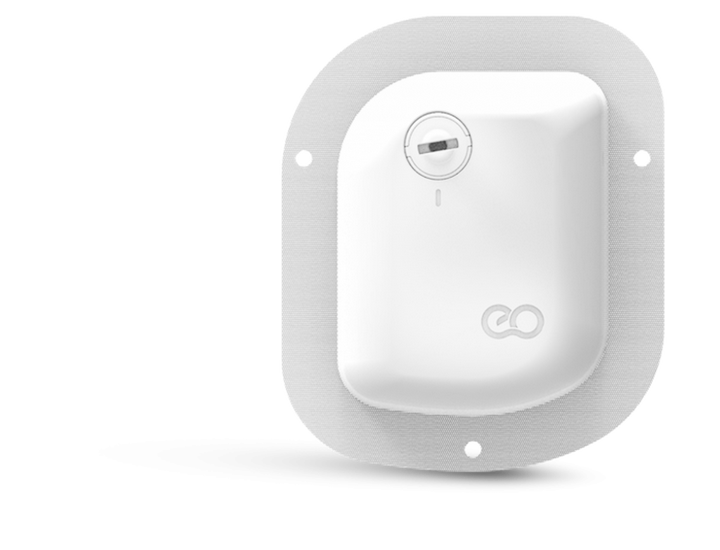
Data shows that EOFlow is a medical device company in South Korea specializing in the research, development, and manufacturing of insulin pumps. The company has developed a tubeless, wearable, and fully disposable insulin delivery device.“EOPatch”. This device is a patch pump designed to provide a more convenient and off-body insulin delivery method for diabetic patients.
According to the promotional materials,EOPatch is the world's second tubeless, disposable patch insulin pump, with the first being the OmniPod developed by Insulet Corporation.As of now, the aforementioned two are the only ones in the world.A tubeless, disposable patch-style insulin pump.However, it is "if and only if"These two companies fought each other this year.
Patent War Breaks Out
2023On August 3, Insulet filed a lawsuit accusing EOFlow's EOPatch of infringing on the patents of its OmniPod product.It is speculated that their former executive (now employed by EOFlow) may have leaked confidential information.
Insulet stated that EOFlow had spent the first five years developing an insulin patch pump with a unique design and internal pumping technology, but without any particularly valuable progress.So around 2016, EOFlow began to shift its plans, replicating Insulet's Omnipod system.
EOFlow also hired former senior executives and some core employees from Insulet Corporation, and signed an agreement with Flex.Among them, Flex is the "original equipment manufacturer (OEM)" for Insulet. Through the manufacturing agreement signed with Insulet, Flex has mastered every detail of Insulet's proprietary and confidential manufacturing processes.

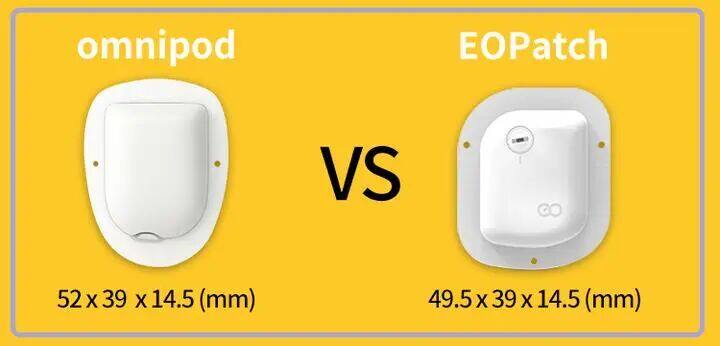
In 2018, EOFlow launched the EOPatch device. According to the lawsuit filed by Insulet,EOPatch bears a "striking resemblance" to the Omnipod pump in both appearance and internal components, to the extent that many parts of the two products are entirely interchangeable when examining their internal composition.
Therefore, shortly after EOFlow submitted the EOPatch device to the FDA for 510(k) clearance, Insulet accused the EOPatch device of being based on"Large-scale plagiarism of Insulet's intellectual property""On the basis of. 'This only requires proving that a new device is substantially equivalent to another device already approved by the agency.'"

EOFlow Obtains Preliminary Injunction
On October 6, the U.S. District Court for the District of Massachusetts issued a preliminary injunction against EOFlow.Prohibiting it from manufacturing or selling any products developed based on Insulet technology.The order will remain in effect until the trial of the case is completed.
Regarding this ruling, EOFlow responded: "Although we believe there has been no infringement of trade secrets, the preliminary injunction submitted by Insulet has been granted. To minimize future legal risks from litigation, we have decidedSuspend the production, sales, or distribution of the EOPatch product."Until we completely resolve this issue."
ThisA decision not only temporarily halted EOFlow's EOPatch expansion plans in the United StatesThe production halt will also cause it to lose approximately 2.6 billion Korean won (equivalent to 1.94 million US dollars), accounting for 39.86% of its sales revenue in 2022.

So, how similar are these two patch pumps from Insulet and EOFlow? You can observe for yourself.
It is reported that as early as 2003, Insulet received the first 510(k) clearance from the FDA for the OmniPod system.The commercial version of the OmniPod system was approved by the FDA in 2005.The product mainly consists of two parts: the infusion pump (Pod) and the controller (PDM).It is the world's first commercially available "patch pump," and its key difference from other traditional pumps lies in its tubeless design. It is a fully integrated wearable pump, wirelessly controlled by a handheld device with a built-in blood glucose meter.
In 2018, the FDA also approved the second-generation insulin pump system Omnipod DASH from Insulet Corporation for marketing.
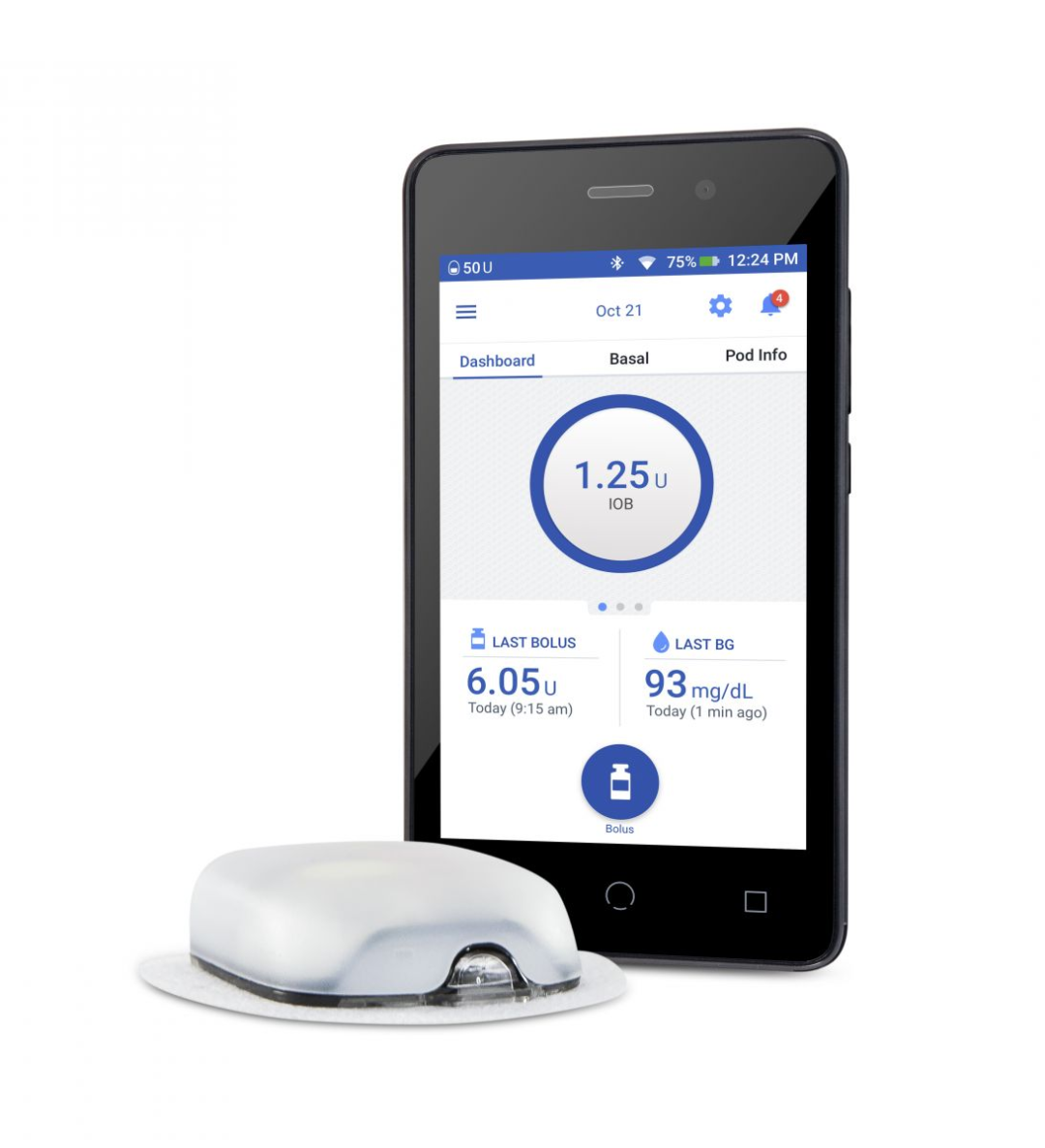
February 2020On the 19th, Insulet announced a partnership with CGM giants Abbott and DexCom, which has led to the creation of Insulet's latest generation insulin pump product—the Omnipod 5.This product is currently the world's only tubeless automated insulin delivery (AID) system, integrating the Omnipod patch pump with the Dexcom G6 continuous glucose monitor.
EOPatch
EOFLOW's disposable patch insulin pump EOPatch completed its prototype in 2015.Completed animal experiments in 2018, obtained the CE mark and South Korean medical device certification in 2020, and began mass sales in South Korea in April 2021. It is the world's second tubeless, disposable patch-style insulin pump.
EOPatch is designed to be discreet and easy to use, with a slim profile and a fully disposable patch that can be worn on various parts of the body. Additionally, the device is able to determine infusion dosing based on the user's current blood glucose level, the amount of insulin already present in the body, and carbohydrate intake.

In addition to EOPatch, EOFlow is also developing the artificial pancreas system EOPatch X.This system is similar to Insulet's Omnipod 5 and uses the Dexcom G6 continuous glucose monitoring system.
Insulet once stated in the litigation: "Once EOFlow discloses Insulet's trade secrets to Medtronic, a competitor with unlimited resources, through the acquisition,This will cause direct and irreparable harm to Insulet and even deprive Insulet's trade secrets of all their value.”
In fact,Previously, the overseas automated insulin delivery (AID) market had always been a three-way split.The emergence of insulin pumps supported by Continuous Glucose Monitoring (CGM) and the invention of automatic pump suspension technology at low blood glucose thresholds have made insulin pumps work more intelligently, marking an important step towards a closed-loop system.
Among them, Insulet and Tandem have both chosen to collaborate with CGM companies; whereas Medtronic has long achieved independent R&D of CGM and, in conjunction with insulin pumps, created a market sensation upon their release.MiniMed was its first CGM product, which received FDA approval for market release as early as 1999 and has been continuously updated and improved in the years since.
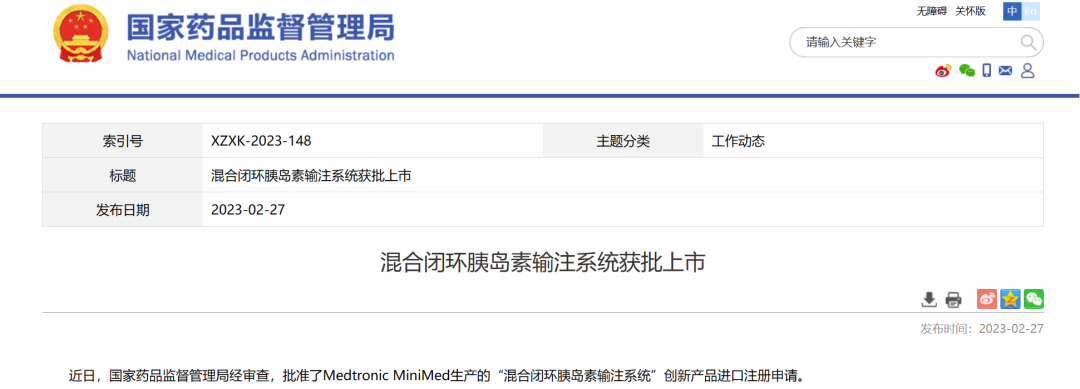
InRecently,Its "Hybrid Closed-Loop Insulin Delivery System" has received approval from the National Medical Products Administration for the import registration of innovative products.
Medtronic, as an all-around player with both CGM and insulin pump product lines, has consistently dominated the market with its first-mover advantage.Highlands. From the financial report,Medtronic's Revenue in the Second Quarter of Fiscal Year 2024 Reached Approximately $8 Billion (RMB 56.8 Billion), a Year-on-Year Increase of 5.3%; Diabetes Revenue was $610 Million, a Year-on-Year Increase of 9.7%.
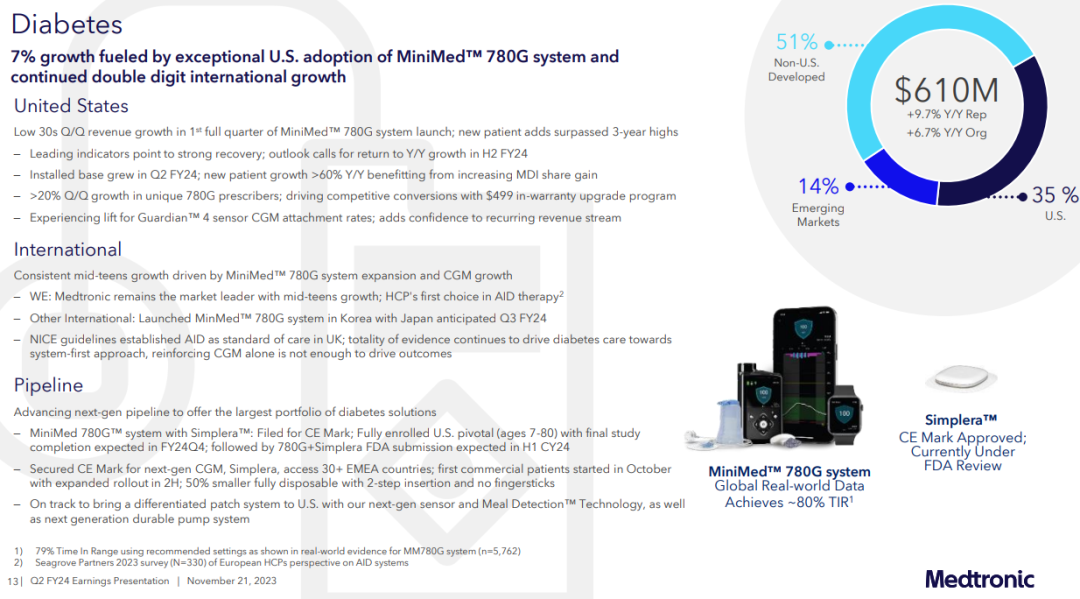
However, the market for tubed insulin pumps is being slowly eroded by the ease of use of patch pumps.As for Insulet has officially taken control of this "pure land," establishing its reign.If Medtronic canEnough to complete the task.EOFlOW's Acquisition, plusIts OwnDietary detection technology algorithm and next-generation continuous glucose monitor (CGM), perhapsThe Entire Diabetes MarketThe pattern will be rewritten.
However, Medtronic stated in its announcement,The company remains firmly committed to launching a differentiated patch pump that integrates its most advanced continuous glucose monitoring (CGM) platform and clinically validated meal detection technology algorithm into the market.
It can be seen that Medtronic forThe tubeless closed-loop artificial pancreas is imperative. ThenHow will Medtronic plan its first step to "break into" the market in the future?? Instrument Family will continue to follow up.
More exciting content
Welcome to follow WeChat Video Channel


The Wall Street Journal: Who Will Be Johnson & Johnson's Next CEO?
Market Value of 6.2 Billion, Listed Medical Device Company Plans to Invest 4 Billion in Financial Products
United Imaging Healthcare, Good News! Effective December 8
Over 1 Billion: Another Major Bet on "Da Vinci"
Johnson & Johnson, NVIDIA, and the Father of Surgical Robots Target “Da Vinci”
TIME: The Best Medical Device Inventions of 2023
Innovative Device Unicorn Files for Bankruptcy Reorganization
Bayer Strengthens Its Position in This Medical Device Field
First Batch of China-Made, GE Healthcare's Heavyweight Product Rolls Off the Line
Pointing to China, FDA Announces "Withdrawal"


BusinessBusiness cooperation email: qxzj@landianyiliao.com