

Qilu Pharmaceutical Presents Phase I Clinical Results of Novel Bispecific Antibody QLS31905 at ESMO Immuno-Oncology Congress

Qilu Pharmaceutical
Specialty Formulations and Active Pharmaceutical Ingredients (API) Developer
JinanDecember 8, 2023PR Newswire -- December 6-8, the European Society for Medical Oncology Immuno-Oncology (ESMO Immuno-Oncology) conference was held in Geneva, Switzerland. Qilu Pharmaceutical presented the latest Phase I clinical trial results of QLS31905 in patients with advanced solid tumors in a poster presentation (Poster Number: 132P). The principal investigator was Professor Lin Shen from Peking University Cancer Hospital.
QLS31905 is a bispecific T cell engager (BiTE) targeting Claudin18.2 independently developed by Qilu Pharmaceutical. The main purpose of this study is to explore the safety, tolerability, and preliminary anti-tumor activity of QLS31905 in patients with advanced solid tumors.
Research Background and Design:
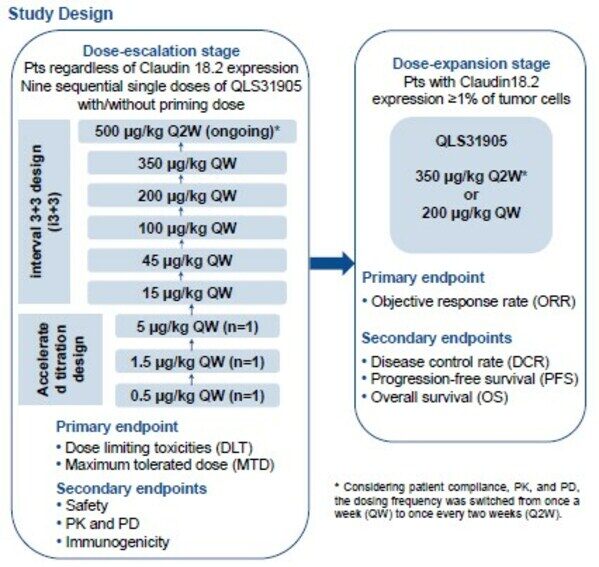
Claudin18.2 is a highly specific cell surface molecule, and its abnormal activation and expression are commonly found in primary gastric cancer as well as solid tumors such as pancreatic cancer and esophageal cancer.[1],[2]QLS31905 binds to Claudin18.2 on the surface of tumor cells and CD3 on the surface of T cells, recruiting and activating T cells near tumor cells to continuously kill and lyse tumor cells. This study enrolls patients with advanced solid tumors who have failed standard treatment, are not suitable for standard treatment, or have no standard treatment available. The study is divided into two phases: dose escalation and dose expansion. The dose escalation phase adopts an accelerated titration and i3+3 study design, with QLS31905 administered at escalating single doses of 0.5 μg/kg QW, 1.5 μg/kg QW, 5 μg/kg QW, 15 μg/kg QW, 45 μg/kg QW, 100 μg/kg QW, 200 μg/kg QW, 350 μg/kg QW, and 500 μg/kg Q2W. The primary endpoints are dose-limiting toxicity (DLT) and maximum tolerated dose (MTD), while secondary endpoints include safety, pharmacokinetics, pharmacodynamics, and immunogenicity. The primary endpoint of the dose expansion phase is objective response rate (ORR), and the secondary endpoints are disease control rate (DCR), progression-free survival (PFS), and overall survival (OS).
Research Results:
As of July 17, 2023, a total of 52 subjects have been enrolled, including 31 patients with gastric cancer and 12 patients with pancreatic cancer. In the dose escalation phase, a total of 22 subjects were escalated from the 0.5 μg/kg QW cohort to the 350 μg/kg QW cohort, and the 500 μg/kg Q2W dose level is currently ongoing. The dose expansion phase adopted two dose levels: 200 μg/kg QW and 350 μg/kg Q2W, enrolling a total of 30 subjects.
In terms of safety, no DLT occurred, and the MTD has not been determined. A total of 21 subjects (40.4%) experienced treatment-related adverse events (TRAE) of grade 3 or higher. Treatment-related serious adverse events occurred in 10 subjects (19.2%). Two subjects (3.8%) experienced TRAE leading to treatment discontinuation. The most common TRAEs were fever (30 subjects, 57.7%), nausea (26 subjects, 50.0%), and decreased white blood cell count (18 subjects, 34.6%). Two patients in the 350 μg/kg QW cohort experienced cytokine release syndrome of grade 3 or higher.

In terms of efficacy, among the 27 evaluable subjects, the ORR was 11.1% and the DCR was 63.0%. Of the three patients who achieved partial response (PR), two had pancreatic cancer and one had gallbladder cancer, all with medium/high expression of Claudin18.2. Among the 14 patients with stable disease (SD), eight had a reduction in target lesions, seven of whom had medium/high expression of Claudin18.2.
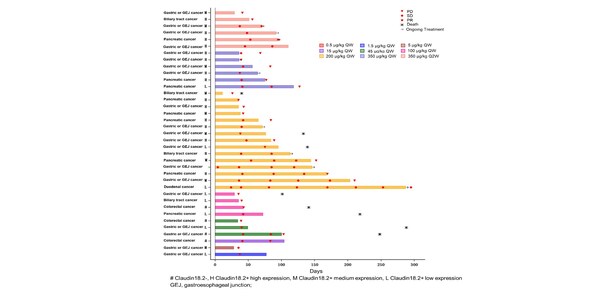
In summary, QLS31905 has demonstrated good safety, tolerability, and preliminary anti-tumor activity in patients with advanced solid tumors. The phase II clinical trial of QLS31905 is currently underway.
[References]
1. Sahin U, et al. Clin Cancer Res. 2008;14(23):7624-34.
2. Singh P, et al. J Hematol Oncol. 2017;10(1):105.