Is It Worth It? Johnson & Johnson Bets Hundreds of Millions on AI, Hiring 6,000 Data Scientists

Johnson & Johnson
Healthcare Product Manufacturers, Health Service Providers


Johnson & Johnson is leveraging data science and artificial intelligence to support its work, which is one of the biggest bets in the healthcare industry.
The Wall Street Journal reported that in recent years, Johnson & Johnson has invested hundreds of millions of dollars in its artificial intelligence (AI) capabilities, including hiring approximately 6,000 data science and digital experts.
For this 137-year-old pharmaceutical and device company, building AI capabilities is crucial amidst progress and transformation.
But is this investment worth it?
 Increase Investment in Data Science
Johnson & Johnson currentlyWith over 130,000 employees and global annual sales reaching $80 billion, the company has had data-based projects for many years. However, the company's leadership began adopting a more coordinated approach about a decade ago and increased investment approximately four years ago.
In recent years, Johnson & Johnson has hired as many as 6,000 data scientists and digital experts, spending hundreds of millions of dollars on their work, such as using machines to search large health record datasets.
Last September, the company opened a state-of-the-art research center near San Francisco, with a nearly 200,000-square-foot facility capable of accommodating up to 400 employees, focusing on utilizing gene and RNA therapies, as well as advanced data science, including artificial intelligence and machine learning.
These data scientists have put a lot of effort into medical diagnostics, such as algorithms that detect life-threatening hypertension earlier than humans by analyzing heart tests, and speech recognition technologies that identify early signs of Alzheimer's disease by analyzing speech.
However, Johnson & Johnson's hiring of so many data scientists has a long-term goal:Utilizing Artificial Intelligence for Drug Discovery.
AI for drug discovery has been the subject of much hype, with large sums flowing into the field but with few concrete examples demonstrating that AI can make a significant contribution to drug development.
Although they have entered clinical trials, the vast majority of AI-empowered drugs in the hands of biotech companies are still in the early stages of clinical testing, with few advancing to Phase III clinical trials.
Google has launched cloud-based artificial intelligence tools this year to help pharmaceutical manufacturers find new treatments. However, it may take several more years for drugs discovered by artificial intelligence to gain regulatory approval for sale.
Thus, some pharmaceutical industry leaders are skeptical about whether artificial intelligence can discover new drugs better than humans.
Johnson & Johnson stated,The company has a large database named Med, containing over 3 PB of information.. This information includes not only real-world data but also a variety of clinical trial results.Artificial intelligence can screen these data on a large scale, helping to accelerate drug development.
Analysts believe that Johnson & Johnson is one of the most active large pharmaceutical companies committed to artificial intelligence.
CB Insights recently ranked it third among 50 companies in its Pharma AI Readiness Index, which tracks patent applications, investments, deals, and AI-related efforts of companies.
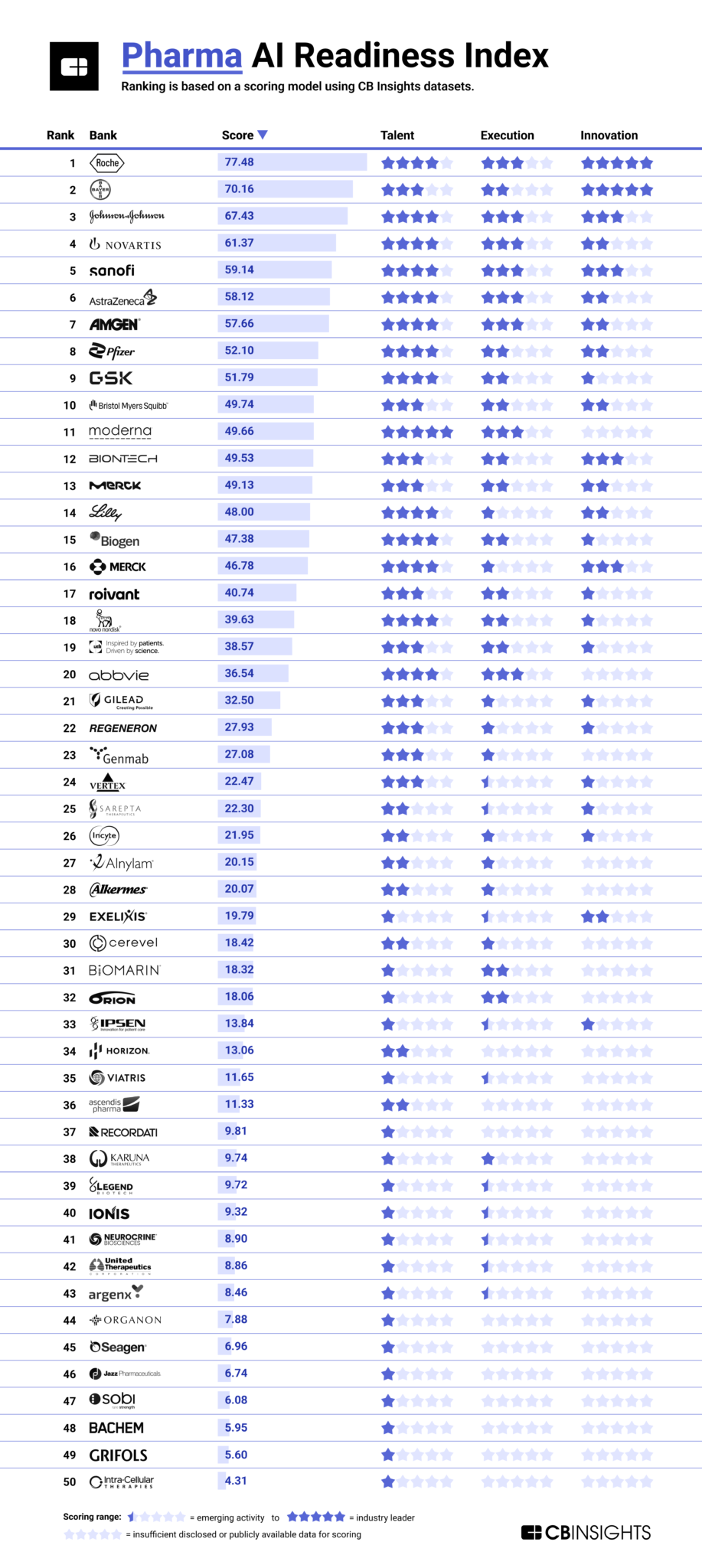
Today, the majority of Johnson & Johnson's drug development projects incorporate some aspects of data science, whereas only a few projects did so five years ago.Many data employees of Johnson & Johnson are distributed across multiple company locations, including the United States, China, and Belgium.
 50 External Partnerships
From 2018 to earlier this year, Mathai Mammen served as the head of Johnson & Johnson's pharmaceutical R&D department, helping the company build up its data science capabilities.
Mathai Mammen stated that the pursuit of precision medicine is one of the driving forces. In precision medicine, treatments are personalized to match the genetic or other variations of an individual's disease.
Johnson & Johnson hopes to cleverly use its data to find answers about the molecular characteristics of diseases and how to develop drugs that exploit these characteristics.
One hallmark of the Johnson & Johnson approach is collaboration — more than 50 external partnerships with data science startups and other companies.
On November 30, the UK Biobank Whole Genome Sequencing (WGS) project released the whole genome sequencing data of 500,000 volunteer participants. In this project, scientists from Johnson & Johnson led the collaboration of 13 pharmaceutical companies, playing a significant role.
This means that approved researchers will have access to an unprecedented amount of data, which can be used to accelerate new discoveries.
Johnson & Johnson Plans to Use Artificial Intelligence and Machine Learning to Analyze Datasets to Help Discover Patterns. This, in Turn, May Lead to the Emergence of New Drugs or Diagnostic Methods for Gene-Protein Associations Related to Various Diseases.
In the past, industry scientists would search academic papers to find such molecular drug targets, but AI-based methods can discover more targets faster.
Johnson & Johnson believes that artificial intelligence will drive transformation in multiple areas of healthcare, enabling patients to receive better care.
Promote the Early Detection of Diseases
Johnson & Johnson Collaborates with Anumana and Mayo Clinic to Treat Pulmonary Arterial Hypertension, and with Ultromics Ltd. and Atman Health to Address Cardiac Amyloidosis, Developing AI Algorithms Aimed at Early Detection of These Diseases.
Johnson & Johnson and its partners have collected 6 million patient records, all of which have been anonymized to hide personal sensitive data, including more than 8 million electrocardiogram (ECG) records.
They fed these records into a software algorithm, teaching it to recognize patterns in the electrical readings of patients later diagnosed with pulmonary hypertension. Johnson & Johnson stated that using this algorithm in conjunction with an electrocardiogram could reduce the diagnosis time for pulmonary hypertension by 12 to 18 months.
The U.S. Food and Drug Administration has granted the algorithm the "Breakthrough Device" designation, which applies to products that can improve the diagnosis or treatment of serious diseases. The FDA has not yet approved the algorithm, but a decision may be made next year.
Promote Drug Discovery
Artificial intelligence enables researchers to develop more targeted drugs, driving the advancement of precision medicine.
In oncology, artificial intelligence algorithms can be applied to digital images of biopsies to help identify subtle differences between tumors and indicate whether genetic mutations exist in a subset of patients.
The company also uses artificial intelligence algorithms to study digitized images of biopsies to detect subtle differences between tumors, which may help identify genetic subtypes of certain tumors.Researchers can use this information to develop a drug specifically targeting that gene subtype.
Achieve More Targeted Clinical Trial Recruitment
At Johnson & Johnson, researchers are applying artificial intelligence and machine learning algorithms to large anonymized datasets to identify and locate clinical study sites for patients who may benefit from the drugs under investigation. The clinical trial operations team can then determine the feasibility of including these newly identified sites in the trials.
Optimize the supply chain
Johnson & Johnson is utilizing advanced machine learning algorithms to filter and analyze vast amounts of data, including demand fluctuations and supplier performance, while also helping predict the impact of real-time events that could disrupt the supply chain. This enables rapid response to deliver medications to patients as quickly as possible.
Analyzing Operating Rooms to Improve Efficiency and Surgeon Learning
Johnson & Johnson Medical Technologies is developing a series of digital operating room solutions that use artificial intelligence algorithms to "clip highlights of these videos" within minutes, allowing surgeons to review key moments of the surgery. Without AI, this process could take hours or even days to complete.
Reference link:
https://www.wsj.com/tech/biotech/johnson-johnson-hiring-data-scientists-ai-ccbf2c07
—The End—
Recommended Reading