

Vanda Pharmaceuticals Acquires U.S. and Canadian Rights to Ponvory® (ponesimod) from Johnson & Johnson for $100 Million

Vanda Pharmaceuticals
Biopharmaceutical Company

Actelion Pharmaceuticals
Biopharmaceutical Manufacturer

Johnson & Johnson
Healthcare Product Manufacturers, Health Service Providers
On December 7, biopharmaceutical company Vanda Pharmaceuticals announced the acquisition of Ponvory from Actelion Pharmaceuticals Ltd., a subsidiary of Johnson & Johnson.®(Ponesimod) rights in the United States and Canada.
According to the terms of the agreement, Vanda will pay Johnson & Johnson $100 million. Johnson & Johnson will continue to operate the business under the transitional commercial license agreement, during which time Johnson & Johnson will transition Ponvory.®The regulatory and supply responsibilities were transferred to Vanda.
Ponvory®Developed by Actelion initially, it was integrated into Johnson & Johnson's autoimmune disease treatment collaboration group in November 2016 and is planned to be developed as a new therapeutic drug.
Ponvory®It is an oral sphingosine-1-phosphate receptor 1 (S1P1) modulator that functionally inhibits the activity of the S1P protein and traps lymphocytes within the lymph nodes, reducing the number of circulating lymphocytes that cross the blood-brain barrier. In patients with multiple sclerosis (MS), lymphocytes enter the brain and damage myelin. Myelin is a protective sheath that insulates nerve cells, and damage to myelin can slow or halt nerve conduction, producing the neurological symptoms and signs of MS.
In March 2021, the US FDA approved Ponvory®For the treatment of adult patients with relapsing forms of multiple sclerosis (RMS), including clinically isolated syndrome (CIS), relapsing-remitting multiple sclerosis (RRMS), and active secondary progressive multiple sclerosis (SPMS).
In May 2021, the European Commission (EC) approved Ponvory for clinical use in all 27 member states and three European Economic Area countries (Norway, Iceland, and Liechtenstein).®Treatment of adult RMS. Ponvory®Has also been approved for the same indication in Canada.
Ponvory®The approval for marketing is based on data from a Phase 3 clinical trial named OPTIMUM — compared with Aubagio®(teriflunomide) head-to-head comparison study, this is the first large-scale controlled head-to-head study comparing two oral drugs for the treatment of RMS.
Aubagio®It is a dihydroorotate dehydrogenase inhibitor developed by Sanofi, which can inhibit experimental allergic encephalomyelitis. In September 2012, Aubagio®Approved by the FDA for the treatment of adult RMS. In July 2018, Aubagio was approved in China for the treatment of RMS, with the trade name奥巴捷 (Aubagio), becoming the first oral disease-modifying therapy (DMT) drug approved for marketing in China.
OPTIMUM Study Results Show That Ponvory®20mg is more effective than Aubagio® 14mg,Ponvory®The annual relapse rate of RMS patients in the group decreased by 30.5%. Two years later, Ponvory®71% of the group's patients had no confirmed recurrence, while Aubagio®The group's is only 61%.
Ponvory®Showed better performance in terms of visible disease activity on magnetic resonance imaging (MRI) and demonstrated a positive effect in preventing disability progression. Data indicates that among 10 cases treated with Ponvory.®Among the treated patients, 9 cases did not show disability deterioration at 3 months. Meanwhile, Ponvory was observed in the study.®The safety profile of Ponvory is consistent with prior studies and the safety profiles of other S1P receptor modulators.®The most common treatment-emergent adverse events (TEAEs) during the treatment period were increased alanine aminotransferase (ALT), nasopharyngitis, headache, and upper respiratory tract infection.
In addition, receiving Ponvory®Patients treated with this drug can begin to see their lymphocyte counts return to normal within a week after stopping treatment, which is a shorter duration compared to other similar drugs. In terms of medication, for most patients, Ponvory®No genetic testing or first-dose cardiac monitoring is required. However, initiation of Ponvory®Treatment may cause a decrease in heart rate; it is recommended to monitor the first dose in patients with specific heart disease history.
It is worth noting that Ponvory®With over 10 years of cumulative clinical research data demonstrating its efficacy and safety, it is currently the first and only DMT therapy approved by the FDA for existing oral treatment drugs.
In Ponvory®Before its market launch, multiple MS drugs had already been approved, making the MS market highly competitive. Ponvory®Shortly after the market launch, generic versions of Biogen's Tecfidera and Roche's CD20 monoclonal antibody Ocrevus, among other MS drugs, were also introduced successively, with numerous companies entering this field. The MS drug market is mainly dominated by MNCs such as Roche and Novartis. In 2021, Ocrevus topped the MS sales revenue rankings, with its 2021 sales reaching 5.055 billion Swiss francs (approximately 5.474 billion US dollars).
In comparison, Ponvory®With neither first-mover advantage nor late-mover advantage, it eventually led to unsatisfactory sales results. Since its launch, Johnson & Johnson has never disclosed Ponvory.®The specific sales data indicates that the product's revenue is below the minimum disclosure threshold in the financial report. It is speculated that it might be categorized under the revenue of "other neuroscience drugs." Johnson & Johnson's 2021 financial report revealed that the revenue for this category in 2021 was only $1.73 billion.
In addition, this sale of Ponvory®The rights and interests are related to Johnson & Johnson's previous global large-scale layoff action.
In February 2023, Johnson & Johnson announced at the all-staff Town Hall Meeting its plan to merge the vaccine and infectious disease business units, a comprehensive reform expected to result in large-scale global layoffs. This round of layoffs will affect not only the R&D department but also the sales department in the neuroscience field, particularly the MS sales team.
In December 2023, Johnson & Johnson announced its long-term sales outlook at the 2023 Enterprise Business Review. The company stated that it will fully focus on three major fields—oncology, immunology, and neuroscience—in the future. It is expected to launch more than 20 new drugs and over 50 products by 2030. Its innovative drug pipeline and product portfolio are projected to drive operational sales growth of 5%-7% from 2025 to 2030. Notably, more than 10 products have the potential to generate over $5 billion in operational revenue.
Although Johnson & Johnson acquired Actelion for $30 billion in 2017, Ponvory was not the reason for the hefty acquisition.®, but rather Actelion's Tracleer, Opsumit, and Uptravi, drugs used to treat pulmonary arterial hypertension. In addition, the patent information listed in the U.S. Orange Book shows that Ponvory®The patent is expected to expire in December 2035. At that time, Ponvory®Will face the impact of generic drugs.
Therefore, although the neurology field remains a key development area for Johnson & Johnson, the revenue of Ponvory has been "disappointing."®For Johnson & Johnson, it has become a "hot potato" that they are eager to get rid of.
In November 2023, Vanda announced its Q3 financial report for 2023. The data showed that the company's total revenue for the first nine months of 2023 was $147.4 million. Vanda's revenue mainly came from two approved products — Hetlioz, used for treating sleep disorders.®(Tasimelteon) and Fanapt for the treatment of adult bipolar disorder®(Iloperidone).
Currently, Vanda's pipeline is focused on the field of psychiatric disorders, with VHX-896 for the treatment of schizophrenia and Tradipitant for gastroparesis both in Phase 3 clinical trials.
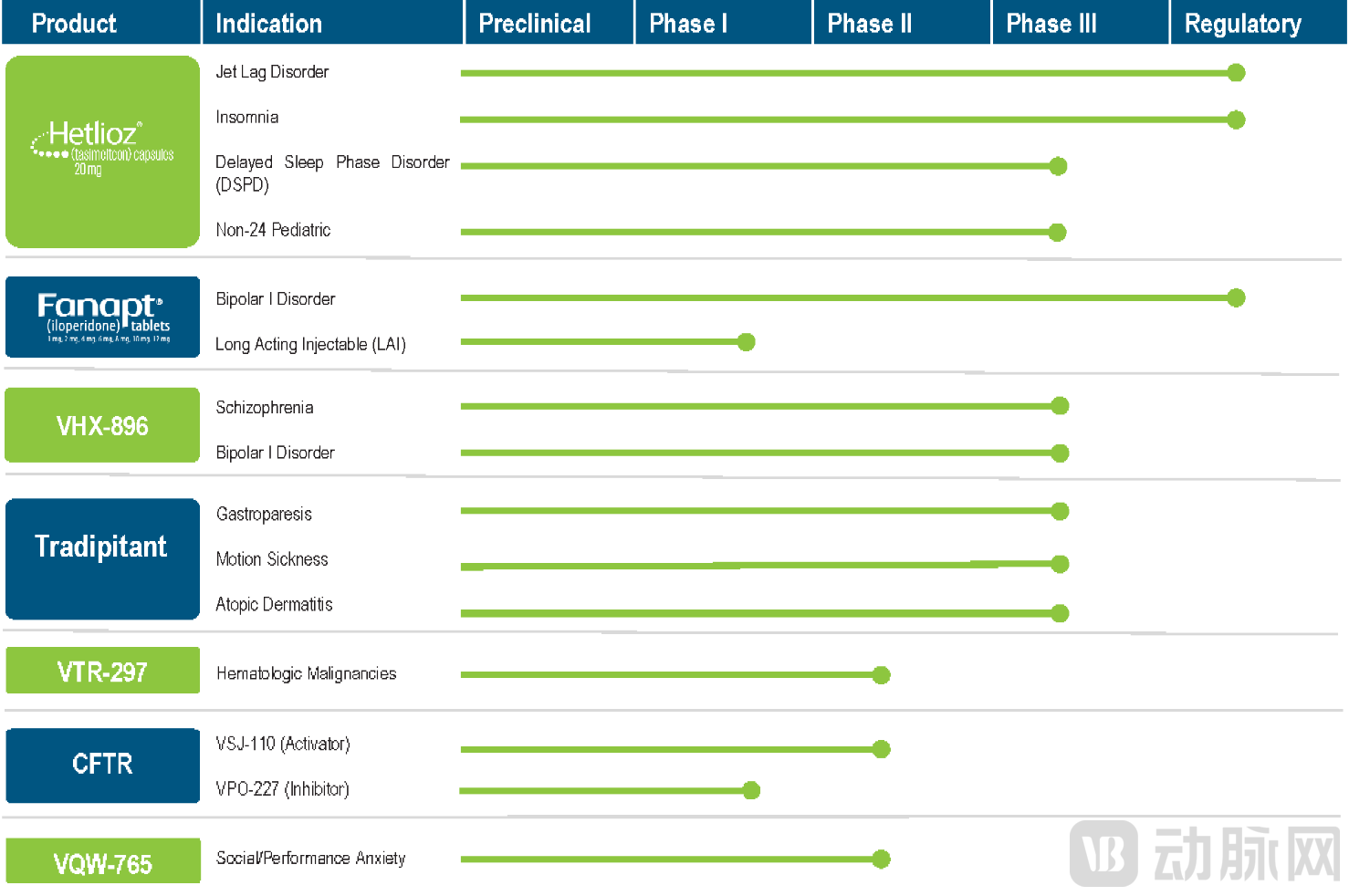 Vanda's R&D Pipeline
Source: Vanda official website
Despite the rapid progress in its R&D pipeline, most of Vanda's revenue comes from Hetlioz.®and Fanapt®. Among them, Hetlioz®Is a key product, with its sales reaching $79.1 million in Q3 2023, contributing to nearly half of the revenue in Q3 2023. However, this represents a 34% decrease compared to the $119.6 million in sales from Q3 2022. The decline is associated with Hetlioz.®Related to the launch of generic drugs.
Therefore, the acquisition became Vanda's solution for Hetlioz.®One of the challenges faced is the patent cliff issue and ways to increase revenue sources.
According to data released by the Multiple Sclerosis International Federation (MSIF), there are currently over 2.8 million MS patients worldwide. Meanwhile, based on Datamonitor's latest market forecast for MS and ulcerative colitis, the U.S. S1P market is expected to reach $2 billion by 2024 and grow to approximately $3.5 billion by 2028.
Therefore, despite only $147.4 million in total revenue in Q3 2023, Vanda is spending $100 million to acquire Ponvory.®In the United States and Canada, this will open up an entirely new market. Notably, prior to this, Ponvory®It has also been developed for various autoimmune diseases such as plaque psoriasis and ulcerative colitis.
Vanda CEO and Chairman of the Board Mihael Polymeropoulos stated, "The acquisition of Ponvory®An important milestone for Vanda. Ponvory®"It has broad market prospects in the fields of MS and autoimmune diseases, and it will change the company's current commercial product portfolio and revenue sources."
However, in 2021, the sales of six MS drugs from Roche, Novartis, Sanofi, and Biogen exceeded 1 billion US dollars. In addition, there are also Bristol-Myers Squibb and other Biotech companies in the MS market.
Ponvory®Whether it can change the previously unsatisfactory sales situation and become Vanda's next blockbuster product remains to be seen!