

Industry Leaders Across the CGT Value Chain Gather to Discuss Cost Reduction and Efficiency Enhancement: Highlights from the 'CGT Industry Upgrade Series'

Yeasen
Tool Enzyme Raw Materials and Diagnostic Product R&D, Manufacturer

Saifu Pharmaceutical
Preclinical CRO Service Provider

Innostellar Biotherapeutics
Innovative Gene Therapy Drug Research, Development, and Manufacturing
In the past few years, the Cellular and Gene Therapy (CGT) industry has been advancing rapidly. Several gene therapy products have been approved for marketing in China, bringing hope to patients. At the same time, many local companies have successively received clinical approvals, and the cellular and gene therapy industry has entered the clinical stage. With the CGT industry developing at an accelerated pace, market competition has intensified rapidly, and various forces are eager to enter the related field.
At the same time, the CGT industry still faces many challenges, such as issues with the quality and batch consistency of CGT products, limitations due to high costs and high pricing, which also make the optimization and iteration of CGT products extremely urgent. Meanwhile, the importance of CMC cannot be overlooked, as designing good products, reducing costs and improving efficiency, and creating effective drugs are the vision of every CGT company. Therefore, industrial chain service providers and high-quality suppliers have become important drivers for industrial upgrading.
Recently, the first stop of the [No Need to Struggle, Go Further] CGT Industry Upgrade Series · Park Tour, jointly organized by HIEA, Hangzhou Xingcheng Biotechnology, Yeasen, Saifu Pharmaceutical, Biorayter, Hong Kong Austar Group, Legend Capital, and ATLATL Innovation Center, and hosted by VCBeat New Medicine, was held at the ATLATL Innovation Center in Shanghai.
In the final open mic discussion session for all participants,Executive Director of Innovation at ATLATL Innovation Center, Lu Wenyuan; Vice President of R&D at Innostellar Biotherapeutics, Ni Zhuoyu; Vice President at Ucar Therapeutics, Wang Wei; Partner at AnJie Law Firm, Gu Long; and the host, Vice President of Business and Marketing at Hangzhou Xingcheng Biotechnology Co., Ltd., Dr. Liu Xiao, who is also the Deputy Chairman of the MAH Committee of the China Pharmaceutical Enterprise Management Association., on the topic of "Achieving Robust, Rapid, and Cost-Effective Progress from IIT/IND to BLA through CMC Collaboration to Support Innovative Enterprises", shared insights.
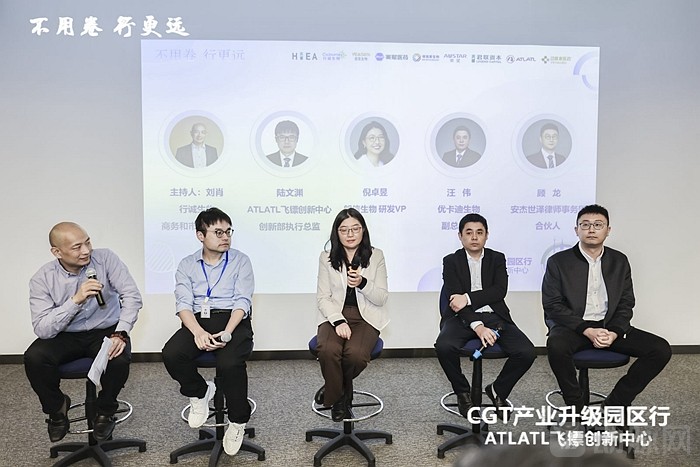
Discussion Guests (from right to left): Liu Xiao, Lu Wenyuan, Ni Zhuoyu, Wang Wei, Gu Long
The following is a summary of the excellent viewpoints from each speaker:
An innovative pharmaceutical company that advances its pipeline from IIT/IND to BLA would certainly want to possess the three traits of being stable, fast, and cost-effective simultaneously. However, due to various factors such as time constraints and barriers, many companies struggle to meet this "want it all" demand and can only focus on developing one particular trait.
In this regard, Lu Wenyuan said, "From the perspective of the Dart Innovation Center, we prefer to help companies advance their pipelines rapidly while striving to improve other aspects of their work. Why do we value speed?Because at present, the entire biopharmaceutical industry is actually in a race against time.CGT companies are more inclined to obtain sufficient and good data as soon as possible for negotiation and discussion with partners in terms of cooperation and financing.
As Party B, the ATLATL Innovation Center is inclined to help enterprises accelerate project advancement and achieve good results as soon as possible.Wang Wei and Ni Zhuoyu, as representatives of Party A, expressed different views.
Wang Wei narrated: "In my opinion,At different stages of development, pharmaceutical enterprises have different requirements."In the early stages of pipeline development, such as project initiation or IND filing, speed is certainly crucial. However, once the product enters the clinical and commercialization phases, the focus shifts to 'stability.' This presents a double-edged sword, as the pursuit of stability can slow down the progress of the product. Nevertheless, if product design and commercialization are approached with the end in mind, and all stages are aligned accordingly, this method of balancing different priorities at different stages can ultimately enable the product to reach the market faster and more effectively."
Ni Zhuoyu also expressed a similar view, "I think these three qualities are all important, butWhat is the most important thing requires weighing."In the process of developing products, we always need to make choices and trade-offs. For example, when it comes to financing or dealing with regulatory agencies, stability and speed are equally important. We need to make innovative products solid as quickly as possible."
Based on the speeches of the previous three speakers, Liu Xiao summarized, "These three qualities are all important."However, given the current capital winter period, many pharmaceutical companies have only one or even no chance to make mistakes."While startups are rushing forward, they should also ensure that other aspects of their work are more solid."
Lu Wenyuan shared a similar case once incubated by the Dart Innovation Center, "For instance, Kodong Biotech, a gene therapy company we incubated last year. It started with only one scientist. In the early stages of its establishment, Dart quickly helped the scientist screen solutions and generate effective experimental data. This year, the company has officially taken off and won the innovation competition champion and funding support from major pharmaceutical companies like Novo Nordisk, thanks to its first batch of valid data and a founding team with deep industry backgrounds. As the company had already rapidly built barriers in the early stage, it gained an advantage in the speed of industry development. Therefore, the next step for the company will be to steadily move forward while consolidating its advantageous position."
As the product pipeline advances, building one's own factory or seeking CDMO collaboration is also a question that must be considered in advance.
In this regard, Wang Wei stated: "A product involves a very long industrial chain. If a company wants to efficiently and cost-effectively advance its product line, in addition to building some of its own facilities, it also needs to collaborate with excellent partners in the industrial chain. During the subsequent product development process, if there are many pipeline layouts at different stages, we will also seek different partners to carry out various technology transfers to rapidly advance the commercialization of our products."
In the commercialization process, the supply chain is closely related to product costs. In addition, product costs are also associated with various factors such as domestic substitution, patent layout, pharmaceutical factory operations, and the medical insurance system.
Cell and gene therapies, however, differ from traditional drugs. In addition to requiring the establishment of entirely new safety and effective CMC, their cost and commercial pricing are also key issues of focus.
Ni Zhuoyu explained, "Making CGT products more affordable is an imperative task. First, we will focus on the source of product design to reduce the effective dosage. Regarding pricing, since our company is not currently at the forefront, we will refer to the prices of some already approved CGT products when setting our prices later. Of course, while ensuring the safety and efficacy of our products, we are also striving to cut costs as much as possible, including production costs, testing costs, R&D costs, and supplier raw materials and equipment costs. As for controlling supplier costs, there is no doubt that the earlier we consider it, the better. However, alternative products developed by suppliers are gradually introduced over time. If a product changes its raw materials in the middle or late stages of commercialization, it will incur high costs and expenses. Although new raw materials may have a favorable cost-performance ratio, at this point, we need to balance the replacement costs."
Wang Wei added, "WeWe should view the issue of domestically produced alternatives rationally.Perhaps the substitution process will take time and bring certain risks. However, we should give domestically produced alternatives a chance. Both domestic and foreign enterprises are continuously upgrading and renovating their equipment, consumables, technical processes from third-party collaborators, and more. When we provide domestic companies with sufficient room for trial and error and growth, I believe that Chinese-produced products can gradually reach a globally leading level in terms of quality.
From the perspective of the Darts Innovation Center, Lu Wenyuan stated, "As a platform itself, while we establish cooperative relationships with major overseas suppliers, we are also willing to collaborate with companies related to domestic products. Within the Darts Innovation Center, we have equipment from various manufacturers, and enterprises can choose the equipment products for experiments according to their own needs. Enterprises will have different equipment requirements at different stages of research and development and financing. We also hope to see a local, complete ecological environment and industrial chain for China's biopharmaceuticals. Additionally, some investment institutions come here for research, hoping that we can provide some objective third-party data to help them compare parameters between domestically produced equipment and imported equipment, assisting the industry in making choices and judgments."
Gu Long, standing from the perspective of regulations and systems, offered another viewpoint: "In the process of domestically produced substitution, issues related to IP cooperation will be involved."When domestic companies cooperate with leading enterprises to obtain some patented technologies or key IPs, the agreements often include clauses related to patent infringement. For instance, certain restrictions on competition may be added, targeting specific products in niche markets, imposing non-compete constraints. Through such restrictions, the abuse of IP rights for industrialization can be prevented at the source."
For domestically produced alternatives,Liu Xiao also shared four viewpoints he summarized."First, most domestic substitutes enter the market with cost advantages. Secondly, supply chain tensions in recent years have also been an important reason for the rapid rise of domestic substitutes. Moreover, factors such as the political situation and trade conditions have also contributed to the fast growth of local suppliers, ensuring that the industry is not held back. Finally, the biopharmaceutical sector is an ecosystem and industrial chain where we need to grow together. Nowadays, many excellent domestic suppliers not only have price advantages but also possess reliable quality and batch-to-batch stability."
In BD transactions, how can enterprises protect their patents and know-how? Gu Long emphasized, "BD transactions, compared to equity transactions, do not have a specific form."In each project, the resources and demands invested by clients vary, and their down payments, milestone payments, and subsequent commercial profit-sharing arrangements differ. In such cases, it is best for the project acquiring party to obtain co-ownership of the patent, which will be greatly beneficial for long-term commercial operations."
"Not only in IP licensing and collaboration, but also in BD and overseas expansion, Gu Long has accumulated relevant cases and experience to share. 'In a challenging environment, whether it’s the investment and financing market, the secondary market, or listed and unlisted companies, all are facing financial pressures. In such a situation, BD collaborations will become significantly more active, which plays a positive role in the development of Biotech companies.'"
Liu Xiao explained: "In summary, whether it is the previous cooperation between CDMO and Biotech, or cooperation among Biotechs, or other forms of collaboration, patent protection and licensing scope during the cooperation process are very important. With the rapid development of China's innovative pharmaceutical companies, we will have more innovative products and technologies to collaborate with global enterprises in the future. In this process, how to invest money, share profits, and build a patent moat are issues that companies should pay attention to in their early stages of development."
Regarding the current status and future of the CGT field, Wang Wei summarized, "The CGT field is currently in a period of flourishing diversity, where various process routes, facility designs, and CMC establishments coexist. However,From the perspective of saving resources and reducing costs, we can actually identify some common issues as well as specific ones."The common parts can be shared by everyone, and the upstream and downstream of the industry chain can also quickly establish relevant standards and specifications based on this, promoting the development of the CGT industry and the standardization of later-stage regulation."
Ni Zhuoyu added, "Today, everyone discussed multiple issues from different perspectives, such as the Party A and Party B. In fact, these positions are all variable.When we develop products and collaborate with CDMOs, suppliers, and other companies, perhaps we are the甲方 (Party A); however, once our CGT products are approved and launched in the market, we become the乙方 (Party B) when facing clinical patients."Regardless of which party, I hope that multiple parties in the industrial chain will unite, grow together, and push China's innovative drugs towards internationalization."
Lu Wenyuan said, "As a former pharmaceutical R&D worker, I hope to see more iterations in the CMC processes within the CGT field in the future, along with more cost-effective and efficiency-boosting solutions. As an investor, I look forward to seeing more innovative products that address current unmet clinical challenges."
Finally, Liu Xiao mentioned: "We started by discussing which is more important among speed, stability, and cost-effectiveness, and moved on to the subsequent topic of domestic substitution and its related legal issues. Based on my industry experience over the past decade, I believe that for an ecosystem to develop well, pharmaceutical companies and other parties on the demand side should meet the needs of patients, while suppliers and other service providers should meet the needs of the demand side. With the development of policies, economy, and trends, partners in the industrial chain will also become rich and diverse."