

Fangzhou’s Xingshi LLM earns spot in Nature News for its AI approach to chronic disease management
A recent report on Chinese medical large language models (LLMs) published in the news section of Nature has garnered significant industry attention. As a globally premier journal, Nature's news coverage typically focuses on the most cutting-edge and critical technological innovations worldwide. For instance, it has published numerous articles on the intensely discussed topic of LLMs in recent years, including notable examples from China such as DeepSeek and Kimi.
It is worth emphasizing that, over the past six months, this marks the only report by Nature specifically addressing Chinese medical LLMs—or, more precisely, Chinese LLMs for chronic disease management.
What has drawn the attention of this leading international journal to China's medical LLMs?
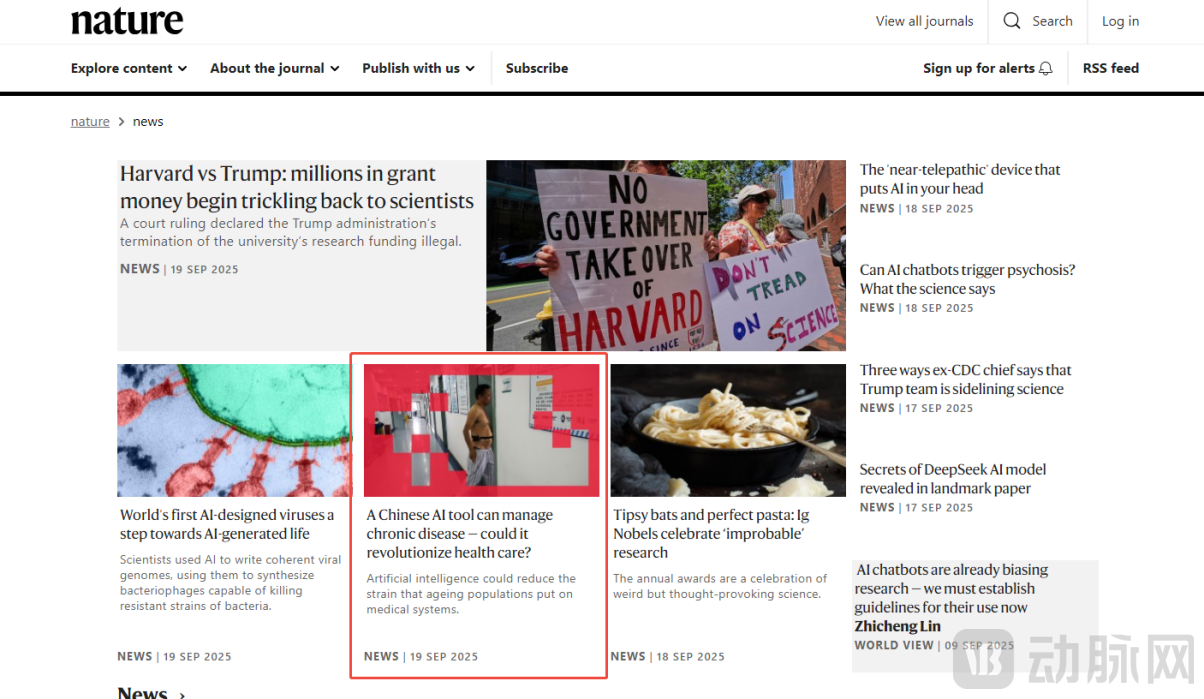
Image Source: Nature Website
How the "Chinese Model" Deeply Integrates AI with Chronic Disease Management
To understand the reasons behind this, we must start with the industry-specific attributes of the medical LLM mentioned in the article. Strictly speaking, it is a multimodal medical LLM focused on chronic disease management, which constitutes the primary reason for its coverage by Nature.
Chronic disease management has long received significant attention due to the substantial harm caused by these conditions and their rising incidence rates, growing into a multi-hundred-billion-dollar market. According to data from Global Growth Insights, the global chronic disease management market size reached $481.41 billion in 2024, is projected to grow to $511.74 billion in 2025, and may reach $834.28 billion by 2033, with a compound annual growth rate (CAGR) of 6.3% from 2025 to 2033.
Alongside market growth, a new trend has emerged: the "efficiency revolution" driven by the continuous iteration and deepening application of AI technology is disrupting various industries. How can the advantages of AI be leveraged to empower chronic disease management services? From an overall industry perspective, companies globally have begun explorations, but this particular Chinese company has chosen to target the vertical market of "chronic disease management." This strategic focus represents the secondary reason for Nature's interest in the Chinese AI-powered chronic disease management model.
Furthermore, the Chinese chronic disease management model highlighted in the Nature report represents a relatively rare global case study that has successfully deeply integrated AI with the management of multiple chronic diseases and demonstrated significant results.
Consider leading global chronic disease management companies like Livongo and Omada Health for context. As the first publicly listed company in this sector, Livongo primarily utilizes an "AI+AI" intelligent system to provide integrated health management services for chronic disease patients, thereby empowering US commercial insurers to address cost control challenges. It is important to note, however, that Livongo's "AI+AI" system does not refer to Artificial Intelligence but rather to a cycle of Aggregate, Interpret, Apply, and Iterate.
Omada Health is another key player in the global chronic disease management landscape. Regarding AI, Omada Health emphasizes its application for personalized coaching and improving the efficiency of care teams. In May, it launched OmadaSpark to provide nutritional analysis services to its members. Based on public reports, Omada Health's AI applications appear "fragmented" and have not yet been integrated into a comprehensive, end-to-end chronic disease management system. As for the highly discussed Hippocratic AI in recent years, it primarily focuses on using LLMs to address nursing staff shortages, with chronic disease management being just one of its many application scenarios.
In other words, within the current overseas market, companies that have achieved a deep integration of AI with the management of multiple chronic diseases and operate at a significant scale remain relatively scarce. In contrast, Chinese companies are rapidly emerging in this very track. Taking Fangzhou, the company featured in the recent Nature news report, as an example, let us analyze how the "Chinese model" achieves this deep integration of AI and chronic disease management.
As early as 2015, Fangzhou built a new smart healthcare ecosystem based on the H2H (Hospital to Home) model, advocating the gradual extension of medical services, chronic disease management, doctor-patient education, and pharmaceutical services from hospitals to patients' homes.
In 2024, Fangzhou upgraded its existing platform and established a more professional and efficient "Fangzhou AI + H2H New Smart Healthcare Ecosystem". Driven by AI technology, this ecosystem upgrades doctor-patient services and provides patients with a seamless healthcare experience from hospitals to their homes.
The extension of healthcare services from hospitals to home scenarios has fostered a unique "familiar doctor-patient relationship" between patients and physicians. This familiar bond enhances patients' trust in their doctors, while also enabling physicians to provide continuous management for patients—helping to reduce the incidence of chronic disease complications and improve patient adherence. This constitutes Fangzhou’s competitive moat, and also explains why it has amassed 58.2 million users, 11.9 million monthly active users (MAUs), and an impressive 85.4% repurchase rate among paying users.
In summary, Fangzhou has built a comprehensive AI application system that spans the entire process of chronic disease management.
In recent years, a new wave of AI technology—represented by LLMs—has emerged. Fangzhou has also promptly captured this industry development trend and conducted corresponding explorations. This September, Fangzhou's Large Language Model, called Xingshi, was officially launched. It has not only attracted attention in the medical field, but its innovative model has also been keenly noted by foreign scholars, making its first appearance in a Nature report.
China's Chronic Disease Management Model Poised to Enter the Global Market
The multimodal capabilities, massive storage of medical knowledge, and reasoning capacity of Xingshi constitute its technical advantages—and also the third reason for its coverage in Nature News. Specifically, Xingshi has built an underlying system integrating image and speech recognition, natural language understanding, and the storage and reasoning of massive medical knowledge. Its model performance has reached the State-of-the-Art (SOTA) level, meaning it meets the advanced performance standards in the field of medical AI.
Fangzhou is well aware that the application of AI technologies—including LLMs—is not for mere technical showboating, but to solve practical problems. Therefore, Xingshi model powers the operation of five key intelligent agents: the AI Knowledge Agent, AI Triage Agent, AI Pre-Consultation Agent, AI Physician Assistant, and AI Electronic Medical Record Agent. Through the collaboration of these five intelligent agents, Fangzhou has established a closed-loop service system that covers the entire lifecycle of chronic disease management.
In addition, as the "Super Digital Brain" of Fangzhou, Xingshi also powers five key applications: the AI Medication Assistant, AI Health Manager, AI Physician Assistant, AI Academic Assistant, and AI Search. Each application can target specific scenarios on both the clinical (physician) and patient sides, providing real-time and accurate support in areas such as medication guidance, patient education, diagnostic assistance, and medical literature retrieval. For instance, the AI Academic Assistant, equipped with voice interaction functionality, supports second-level voice broadcasting of expert-level answers—an feature that aligns with the busy clinical workflow of physicians, enhancing both the efficiency of tool usage and user stickiness.
As a result, Fangzhou has also gained favor with numerous pharmaceutical companies. On the day of Xingshi's launch event, Innovent Biologics—a well-known innovative pharmaceutical enterprise—signed an agreement with Fangzhou. This collaboration is expected to bring more efficient and personalized chronic disease management services to patients with obesity.
The cooperation between the two parties is expected not only to bring more efficient, personalized, and precise chronic disease management services to patients with obesity but also serves as an example of the close collaboration between China's chronic disease management service providers and innovative pharmaceutical device enterprises. In more areas of other chronic diseases, Ark Jianke is also leveraging its large model's advantages and chronic disease management capabilities to provide in-depth services.
Nature's focus on China's medical LLMs is merely a starting point. As China's innovative models for chronic disease management are gradually recognized and accepted by the international market, as AI technology continues to iterate and deepen in practical application, and as the industrial ecosystem becomes increasingly sound, the development space for China's chronic disease management models is expected to expand continuously.