

Original Combination Drug Launches Amid Fierce Race for First Generic by Qilu, Huahai and Others in China's Multi-Billion-Dollar Antidiabetic Market

Qilu Pharmaceutical
Specialty Formulations and Active Pharmaceutical Ingredients (API) Developer
The original product of dapagliflozin and metformin sustained-release tablets, Andes®, which has been formally commercially launched for less than a month, is already seeing the smoke of competition from the first generic drug.
Recently, the official website of the Center for Drug Evaluation of the National Medical Products Administration showed that the marketing application of Dapagliflozin Metformin Sustained-Release Tablets (I) (III), submitted by Qilu Pharmaceutical Co., Ltd. as a Class 4 generic drug, has been accepted.

According to data from Menet, the market size of chemical drugs (including biologics) for diabetes treatment in Chinese public medical institutions has exceeded 50 billion yuan. In terms of sales channels, the market shares of urban public hospitals and urban community health centers in China have increased, while those of county-level public hospitals and township health centers have declined. Since the beginning of this year (up to November 10), 26 products (83 specifications) in the field of chemical drugs (including biologics) for diabetes treatment have been approved for marketing, with 51 products (175 application numbers) under review for production. Market competition is extremely fierce.
With the impact of an aging population, lifestyle factors, etc., China has the largest number of people with diabetes in the world. The continuous improvement in diabetes diagnosis and treatment rates in China has further driven the expansion of the domestic diabetes market.
Some argue that the overall demand for diabetes medications in China is still on the rise, with high market potential. As competition in the hypoglycemic drug market extends to combination formulations, it's not hard to imagine that this field still has significant room for growth, indicating broad prospects for industry development.
01
Will the 3 billion market for Dapagliflozin be divided?
Dagliflozin Tablets are the world's first approvedSGLT-2 inhibitor, developed by Bristol-Myers Squibb (its global sales rights have been acquired by AstraZeneca), was approved for marketing by the European Medicines Agency (EMA) in November 2012, and was approved to enter the Chinese market in March 2017, becoming the first SGLT-2 inhibitor approved in the Chinese market.
Currently, Dapagliflozin Tablets are mainly used for the treatment of adult patients with type 2 diabetes, adult patients with heart failure, and adult patients with chronic kidney disease. According to AstraZeneca's financial report, the global sales of Dapagliflozin Tablets reached $4.381 billion in 2022, a year-on-year increase of 46%.
In the Chinese market, the product was included in the Class B National Medical Insurance Catalogue through negotiation in 2019, with its sales and market size expanding year by year. Data from Menet shows that in 2022, the sales of Dapagliflozin Tablets in Chinese public medical institutions exceeded 3 billion yuan, a year-on-year increase of 53.98%, making it the top product among oral diabetes medications.
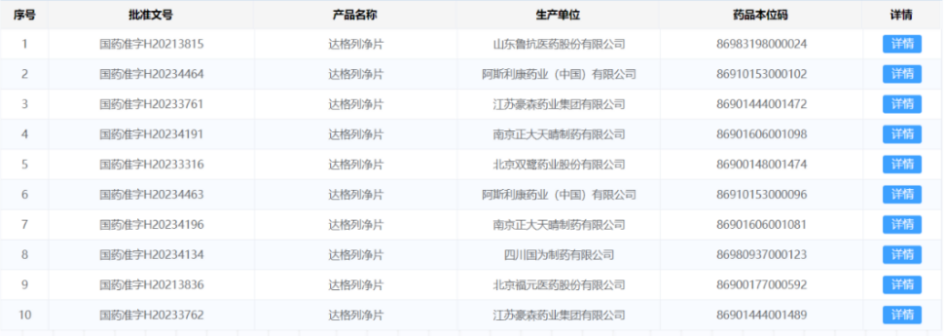
For dapagliflozin, seven companies in China currently hold production licenses. Six domestic companies, including Nanjing Chia Tai Tianqing Pharmaceutical and Sichuan Guowei Pharmaceutical, have received approval for Category 4 generic production, which is considered as passing the quality evaluation. Among them, Shandong Lukang Pharmaceutical and Beijing Fuyuan Pharmaceutical were the first to pass the evaluation, simultaneously obtaining China's first generic approval in October 2021.
In addition, nearly 20 companies in China, including Qilu Pharmaceutical, Ouyi Pharmaceutical of Shijiazhuang Pharmaceutical Group, Chengdu Better Pharmaceutical, and Hunan Jiudian Pharmaceutical, are currently under review for the production of Dapagliflozin tablets. It can be foreseen that the competitive landscape for this product will become even more intense in the future.
Facing the "involution" competition in the single-drug hypoglycemic market, some companies have begun to develop combination hypoglycemic formulations.
Dapagliflozin and Metformin Hydrochloride Extended-Release Tablets combine the mechanisms of dapagliflozin (an SGLT2 inhibitor) and metformin hydrochloride extended-release tablets. AstraZeneca submitted a Class 5.1 import listing application for dapagliflozin and metformin hydrochloride extended-release tablets in February 2022, which was approved for marketing in June this year. On November 22, 2023, AstraZeneca announced that dapagliflozin and metformin hydrochloride extended-release tablets had officially launched for sale in China.
Although no generic versions of dapagliflozin and metformin hydrochloride sustained-release tablets have been approved in China so far, previously, in November this year, the CDE website showed that Zhejiang Huahai Pharmaceutical's dapagliflozin and metformin hydrochloride sustained-release tablets (I), dapagliflozin and metformin hydrochloride sustained-release tablets (III), and dapagliflozin and metformin hydrochloride sustained-release tablets (IV) were all accepted for production on the same day as Category 4 generics.
Among them, the marketing applications for Dapagliflozin and Metformin Hydrochloride Extended-Release Tablets (I) and Dapagliflozin and Metformin Hydrochloride Extended-Release Tablets (III) submitted by Beijing Fuyuan Pharmaceutical are currently under review, with the acceptance dates both in October this year; no company has submitted a marketing application for Dapagliflozin and Metformin Hydrochloride Extended-Release Tablets (IV) for review so far. In addition, Shanghai Xuantai Pharmaceutical and Beijing Fuyuan Pharmaceutical have also submitted generic drug marketing applications.
Currently, in China, the compound hypoglycemic drugs composed of metformin and SGLT2 inhibitors that have been marketed include not only dapagliflozin metformin but also metformin empagliflozin tablets, which have been approved for marketing. Additionally, 20 manufacturers have submitted their compound formulation (tablets/extended-release tablets) marketing applications. Moreover, oral compound hypoglycemic drugs also come in various combinations such as metformin + DPP-4 inhibitors, metformin + sulfonamide urea derivatives, and SGLT2 inhibitors + DPP-4 inhibitors.
02
Qilu, Hengrui and other major pharmaceutical companies enter the market
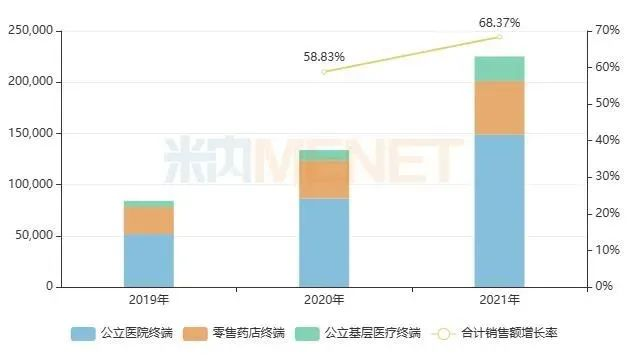
The sales scale of domestically produced oral compound hypoglycemic drugs in China is growing rapidly. According to data from Menet, the compound hypoglycemic drug market in China...The market size surged from 800 million yuan in 2019 to over 2.2 billion yuan in 2021, with growth rates reaching 58% and 68% in 2020–2021, respectively, indicating that the market potential of compound oral hypoglycemic drugs is rapidly unleashing.
Targeting the development trend of potential markets, Qilu Pharmaceutical has been continuously strengthening its efforts in the hypoglycemic drug field in recent years.
Currently, Qilu Pharmaceutical has more than 10 oral hypoglycemic drugs approved for marketing in China, including DPP-4 inhibitors such as Vildagliptin Tablets, Saxagliptin Tablets, Sitagliptin Phosphate Tablets, and Linagliptin Tablets; compound hypoglycemic drugs such as Metformin Vildagliptin Tablets (Ⅱ), Linagliptin Metformin Tablets (Ⅰ), and Sitagliptin Metformin Tablets (Ⅱ); SGLT2 inhibitors such as Canagliflozin Tablets, etc.
Moreover, data from Menet shows that Qilu Pharmaceutical has multiple oral hypoglycemic drugs under review with new classifications, including Empagliflozin Tablets, Dapagliflozin Tablets, Empagliflozin and Linagliptin Tablets, Sitagliptin Metformin Sustained-Release Tablets, Metformin Empagliflozin Tablets (I), and Metformin Empagliflozin Tablets (VI). Among these, no generic version of Empagliflozin and Linagliptin Tablets has been approved yet. Qilu Pharmaceutical is the first to submit for production under the new classification and is highly likely to obtain the first generic approval.
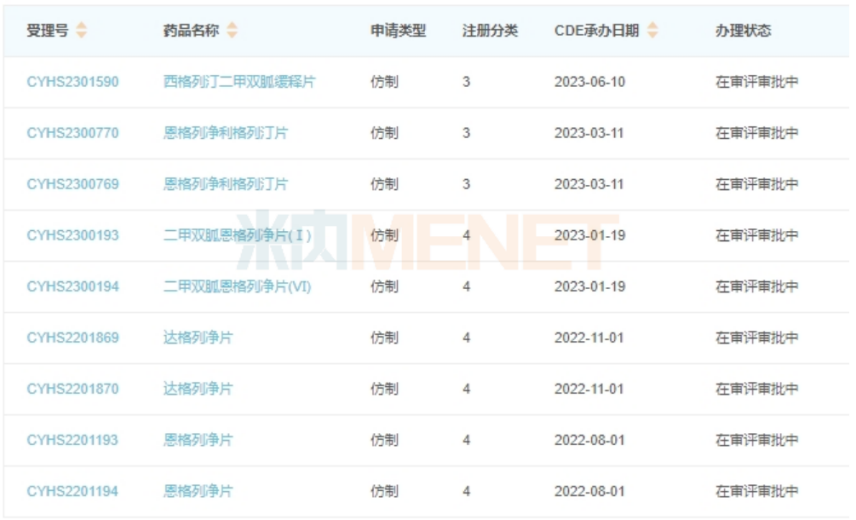
Oral Hypoglycemic Drugs Reported for New Classification by Qilu Pharmaceutical and Currently Under Review
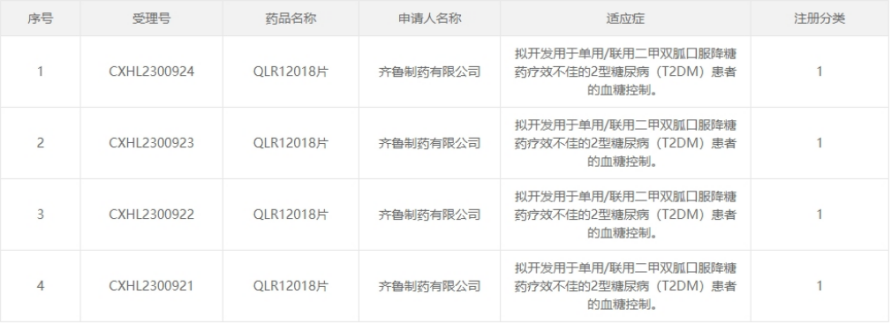
In terms of Class 1 innovative drugs, in November this year, the CDE official website showed that Qilu Pharmaceutical's Class 1 new drug QLR12018 tablets received clinical trial implied permission. This is also its first approved clinical oral hypoglycemic new drug, used for blood glucose control in patients with type 2 diabetes (T2DM) who have inadequate efficacy with metformin alone or in combination with other oral hypoglycemic drugs.
Notably, in this field, Hengrui also had new developments previously.
In November this year, Hengrui announced that its subsidiary Shengdi Pharmaceutical had submitted a new drug marketing application for the compound hypoglycemic oral preparation HR20031 tablets, which has been accepted. HR20031 tablets consist of three components, one of which is metformin, and the other two components are Henglijeptin and Reeglitan, both developed by Hengrui. Henglijeptin is an SGLT-2 inhibitor, which was approved for marketing by the NMPA in December 2021; Reeglitan is a DPP-4 inhibitor, approved for marketing by the NMPA in June 2023. HR20031 tablets lower blood sugar through three different mechanisms. Additionally, the drug is also a sustained-release preparation, planned to be taken orally once daily, which can reduce the frequency of medication and simplify the treatment regimen.
It is reported that there are two similar triple-combination formulations of SGLT2 inhibitors, DPP4 inhibitors, and extended-release metformin already available abroad: Boehringer Ingelheim-Lilly's Empagliflozin/Linagliptin/Metformin Extended-Release Tablets (brand name: Trijardy XR) and AstraZeneca's Dapagliflozin/Saxagliptin/Metformin Extended-Release Tablets (brand name: Qternmet XR). However, no such drugs have been approved for marketing in China.
Diabetes is becoming a common health issue globally, and the field of diabetes treatment is constantly evolving. Market perspectives suggest that combination therapy is becoming a key approach for blood sugar control in diabetic patients, with the market size for compound oral hypoglycemic drugs increasing annually.
Editor: Zhu Di



www.yyjjb.com.cn
Insight into Industry Trends

"Pharmaceutical Economy Newspaper"
Academic Official Account
Focusing on the Frontiers of Oncology Academia

Terminal Official Account