

Agenus Receives $25M Milestone Payment from BMS for TIGIT/CD96 Bispecific Antibody BMS-986442

Agenus
Cancer Drug Developer
Bristol-Myers Squibb
Biopharmaceutical and Nutritional Product R&D and Sales

Welcome to follow Asymchem Pharma News

On December 11, Agenus, Inc., a novel immunotherapy company, announced that under the global licensing agreement with Bristol-Myers Squibb Company for BMS-986442 (an Fc-enhanced bispecific TIGIT antibody), the first patient has been dosed in the Phase 2 dose expansion portion of the ongoing CA115-001 clinical trial for BMS-986442.Agenus to Receive $25 Million Cash Payment from Bristol-Myers Squibb Company. This is the second development milestone payment received by Agenus for BMS-986442.
On May 18, 2021, Bristol-Myers Squibb (BMS) and Agenus entered into an agreement for the introduction of Agenus’ bispecific antibody pipeline AGEN1777 (also known as BMS-986442), with an upfront payment of $200 million, potential milestone payments of $1.36 billion, and tiered double-digit royalties on net product sales. BMS obtained global development and commercialization rights for AGEN1777.
One
About BMS-986442
BMS-986442 (also known as AGEN1777) is a dual antagonist of TIGIT and CD96 with an enhanced Fc region that improves tumor-reactive T-cell responses.
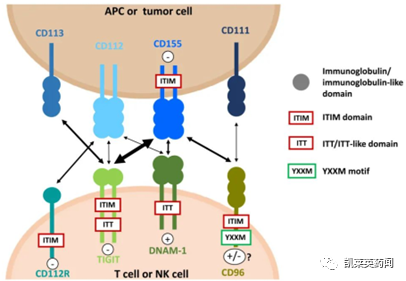
TIGIT is an inhibitory receptor primarily expressed on T cells and NK cells. It suppresses the activation mechanism of CD226 by competitively binding with CD226 to PVR (CD155), thereby inhibiting the activity of T cells. Similar to TIGIT, CD96 can also bind to PVR to transmit immunosuppressive signals. Therefore,TIGIT and CD96 are a set of complementary targets, and simultaneously blocking both can further block the immunosuppressive signals mediated by PVR.。
In addition, BMS-986442 has an enhanced Fc region. Fc enhancement modification helps to strengthen the binding of Fc to receptors, further enhancing Fc effects including ADCC, thereby achieving better activation of T cells or NK cells. This mechanism is very important for the efficacy of TIGIT antibodies. The T cell response effect of using BMS-986442 is...Significantly superior to the use of anti-TIGIT antibody or anti-CD96 antibody alone, and also significantly superior to the combination of two single-target antibodies.
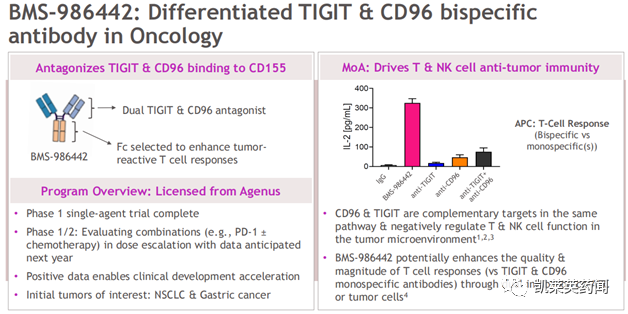
BMS disclosed at the 2023 R&D Day event that it has decided to terminate the development of the TIGIT antibody and further develop the TIGIT/CD96 bispecific antibody BMS-986442. BMS-986442 is under development for non-small cell lung cancer and gastric cancer. The monotherapy Phase I clinical trial has been completed; the Phase 1/2 dose escalation combination trial (e.g., PD-1±chemotherapy) is expected to release data next year.
In addition, on August 27, 2021, BMS and Agenus registered a Phase I clinical trial on Clinicaltrials.gov for the combination of PD-1 antibody and AGEN1777 in the treatment of advanced malignant tumors.
Two
Global TIGIT Bispecific Antibody Pipeline
According to incomplete statistics, there are currently over 80 TIGIT drugs under research, with nearly half in the preclinical research stage.
Among these investigational drugs, 20 are bispecific antibodies, with targets for the TIGIT-binding bispecifics including PDL1/PD1, CD112R, CTLA4, CCR8, LAG3, CD96, and others.
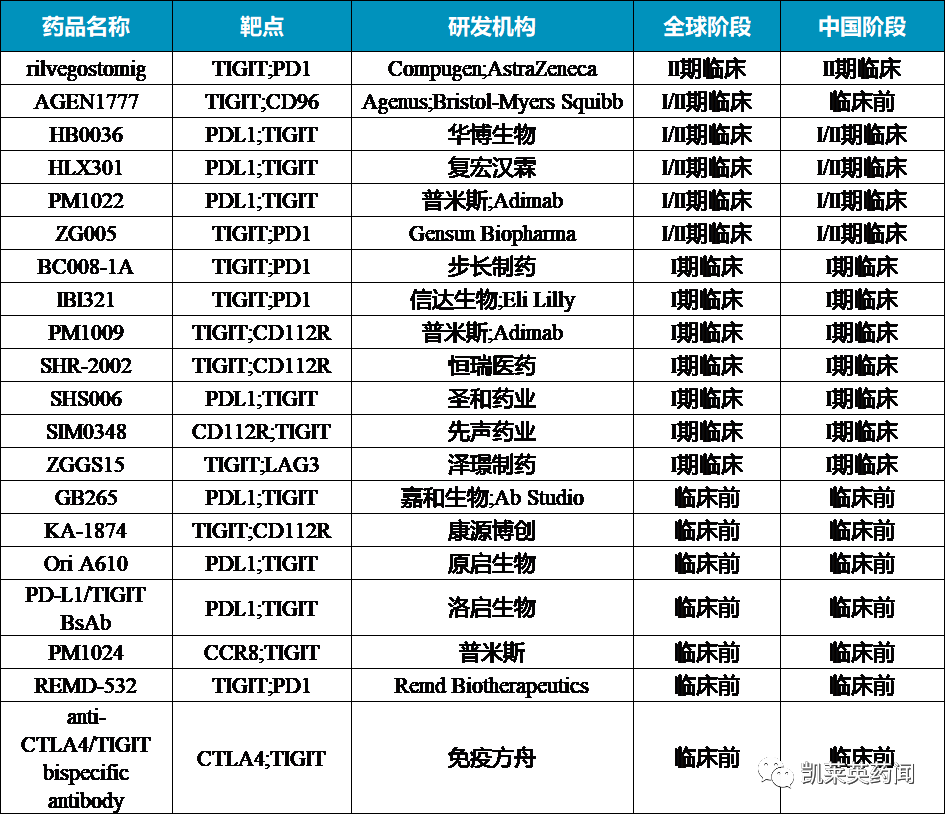
InOf the 20 pipelines mentioned above, 16 are being developed with the participation of companies in China.,These include Huabio Biotech, Henlius, Promab, Buchang Pharmaceutical, Innovent, Hengrui, Sunho, Simcere, Zelgen, etc., and the drugs of the aforementioned companies have all entered the clinical stage.。
The general view is that the combination of TIGIT monoclonal antibody with PD-1 monoclonal antibody and PD-L1 monoclonal antibody can enhance the effects of PD-1 monoclonal antibody and PD-L1 monoclonal antibody. In 2022, the global PD-(L)1 market size was approximately USD 38.764 billion, increasing by 19% year-on-year. This marks the 8th consecutive year of expansion for the PD-(L)1 market. It is speculated that TIGIT is expected to become the next blockbuster drug worth tens of billions of dollars.


"Views"Click once