

CMC, Drug Delivery, and Domestic Substitution: Key Issues in China's CGT Industry
RRGENER
Biopharmaceutical R&D Developer

UniXell
Cell Therapy Drug Developer
In the past few years, the Cellular and Gene Therapy (CGT) industry has been developing at an unprecedented pace. Several gene therapy products have been approved for marketing in China, bringing good news to patients. At the same time, many local companies have successively obtained clinical approvals, and the cellular and gene therapy industry has entered the clinical stage. With the rapid acceleration of the CGT industry, market competition has intensified rapidly, and various forces are eager to enter the related field.
At the same time, the CGT industry still faces many challenges, such as issues with the quality and batch consistency of CGT products, as well as limitations due to high costs and high pricing, which make the optimization and iteration of CGT products extremely urgent. Meanwhile, the importance of CMC cannot be ignored, as designing good products, reducing costs, improving efficiency, and creating effective drugs are the vision of every CGT company. Therefore, industry chain service providers and high-quality suppliers have become important drivers for industrial upgrading.
Recently, the second stop of the [No Need to Strive, Go Further] CGT Industry Upgrade Series - Park Tour, jointly organized by HIEA, Hangzhou Xingcheng Biotechnology Co., Ltd., Yusheng Biotechnology, Safu Pharmaceuticals, Bioruisi, Hong Kong AUSTAR Group, and Legend Capital, and hosted by VCBeat New Medicine, was held at Shanghai StarNorth · FTI No.1, with support from StarNorth · FTI No.1 and No.1 Entrepreneurs Club.
In the final open-mic discussion session for all participants,Liu Xinxing, General Manager of RRGENER, Tang Chenxiang, COO of CirCode, Chen Lijuan, COO of UniXelI BIOTECHNOLOGY, Gu Long, Partner of Anjie Broad, and the moderator, Dr. Liu Xiao, Vice President of Business and Marketing at Hangzhou Xingcheng Biotechnology Co., Ltd., and Deputy Director of the MAH Committee of the China Pharmaceutical Enterprise Management Association., on the topic of "Achieving Robust, Rapid, and Cost-Effective Progress from IIT/IND to BLA through CMC Synergy to Support Innovative Enterprises", shared insights.
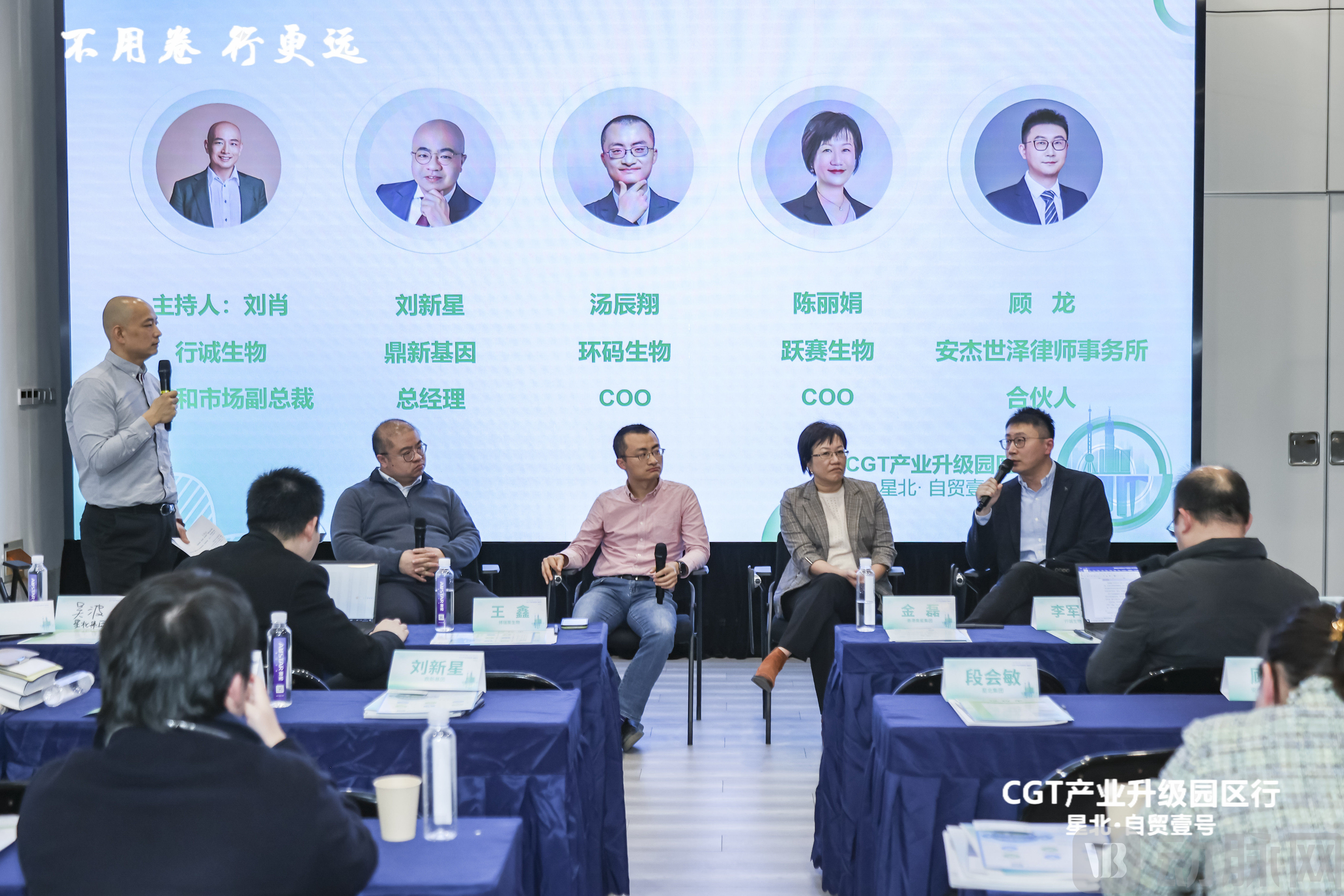
Discussion Session (from right to left):
Liu Xiao, Liu Xinxing, Tang Chenxiang, Chen Lijuan, Gu Long
The following is a summary of the excellent viewpoints of the guest speakers:
What Development Traits Are Most Important for Startups to Choose?
"Survival" is the most important
For pharmaceutical companies and other client enterprises, establishing CMC is undoubtedly a systematic process. In this regard, Liu Xinxing stated, "CMC issues should be considered as early as possible. From an industry perspective, ‘pitfalls’ are everywhere in the process of establishing CMC. Facing CDMOs in the emerging CGT field, there will certainly be some small pitfalls hidden in certain places waiting for practitioners to step into."However, the pitfalls that CDMOs have encountered during their development over the past few years are all advantageous, helping to address CMC issues."
The CDMO industry, which is derived from emerging industries such as CGT, is actually in a rather awkward position, requiring a long wait to accompany the industry's growth. Tang Chenxiang stated: "Because this emerging CDMO means the market is relatively new and small. In this case, investing in the CDMO field, how much to invest and how much return to expect, remains uncertain.The field of circular RNA that CirCode focuses on is also very new in the CDMO industry, with few companies able to provide services, so many things need to be built by ourselves."
Liu Xiao raised a question, "In fact, for some emerging fields like this, or some entirely new targets and FIC drugs, where there is a lack of benchmarks, some investors tend to adopt a wait-and-see attitude. The circular RNA industry that CirCode focuses on is also relatively new, and some services cannot be provided by CDMOs or CROs. How can we ensure the accuracy of our self-built CMC?"
Tang Chenxiang explained: "One of the core technologies of CirCode's own scientific research team is RNA cyclization, so we can build up CMC through intrinsic drive. Moreover, the company's exclusive technology gives us a certain competitive edge and advantage, allowing us to continuously optimize based on previous accumulation. Additionally, CirCode can also leverage this platform technology to collaborate with industry chain partners and simultaneously advance multiple pipelines."
In the process of establishing CMC, it is also a question worth considering for companies to choose which frequency among stability, speed, and cost-saving to advance the pipeline from IIT/IND to BLA.
In response, Chen Lijuan provided a different answer: "In the current environment, whichever option allows a startup to survive first is the most important.Some companies have survived by cutting costs, while others have survived by quickly achieving results and securing financing—there is no standard answer to this. If my answer is to keep the company alive by cutting costs, what are the ways to reduce costs? In recent years, the most common approach has been domestic substitution. However, the timing of domestic substitution is crucial, requiring a dense process plan to obtain comparable research data to support applications. Generally speaking, the later the substitution, the higher the cost."
Liu Xinxing, regarding these three traits, stated, "We often say, haste makes waste. We should judge which trait to focus on at a specific point in time based on the product's lifecycle. There's no need to choose just one of these three traits."
During the development cycle of biopharmaceuticals, many pipelines cannot generate profits for their companies before they come to market. Regarding this, Liu Xiao mentioned: "How do companies survive before becoming profitable? There are generally three ways: selling pipelines, selling technology, and financing."
Gu Long provided a more detailed explanation from the perspective of partnership transactions: "In order to survive in the early stage, start-ups will first consider conducting BD (Business Development) deals by licensing out their product pipelines. In addition, companies can also choose contract research or collaborative research models to work closely with industry chain partners, jointly investing costs and sharing risks. Besides, during operations, reducing costs while increasing revenue, co-developing with complementary partners, and sharing profits or patents can also alleviate some of the pressures associated with growth."
In the CGT field, besides the establishment of CMC, its delivery is also an unavoidable important topic.
Tang Chenxiang stated, "Not only in the CGT field, but in all drug research and development fields, drug delivery is a challenge."However, the CGT field involves delivering strongly charged macromolecular drugs into cells, which presents greater challenges. In this context, it is difficult for the industry to resolve this bottleneck through a single method or system. Therefore, I personally believe that collaboration on drug delivery is essential in the CGT field.CirCode is also willing to cooperate with various delivery platforms to jointly overcome these bottlenecks."
Chen Lijuan also stated, "The process development of cell-based drugs is a highly complex engineering system with challenging patent barriers to overcome. We should leverage the technologies of our own enterprises, collaborate with each other, and ensure mutual benefits within the ecosystem, rather than wasting resources on fields that are not our expertise."
Liu Xinxing expressed a different view: "Cooperation between industries should be centered around the concept of '1+1 being greater than 2,' meaning that collaboration should create new value and unlock new potential. Under this premise, companies should identify what they need based on their core competencies."In the process of pharmaceutical research and development, drug delivery is merely a means or tool, not our ultimate goal. Our objective is to develop accessible drugs through an appropriate delivery system."Therefore, we should look for a suitable delivery system team based on the characteristics of the drug."
Liu Xiao also expressed a similar viewpoint:"Our goal is to develop drugs. In this process, issues related to delivery technology must be resolved, as well as other systemic problems, in order to create safe, effective, and accessible medicines."
"Cooperation related to drug delivery has extended to collaborations between companies across the entire pharmaceutical field. Based on past case studies, Gu Long summarized relevant experiences: 'I believe these successful cases share similar characteristics. First, both parties in a collaboration must have strong technical or resource complementarity advantages. In my personal understanding, drug development often requires the use of multiple relatively independent technologies, and different companies can provide different technical support. On the other hand, in terms of transaction structure, license out and collaborative research and development are actually quite different. When a company licenses out a product, it generally retains only partial rights to the intellectual property. Most collaborative research and development efforts involve both parties sharing risks and benefits over the long term.'"
For domestically produced alternatives,
Should be viewed rationally
Regarding the issue of the domestically produced supply chain, Liu Xiao described the difficult situation of suppliers: "We actually don't want to talk about so-called 'direct replacements',"Affordable alternatives mean you can buy something worth a thousand yuan for just a hundred. But in reality, many things are 'you get what you pay for.'""If we can achieve the passing performance of a product worth a thousand yuan at the price of a hundred yuan, many companies are actually willing to give it a try. However, in the process of suppliers reducing costs and iterating on their processes, I often hear supplier companies talk about the difficulties they face in fierce competition."
Achieving domestic substitution is difficult for both Party A and Party B. How should we rationally view domestic substitution? In this regard, Chen Lijuan stated: "Whether it is a domestic or foreign supplier, the first thing we look at is the quality of the supplied materials. Secondly, if the product needs to be registered globally in the future, the stability of the supplier's delivery must also be considered.""For example, in the future, if we build a factory overseas, how to purchase materials from domestic suppliers abroad will also be a problem."
Tang Chenxiang stated: "Whether to consider domestically produced alternatives, cost is certainly an important factor, but it is only one of many considerations. We should first focus on whether the supplier's product is usable, user-friendly, and to what extent it is user-friendly. On the basis of being user-friendly, we also need to consider the security of the supply chain."Especially for suppliers related to consumables, there is concern about whether some small emerging CGT consumable companies will disappear in a few years. On the other hand, this also presents an excellent opportunity. In the CGT field, companies worldwide are on the same starting line, giving Chinese companies the chance to participate in setting CGT industry standards."Especially for some special processes, CGT companies in China can collaborate with domestically produced suppliers to develop and optimize these special processes and establish industry standards."
Liu Xiao also stated, "China's CGT industry, especially in recent years, has reached a point where we can, to a certain extent, lead the global technology and industrial development. For supplier selection in emerging industries, it is recommended to choose with the end in mind. Because the security and stability of the supply chain are crucial to ensuring the safety and feasibility of drugs, it cannot happen that the product cannot continue to be supplied halfway through production, especially during the application period, which is a significant test for domestic alternative companies."
From the perspectives of both supply and demand, Gu Long offered some insights: "From the supplier's perspective, I think the biggest issue is whether the services and products provided by companies have sufficient IP protection. This year, I’ve had at least three projects where legal due diligence and financial due diligence were fine, but there were some issues with IP. From the demand side, they may be concerned about intellectual property and trade secret protection when cooperating with domestic suppliers. These issues should be addressed through contractual constraints, while also considering appropriate non-compete clauses."
Finally, Liu Xiao concluded, "Not only the CGT industry but also the entire pharmaceutical industry is currently facing some immediate challenges. However, we should adhere to long-term thinking and look further ahead. The upstream and downstream of the industry chain should also collaborate to jointly promote the development of the industry."