

Lilly’s Non-Covalent BTK Inhibitor Jaypirca Receives Two FDA Accelerated Approvals Within a Year

Eli Lilly
Global Pharmaceutical R&D and Production Company
▎Edited by the WuXi AppTec content team
Pirtobrutinib (Brand name: Jaypirca) is a product developed by Eli Lilly and Company.Non-covalent, highly selective BTK inhibitor. In January this year, pirtobrutinib was approved by the U.S. FDAAccelerated Approval
, for the treatment of patients with relapsed/refractory mantle cell lymphoma (MCL) who have received at least two prior lines of systemic therapy, including a BTK inhibitor. Not long ago, pirtobrutinib once again received FDA'sAccelerated Approval
, for the treatment of adult patients with chronic lymphocytic leukemia or small lymphocytic lymphoma (CLL/SLL) who have previously received at least two lines of therapy, including BTK inhibitors and BCL-2 inhibitors.
According to the official press release from Eli Lilly and Company,Pirtobrutinib is the first non-covalent (reversible) BTK inhibitor approved by the FDA, and also the first BTK inhibitor approved for the treatment of MCL patients who have developed resistance to covalent BTK inhibitors.In today's article, the WuXi AppTec content team will review the history of BTK inhibitors and the development of pirtobrutinib, drawing on publicly available information.
BTK and B-cell Malignancies
In 1952, Dr. Ogden Bruton, a pediatrician at Walter Reed Army Hospital in Washington, discovered a disease called "Congenital Agammaglobulinemia." Using protein electrophoresis, Dr. Bruton quickly found that these patients lacked serum globulins. This primary immunodeficiency is now known as X-linked Agammaglobulinemia (XLA).
Forty years later, the genetic basis of XLA was finally uncovered. It turns out that in patients with XLA, a lack of expression of a tyrosine kinase in B cells prevents precursor B cells in the bone marrow from developing into mature B cells and entering the peripheral blood, leading to a significant reduction or absence of all isotypes of serum immunoglobulins in XLA patients. In 1993, two laboratories independently decoded the gene sequence of this tyrosine kinase, linking the disease to the gene mutation.
To commemorate Dr. Bruton, who discovered the first case of XLA, this tyrosine kinase (namely BTK) was named after his surname.
Since then, scientists have detected more than 800 various mutations in the analysis of XLA patients.
BTK gene abnormalities. These groundbreaking discoveries are milestones in understanding the genetic basis of primary immunodeficiency. Since then, scientists have begun to focus on the various roles of BTK in B-cell development and function.
In this process, the crucial role of BTK in B-cell receptor (BCR) signaling has drawn attention. Scientists have discovered that BCR signaling not only transmits adaptive immune response signals after contact with specific antigens but also plays a fundamental role in B-cell development. Through antigen-induced interactions among a series of proteins and the recruitment of signaling molecules, BTK is activated in response to BCR signaling, leading to processes such as B-cell survival, proliferation, differentiation, and antibody production. Clearly, in the absence of BTK, BCR signaling is insufficient to induce B-cell differentiation.
BTK mutations can also lead to abnormal BCR signaling responses.
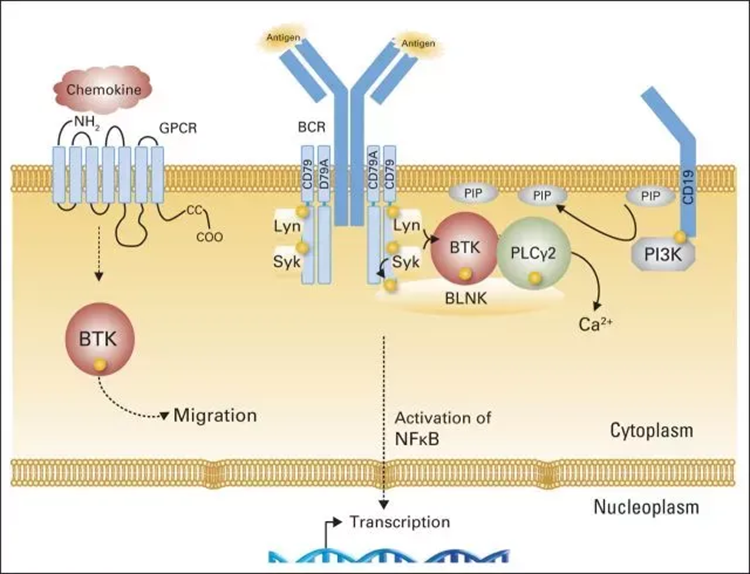
▲Multiple roles of BTK in B-cell signaling (Image source: Reference [1])
Interestingly, overexpression of BTK in B cells can also cause problems, particularly inflammation and autoimmune diseases. Moreover, BTK is expressed in most other cell types of the hematopoietic system. Studies have reported that BTK plays a role in the development of platelets, macrophages, and osteoclasts. Other researchers have noted that BTK is involved in certain B-cell processes and may potentially contribute to the formation of B-cell malignancies.
The Birth of BTK Covalent Inhibitors
Since BTK defects mainly affect B cells, BTK naturally becomes an attractive therapeutic target in autoimmune diseases and B-cell malignancies. Many companies began designing kinase-selective inhibitors based on the molecular structure and function of BTK. However, most attempts were unsuccessful until the emergence of a BTK covalent inhibitor named PCI-32765 (later called ibrutinib).
Interestingly, this small molecule was not initially developed as a drug but rather as a "tool compound" to assist in the screening of BTK inhibitors. Since covalent drugs can non-selectively, irreversibly, and permanently bind to proteins in the human body, off-target binding to normal human proteins may cause severe toxic side effects. This potential risk once made covalent drugs a taboo in drug development.
Later, a company named Pharmacyclics acquired this small molecule candidate. At the time, the company's CEO, Dr. Richard Miller, an expert in hematological oncology, astutely recognized the immense potential of ibrutinib in B-cell cancers — in cancerous B cells, the BTK protein is in a state of hyperactivity, and thus, a covalent inhibitor might be exactly what we need.
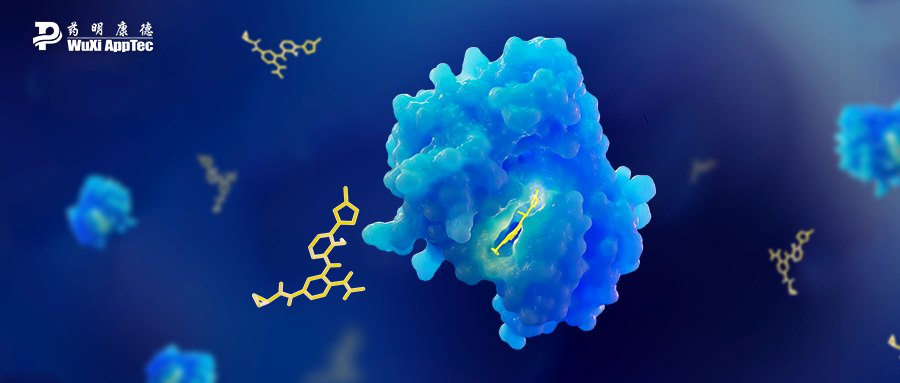
Ibrutinib ultimately did not disappoint Dr. Miller. It not only effectively and durably inhibits BTK activity, but its characteristic of being rapidly cleared by the body also limits potential toxic side effects. With its excellent clinical data showing a nearly 90% remission rate for patients, it took less than five years from the initiation of Phase 1 clinical trials to the final approval of ibrutinib.
On November 18, 2013, ibrutinib (trade name: Imbruvica) received accelerated FDA approval for single-agent use in mantle cell lymphoma. Subsequently, this therapy quickly gained FDA approval for multiple indications, including CLL and Waldenstrom macroglobulinemia, and has been hailed as a "blockbuster new drug that allows patients to avoid chemotherapy."
The Birth of Non-covalent BTK Inhibitors
But whether it is the first-generation or second-generation BTK covalent inhibitors, they all function by irreversibly binding to the C481 residue in the BTK kinase domain. Therefore, if patients develop
BTK resistance mutations prevent these drugs from binding to the C481 residue, significantly reducing their efficacy.
In clinical practice, it is not uncommon for patients to develop drug-resistant mutations as the duration of medication increases.
Moreover, due to off-target effects, many patients cannot tolerate this type of medication, which often leads to treatment discontinuation.
In such a clinical context, developing a BTK inhibitor that possesses both high selectivity and does not rely on binding to the C481 residue for its action may be a new solution. Pirtobrutinib is such a drug, which is completely different from the first two generations of BTK covalent inhibitors.
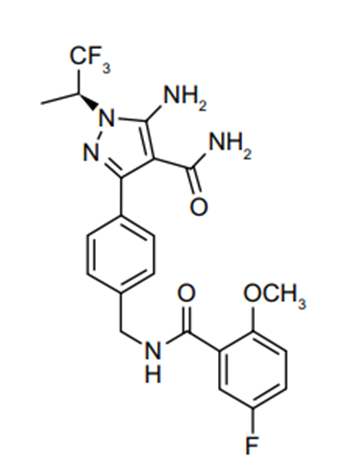
▲
Chemical Structure of Pirtobrutinib (Image Source: Reference [3])
Pirtobrutinib has no direct interaction with C481 and is a non-covalent, reversible BTK inhibitor. Additionally, pirtobrutinib exhibits higher selectivity for BTK, which is expected to reduce adverse events associated with treatment. In preclinical experiments, pirtobrutinib demonstrated...
BTK Wild-Type and Carrying
Pirtobrutinib demonstrated similar efficacy in both cellular and animal models of BTK C481 substitution mutations. This suggests that pirtobrutinib has the potential to introduce an entirely new treatment approach. However, until it successfully passes the test of human trials, everything remains uncertain.
Excellent clinical data within one yearReceived Two FDA Accelerated Approvals
Pirtobrutinib was initially developed by Redx Pharma and later acquired by Loxo Oncology in 2017. In February 2019, Eli Lilly completed the acquisition of Loxo Oncology, bringing this promising candidate therapy into its portfolio. Due to the significant potential pirtobrutinib demonstrated in preclinical studies, high expectations have been placed on this treatment.
By the end of 2018, pirtobrutinib entered the clinical trial phase, launching a Phase 1/2 trial for B-cell malignancies. In this clinical study, pirtobrutinib demonstrated excellent efficacy and safety data across different patient subgroups resistant to BTK covalent inhibitors. Based on these results, pirtobrutinib received two accelerated approvals from the FDA within a year, respectively forMCL
AndCLL/SLL
Patient.
Among 120 MCL patients who had previously received at least one line of therapy containing a BTK covalent inhibitor, the overall response rate (ORR) for those treated with pirtobrutinib was 50%, with 13% achieving complete response and 38% achieving partial response. The median duration of response was 8.3 months.
Pirtobrutinib Shows Stunning Results in CLL/SLL Patients Previously Treated with at Least Two Lines of Therapy. At the 2023 American Society of Hematology (ASH) Annual Meeting, Eli Lilly presented long-term follow-up data on pirtobrutinib for the treatment of CLL/SLL patients. Among 282 patients previously treated with a BTK inhibitor, the overall response rate (ORR) for those treated with pirtobrutinib was as high as 81.6%, with consistent response rates across all subgroups regardless of prior treatment, age, or mutation status. At a median follow-up time of 27.5 months, the median progression-free survival was 19.4 months. At a median follow-up time of 29.3 months, the median overall survival could not be estimated.
The new journey continues.
Of course, receiving accelerated approval from the FDA is just the beginning. We look forward to pirtobrutinib continuing to demonstrate its efficacy in several upcoming randomized Phase 3 studies and ultimately gaining full FDA approval. In China, the marketing application for pirtobrutinib has also been granted priority review.
Indication: Monotherapy for adult patients with relapsed or refractory MCL who have previously received BTK inhibitor treatment.
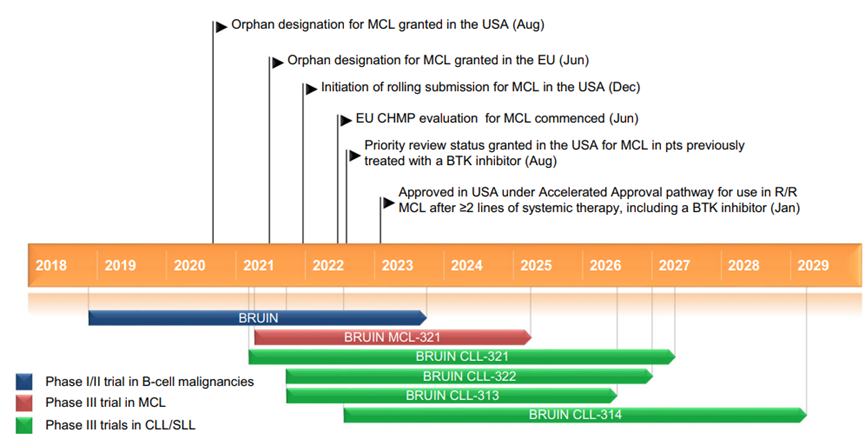
▲
Key Milestones of Pirtobrutinib in the Treatment of B-cell Leukemia and Lymphoma (Source: Reference [3])
It is worth looking forward to that pirtobrutinib is expected to play a role in more therapeutic fields, providing new treatment options for patients with other B-cell-related diseases and even other types of diseases.
For example, 10% of patients with CLL will undergo Richter transformation (RT), becoming more aggressive, and the median overall survival for patients with this rare blood cancer is only 3-4 months. Currently, there are no approved therapies specifically for RT, and traditional BTK inhibitors may also struggle to address it. Based on the positive results of pirtobrutinib in treating CLL patients, this therapy is likely to have a good therapeutic effect on RT patients as well. In addition to blood cancers, several large biopharmaceutical companies have been developing BTK inhibitors for the treatment of autoimmune diseases in recent years, so perhaps we will also see the presence of pirtobrutinib in this field in the future.
In the continuous advancement of medicine, we look forward to seeing the emergence of more innovative treatment methods, bringing better quality of life and longer survival periods for patients.
.rich_media_content{color:#000000e5;font-size:17px;font-size:var(--articleFontsize);overflow:hidden;text-align:justify}.rich_media_content{color:#ffffffa6;color:var(--weui-FG-HALF)}.rich_media_content{position:relative;z-index:0}.data_color_scheme_dark{--weui-ORANGERED: #ff6146;--weui-BG-0: #111;--weui-BG-1: #1e1e1e;--weui-BG-2: #191919;--weui-BG-3: #202020;--weui-BG-4: #404040;--weui-BG-5: #2c2c2c;--weui-FG-0: rgba(255, 255, 255, .8);--weui-FG-HALF: rgba(255, 255, 255, .6);--weui-FG-1: rgba(255, 255, 255, .5);--weui-FG-2: rgba(255, 255, 255, .3);--weui-FG-3: rgba(255, 255, 255, .1);--weui-FG-4: rgba(255, 255, 255, .15);--weui-FG-5: rgba(255, 255, 255, .1);--weui-RED: #fa5151;--weui-REDORANGE: #ff6146;--weui-ORANGE: #c87d2f;--weui-YELLOW: #cc9c00;--weui-GREEN: #74a800;--weui-LIGHTGREEN: #3eb575;--weui-BRAND: #07c160;--weui-BLUE: #10aeff;--weui-INDIGO: #1196ff;--weui-PURPLE: #8183ff;--weui-WHITE: rgba(255, 255, 255, .8);--weui-LINK: #7d90a9;--weui-TEXTGREEN: #259c5c;--weui-FG: #fff;--weui-BG: #000;--weui-TAG-TEXT-RED: rgba(250, 81, 81, .6);--weui-TAG-BACKGROUND-RED: rgba(250, 81, 81, .1);--weui-TAG-TEXT-ORANGE: rgba(250, 157, 59, .6);--weui-TAG-BACKGROUND-ORANGE: rgba(250, 157, 59, .1);--weui-TAG-TEXT-GREEN: rgba(6, 174, 86, .6);--weui-TAG-BACKGROUND-GREEN: rgba(6, 174, 86, .1);--weui-TAG-TEXT-BLUE: rgba(16, 174, 255, .6);--weui-TAG-BACKGROUND-BLUE: rgba(16, 174, 255, .1);--weui-TAG-TEXT-BLACK: rgba(255, 255, 255, .5);--weui-TAG-BACKGROUND-BLACK: rgba(255, 255, 255, .05)}.data_color_scheme_dark{--weui-BTN-ACTIVE-MASK: rgba(255, 255, 255, .1)}.data_color_scheme_dark{--weui-BTN-DEFAULT-ACTIVE-BG: rgba(255, 255, 255, .126)}.data_color_scheme_dark{--weui-DIALOG-LINE-COLOR: rgba(255, 255, 255, .1)}.data_color_scheme_dark{--weui-BG-COLOR-ACTIVE: #373737}.data_color_scheme_dark{--weui-BG-6: rgba(255, 255, 255, .1);--weui-ACTIVE-MASK: rgba(255, 255, 255, .1)}.wxw-img{vertical-align:bottom}@media screen and (min-width:1024px){body:not(.pages_skin_pc) :root{--appmsgPageGap: 20px}}:root{--articleFontsize: 17px}:root{--sab: env(safe-area-inset-bottom)}:root{--wxBorderAvatarRatio: 3}:root{--discussPageGap: 20px}:root{--appmsgPageGap: 20px}*{margin:0;padding:0}.rich_media_content *{max-width:100%!important;box-sizing:border-box!important;-webkit-box-sizing:border-box!important;word-wrap:break-word!important}body,.wx-root,page{--weui-BTN-HEIGHT: 48;--weui-BTN-HEIGHT-MEDIUM: 40;--weui-BTN-HEIGHT-SMALL: 32}body,.wx-root{--weui-FG-1: rgba(0, 0, 0, .55);--weui-ORANGERED: #ff6146;--weui-BG-0: #ededed;--weui-BG-1: #f7f7f7;--weui-BG-2: #fff;--weui-BG-3: #f7f7f7;--weui-BG-4: #4c4c4c;--weui-BG-5: #fff;--weui-FG-0: rgba(0, 0, 0, .9);--weui-FG-HALF: rgba(0, 0, 0, .9);--weui-FG-1: rgba(0, 0, 0, .5);--weui-FG-2: rgba(0, 0, 0, .3);--weui-FG-3: rgba(0, 0, 0, .1);--weui-FG-4: rgba(0, 0, 0, .15);--weui-FG-5: rgba(0, 0, 0, .05);--weui-RED: #fa5151;--weui-REDORANGE: #ff6146;--weui-ORANGE: #fa9d3b;--weui-YELLOW: #ffc300;--weui-GREEN: #91d300;--weui-LIGHTGREEN: #95ec69;--weui-BRAND: #07c160;--weui-BLUE: #10aeff;--weui-INDIGO: #1485ee;--weui-PURPLE: #6467f0;--weui-WHITE: #fff;--weui-LINK: #576b95;--weui-TEXTGREEN: #06ae56;--weui-FG: #000;--weui-BG: #fff;--weui-TAG-TEXT-RED: rgba(250, 81, 81, .6);--weui-TAG-BACKGROUND-RED: rgba(250, 81, 81, .1);--weui-TAG-TEXT-ORANGE: #fa9d3b;--weui-TAG-BACKGROUND-ORANGE: rgba(250, 157, 59, .1);--weui-TAG-TEXT-GREEN: #06ae56;--weui-TAG-BACKGROUND-GREEN: rgba(6, 174, 86, .1);--weui-TAG-TEXT-BLUE: #10aeff;--weui-TAG-BACKGROUND-BLUE: rgba(16, 174, 255, .1);--weui-TAG-TEXT-BLACK: rgba(0, 0, 0, .5);--weui-TAG-BACKGROUND-BLACK: rgba(0, 0, 0, .05)}body,.wx-root{--weui-BG-6: rgba(0, 0, 0, .05);--weui-ACTIVE-MASK: rgba(0, 0, 0, .05)}@media screen and (min-width:1024px){body:not(.pages_skin_pc){background:#191919;background:var(--weui-BG-2)}}@media(prefers-color-scheme:dark){body:not([data-weui-theme=light]).my_comment_empty_data{background-color:#111}}.wx-root,body{--weui-BTN-ACTIVE-MASK: rgba(0, 0, 0, .1)}.wx-root,body{--weui-BTN-DEFAULT-ACTIVE-BG: #e6e6e6}.wx-root,body{--weui-DIALOG-LINE-COLOR: rgba(0, 0, 0, .1)}.wx-root,body{--weui-BG-COLOR-ACTIVE: #ececec}@media(prefers-color-scheme:dark){.wx-root:not([data-weui-theme=light]),body:not([data-weui-theme=light]){--appmsgExtra-BG: #121212}}@media(prefers-color-scheme:dark){.wx-root:not([data-weui-theme=light]),body:not([data-weui-theme=light]){--weui-ORANGERED: #ff6146;--weui-BG-0: #111;--weui-BG-1: #1e1e1e;--weui-BG-2: #191919;--weui-BG-3: #202020;--weui-BG-4: #404040;--weui-BG-5: #2c2c2c;--weui-FG-0: rgba(255, 255, 255, .8);--weui-FG-HALF: rgba(255, 255, 255, .6);--weui-FG-1: rgba(255, 255, 255, .5);--weui-FG-2: rgba(255, 255, 255, .3);--weui-FG-3: rgba(255, 255, 255, .1);--weui-FG-4: rgba(255, 255, 255, .15);--weui-FG-5: rgba(255, 255, 255, .1);--weui-RED: #fa5151;--weui-REDORANGE: #ff6146;--weui-ORANGE: #c87d2f;--weui-YELLOW: #cc9c00;--weui-GREEN: #74a800;--weui-LIGHTGREEN: #3eb575;--weui-BRAND: #07c160;--weui-BLUE: #10aeff;--weui-INDIGO: #1196ff;--weui-PURPLE: #8183ff;--weui-WHITE: rgba(255, 255, 255, .8);--weui-LINK: #7d90a9;--weui-TEXTGREEN: #259c5c;--weui-FG: #fff;--weui-BG: #000;--weui-TAG-TEXT-RED: rgba(250, 81, 81, .6);--weui-TAG-BACKGROUND-RED: rgba(250, 81, 81, .1);--weui-TAG-TEXT-ORANGE: rgba(250, 157, 59, .6);--weui-TAG-BACKGROUND-ORANGE: rgba(250, 157, 59, .1);--weui-TAG-TEXT-GREEN: rgba(6, 174, 86, .6);--weui-TAG-BACKGROUND-GREEN: rgba(6, 174, 86, .1);--weui-TAG-TEXT-BLUE: rgba(16, 174, 255, .6);--weui-TAG-BACKGROUND-BLUE: rgba(16, 174, 255, .1);--weui-TAG-TEXT-BLACK: rgba(255, 255, 255, .5);--weui-TAG-BACKGROUND-BLACK: rgba(255, 255, 255, .05)}}@media(prefers-color-scheme:dark){.wx-root:not([data-weui-theme=light]),body:not([data-weui-theme=light]){--weui-BTN-ACTIVE-MASK: rgba(255, 255, 255, .1)}}@media(prefers-color-scheme:dark){.wx-root:not([data-weui-theme=light]),body:not([data-weui-theme=light]){--weui-BTN-DEFAULT-ACTIVE-BG: rgba(255, 255, 255, .126)}}@media(prefers-color-scheme:dark){.wx-root:not([data-weui-theme=light]),body:not([data-weui-theme=light]){--weui-DIALOG-LINE-COLOR: rgba(255, 255, 255, .1)}}@media(prefers-color-scheme:dark){.wx-root:not([data-weui-theme=light]),body:not([data-weui-theme=light]){--weui-BG-COLOR-ACTIVE: #373737}}@media(prefers-color-scheme:dark){.wx-root:not([data-weui-theme=light]),body:not([data-weui-theme=light]){--weui-BG-6: rgba(255, 255, 255, .1);--weui-ACTIVE-MASK: rgba(255, 255, 255, .1)}}@media(prefers-color-scheme:dark){.wx-root:not([data-weui-theme=light]),body:not([data-weui-theme=light]){--discussInput-BG: rgba(255, 255, 255, .03)}}@media(prefers-color-scheme:dark){.wx-root:not([data-weui-theme=light]),body:not([data-weui-theme=light]){--nickName-FG: #959595}}h1,h2,h3,h4,h5,h6{font-weight:400;font-size:16px}.rich_media_content p{clear:both;min-height:1em}td p{margin:0;padding:0}a{color:#576b95;text-decoration:none;-webkit-tap-highlight-color:#0000;-webkit-user-drag:none}a{color:#7d90a9;color:var(--weui-LINK)}a,button{cursor:pointer}.rich_media_content em{font-style:italic}@media(prefers-color-scheme:dark){body:not([data-weui-theme=light]) .rich_media_content img:not(.wx_img_placeholder){filter:brightness(.8)}}