Pfizer Stock Hits New Low as Company Forecasts $5 Billion Revenue Shortfall for 2024
Pfizer
Pharmaceutical R&D Developer
On December 13, Pfizer's new announcement showed that its revenue in 2024 might be about $5 billion lower than Wall Street's expectations. This caused its stock price to plummet more than 8%, hitting a new low since 2014, and it has fallen over 46% since the beginning of this year. Meanwhile, Pfizer also plans to "incrementally" cut $500 million in costs.
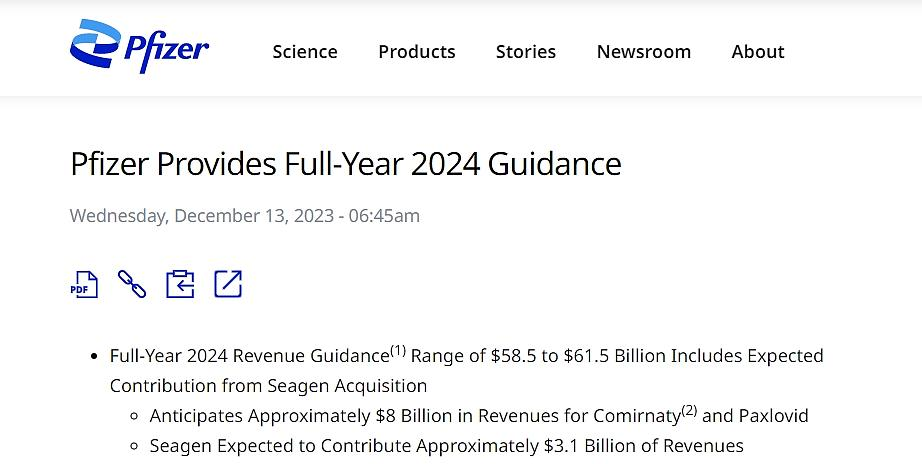
Image Source: Pfizer Official Website
According to the announcement, Pfizer expects its full-year revenue for 2024 may decline or remain flat compared to 2023, with an estimated range of approximately $58.5 billion to $61.5 billion. According to CNBC, analysts' average revenue forecast is close to $63.2 billion.
Tough 2023
Since the third quarter of 2023, Pfizer has experienced its first quarterly loss since 2019, with significant declines in the sales of the Comirnaty vaccine and Paxlovid.
In 2022, the standout year for the COVID-19 product portfolio, Comirnaty and Paxlovid generated nearly $57 billion in combined sales, accounting for nearly 60% of Pfizer's total revenue in 2022, with Pfizer's total revenue exceeding $100 billion for the year.
The announcement shows that Pfizer expects revenue of $8 billion from its COVID-19 products, Comirnaty and Paxlovid, in 2024.
Nowadays, the expectations for 2024 are only a fraction of those for 2022.
In addition, Pfizer also expects to acquire Seagen, which will bring Pfizer approximately $3.1 billion in revenue.
Notably, Pfizer's $43 billion acquisition of ADC giant Seagen passed all regulatory hurdles on December 12 and is expected to be finalized today (December 14).
Therefore, excluding COVID-19 products and Seagen's revenue, Pfizer anticipates 3% to 5% growth in total revenue for the full year of 2024. The combined remaining portfolio of Pfizer and Seagen is expected to achieve 8% to 10% operational revenue growth year-over-year.
Moreover, in October 2023, Pfizer launched a significant cost-cutting initiative aimed at saving approximately $3.5 billion by 2024. To date, the total amount of this plan has been increased to $4 billion.
Cost-cutting measures include layoffs conducted on a global scale. According to incomplete statistics, Pfizer has initiated 7 rounds of layoffs this year, with over 2,000 employees affected.
Continuous Challenges: GLP-1 Stumbles Again
On December 1, Pfizer announced that it plans to abandon the development of its experimental weight-loss drug danuglipron, which is another major blow for Pfizer. The company had originally hoped to enter the currently booming weight-loss drug market and achieve a turnaround with it.
Danuglipron is an oral GLP-1RA formulation that has not yet received any approvals. Danuglipron works by increasing insulin release and decreasing glucagon release, maintaining blood glucose at normal levels. Danuglipron can also slow the digestion of food and increase the feeling of fullness after eating.
Danuglipron is administered twice daily. Study data show that by Week 32, all doses of Danuglipron resulted in a statistically significant reduction in body weight compared to baseline, with an average decrease of 6.9%-11.7%, compared to only 1.4% for the placebo. By Week 26, the average weight loss in the Danuglipron group was 4.8%-9.4%, while the placebo group experienced a 0.17% decrease.
However, in terms of safety, the results shown by Danuglipron are somewhat concerning. The study results indicate a relatively high incidence of gastrointestinal side effects related to the mechanism of action (nausea: 73%; vomiting: 47%; diarrhea: 25%). The discontinuation rate for all doses was higher than 50%, compared to about 40% for the placebo. No new safety signals were reported, and treatment with Danuglipron was not associated with an increased incidence of elevated liver enzymes compared to the placebo.
Perhaps due to safety concerns, Pfizer decided not to proceed with the Phase III clinical development of Danuglipron.
In addition to Danuglipron, Pfizer has also developed another GLP-1R agonist, Lotiglipon. Lotiglipon is an optimized molecule based on Danuglipron, with a longer half-life, allowing patients to take it orally once a day, whereas Danuglipron requires twice-daily oral administration. Although Danuglipron and Lotiglipon differ in dosing frequency, their ultimate fate turns out to be the same.
On June 26, 2023, Pfizer announced the termination of Lotiglipon's development.
Pfizer has also launched a new RSV vaccine called Abrysvo, which is based on mRNA technology. However, Abrysvo's recent market performance has been disappointing, lagging behind its competitor GSK's Arexvy. In the third quarter of 2023, Abrysvo generated revenue of $375 million, compared to Arexvy's $850 million—less than half of Arexvy’s revenue.

Editor: Pea Shooter
Disclaimer: This article is an integrated content and does not represent the views of this platform. If it involves issues related to the content, copyright, or other problems, please leave a message on this platform, and we will handle it promptly.