

Amgen's DLL3/CD3 Bispecific Antibody Tarlatamab Receives FDA Priority Review for Relapsed Extensive-Stage Small Cell Lung Cancer

Amgen
Developer of Treatment Drugs for Serious Diseases

Welcome to follow CAYLAIN PHARMaceutical News

On December 13, 2023, Amgen announced that the U.S. Food and Drug Administration(FDA) has accepted the tarlatamab Biologics License Application (BLA) and granted Priority Review., for the treatment of adult patients with advanced small cell lung cancer (SCLC) whose disease has progressed after platinum-based chemotherapy,Prescription Drug User Fee Act (PDUFA) Date: June 12, 2024BeiGene has the commercial rights to this investigational drug in China.
About Tarlatamab
Tarlatamab is a bispecific T-cell engager (BiTE) targeting DLL3/CD3, and is expected to become the first drug targeting DLL3. DLL3 is expressed in more than 85% of small cell lung cancers and is hardly expressed in normal tissues. Tarlatamab kills cancer cells by recruiting T cells to the vicinity of cancer cells and activating them. Previously, the drug was granted Breakthrough Therapy Designation by the FDA.
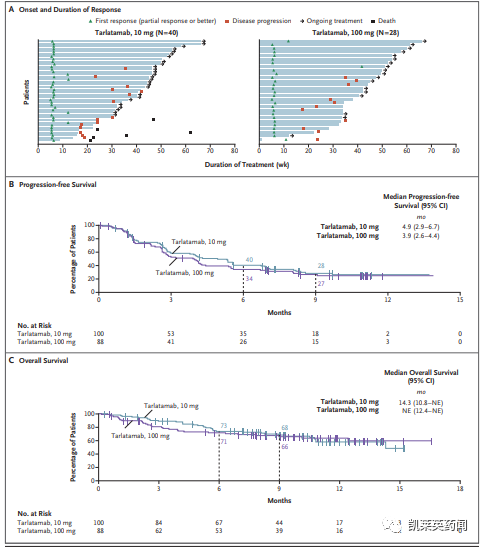
The submission of this BLA is based on the results of the DeLLphi-301 clinical trial, a Phase 2 study designed to evaluate the antitumor activity and safety of tarlatamab (10mg/100mg) administered intravenously every two weeks in patients with previously treated SCLC. The primary endpoint is the objective response rate (ORR) assessed by blinded independent central review (BICR); secondary endpoints include duration of response (DoR), disease control rate (DCR), progression-free survival (PFS), and overall survival (OS).Results:
The ORR of the 10mg group and the 100mg group was 40% and 32%, respectively.
The PFS for the 10mg group and 100mg group were 4.9 months and 3.9 months, respectively.
The OS of the 10mg group was 14.3 months, and that of the 100mg group was not reached.
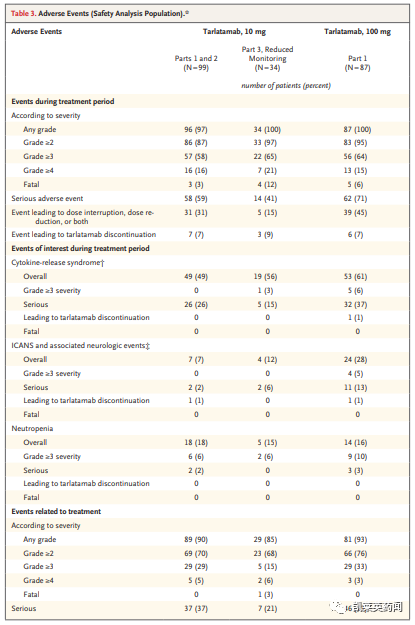
In terms of safety, no new safety signals were observed compared to Phase 1 clinical trials. The most common adverse events included cytokine release syndrome, decreased appetite, and fever. The incidence of Grade 3 cytokine release syndrome was lower in the 10 mg group (1%) compared to the 100 mg group (6%). The proportion of patients discontinuing tarlatamab due to treatment-related adverse events was low (3%).
In addition, multiple studies on tarlatamab are currently underway, including the Phase 1 DeLLphi-302 study, which aims to evaluate the combination of tarlatamab with anti-PD-1 therapy for second-line or later-line treatment of SCLC; the Phase 1b DeLLphi-303 study, which aims to assess the efficacy of tarlatamab combined with the standard of care for first-line SCLC; the Phase 3 DeLLphi-304 study, which compares the efficacy of tarlatamab monotherapy versus standard chemotherapy in second-line treatment of SCLC; and the Phase 1b DeLLpro-300 study, which is aimed at treating de novo or emerging neuroendocrine prostate cancer. Additionally, Amgen plans to initiate another Phase 3 study to evaluate tarlatamab for first-line treatment of SCLC.
About DLL3 Drugs
DLL3 (Delta-like canonical Notch ligand 3) is a member of the Notch pathway ligand family and plays a crucial role in Notch signaling. DLL3 binds to the Notch receptor, thereby activating the Notch pathway, which is associated with tumor cell proliferation, cell cycle arrest, and epithelial-mesenchymal transition.
In addition to the Notch signaling pathway, DLL3 also plays a role in other signaling pathways. For example, DLL3 activates the P13K/Akt pathway by inhibiting the Notch signaling pathway. As DLL3 expression is upregulated, the expression levels of Wnt-1, Wnt-4, and the Wnt target genes Axin-2 and Lef-1 are all upregulated, suggesting that DLL3 is involved in the activation of the Wnt signaling pathway. Furthermore, studies have shown that DLL3 regulates the Notch/Wnt signaling pathway by modulating the cyclic expression of Nrarp.
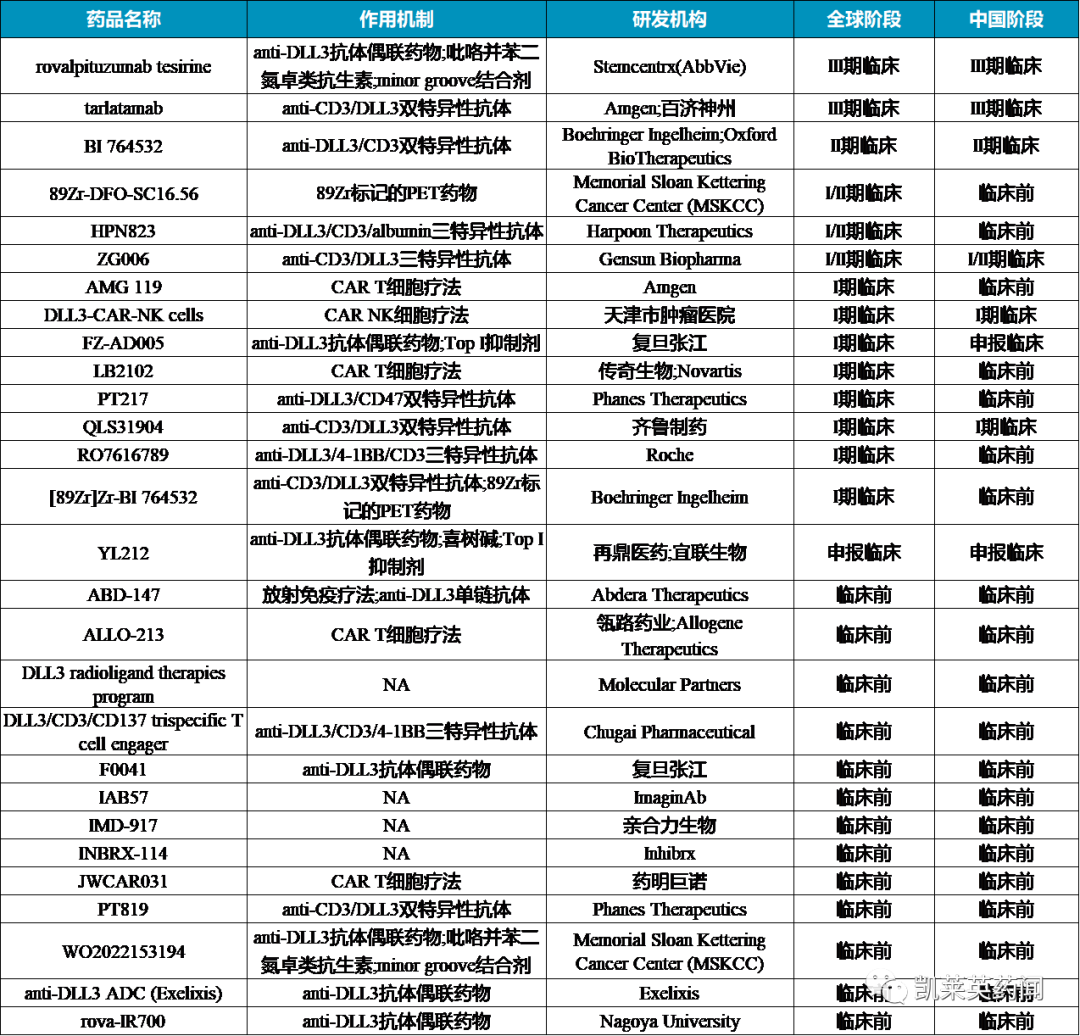
The study found that DLL3 is widely expressed in approximately 80% of SCLC and other neuroendocrine tumors, but rarely expressed in normal cells.According to incomplete statistics, there are currently less than 30 DLL3 drugs under research.
About Small Cell Lung Cancer
Lung cancer is one of the most common malignant tumors globally. According to GLOBOCAN data, there were 2.2 million new cases of lung cancer and 1.8 million new deaths from lung cancer in 2020, ranking at the top for cancer-related mortality.
Small Cell Lung Cancer: A Type of Undifferentiated Carcinoma
(1) First-line chemotherapy regimen
Limited-stage EP regimen (DDP/VP-16), CE regimen (CBP/VP-16), combined with radiotherapy.
In addition to the EP and CE regimens, the DDP/CPT-11 regimen can also be selected for extensive-stage disease.
(2) Second-line chemotherapy regimen
Different treatment regimens are distinguished based on the length of the tumor recurrence period. When the tumor recurs within 3 months and the patient’s physical condition is good, drugs such as docetaxel, gemcitabine, and ifosfamide can be selected; when the tumor recurs after more than 3 months but less than 6 months, options include topotecan, gemcitabine, the CAV regimen (CTX/ADM/VCR), and oral VP-16; when the tumor recurs after more than 6 months, the first-line treatment regimen can still be maintained.
According to data from the National Cancer Center, the number of non-small cell lung cancer cases in China reached 809,000 in 2021, of which small cell lung cancer (SCLC) accounts for 15%-20% of the total number of lung cancer cases; assuming that extensive-stage small cell lung cancer (ES-SCLC) accounts for about 70%, the number of new extensive-stage small cell lung cancer cases in 2021 was approximately 113,000.
About Amgen's Layout in the Bispecific Antibody Field
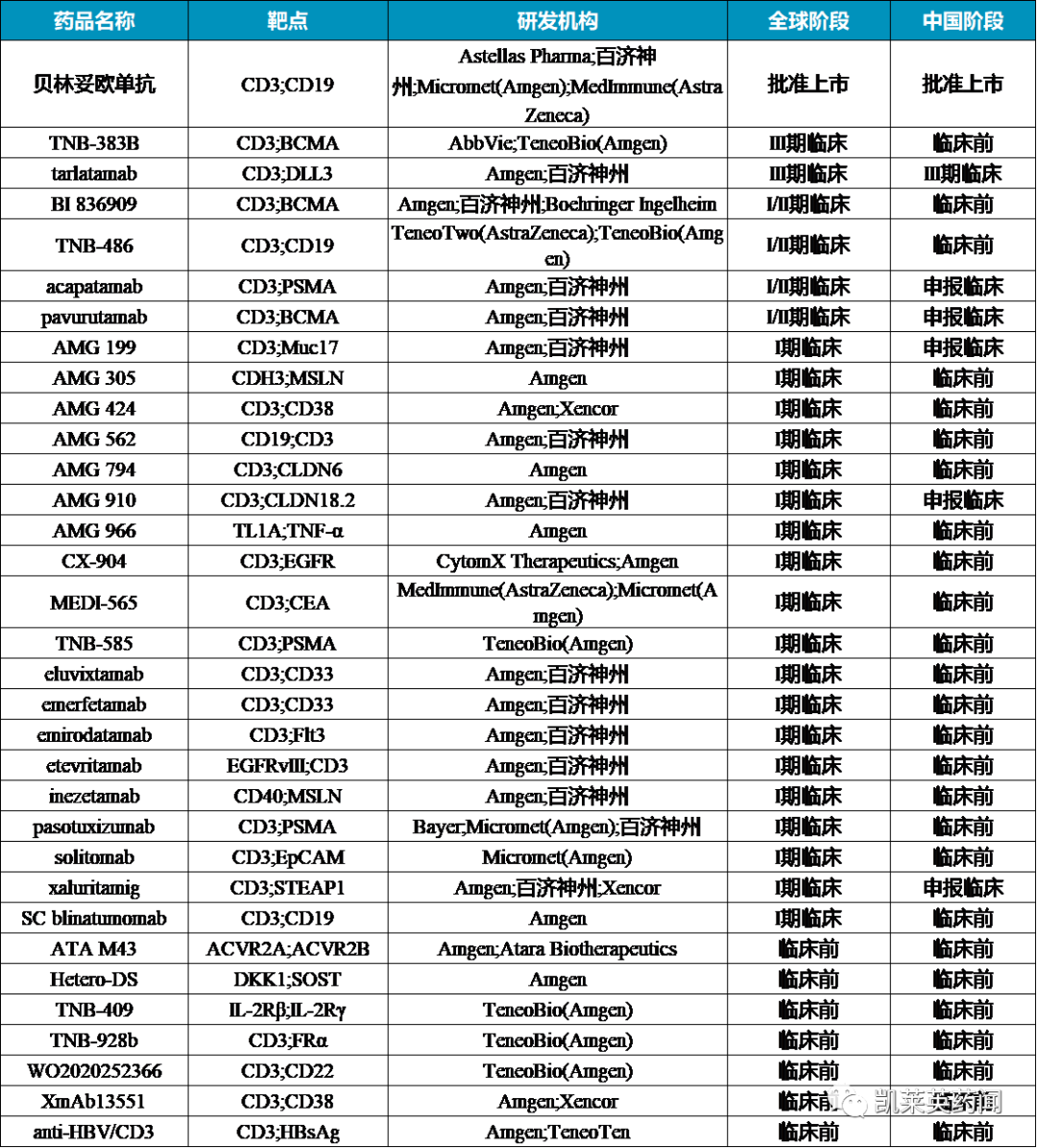
According to incomplete statistics, currentlyAmgen has laid out over 30 innovative drugs in the bispecific antibody field, with only one product, Blinatumomab, approved.
References
1. Official Company Website
2、Ahn M J, Cho B C, Felip E, et al. Tarlatamab for patients with previously treated small-cell lung cancer[J]. New England Journal of Medicine, 2023.
3. Good Doctor Friend, eDrug Safety
4. Southwest Securities, Shenwan Hongyuan



"Views"Click once