

Chinese-originated ScTIL technology demonstrates major breakthrough in treating advanced biliary tract cancer
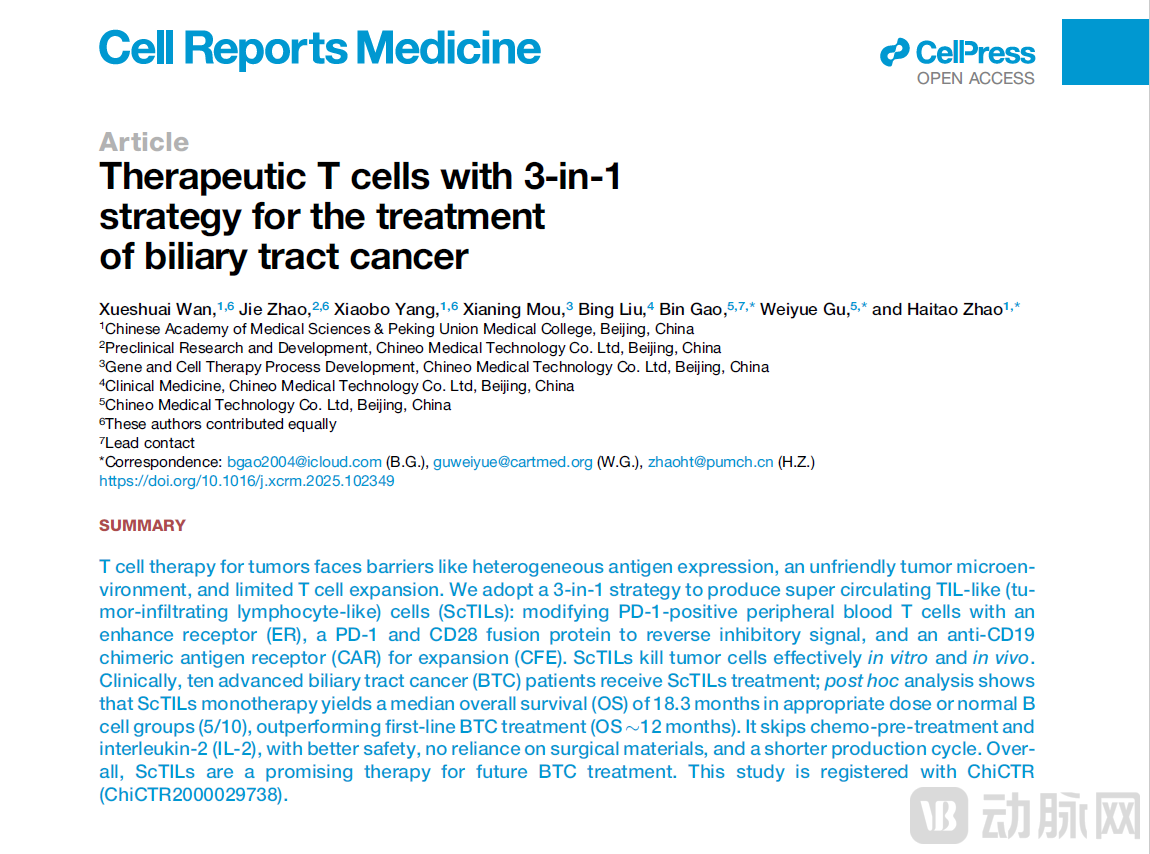
A clinical study on ScTIL technology—an original Chinese peripheral blood-derived TIL-like cell therapy for advanced biliary tract cancer—has recently been published in Cell Reports Medicine.
Although this is only a proof-of-concept clinical study, it represents a significant conceptual breakthrough in the field of solid tumor immunotherapy. For the first time, TIL-like cells were isolated from peripheral blood, genetically modified, and their clinical efficacy validated in biliary tract cancer, one of the most aggressive malignancies.
Study data revealed that ScTIL therapy extended the overall survival (OS) of heavily pretreated advanced biliary tract cancer patients by fivefold compared to the control group, with their OS even significantly surpassing that of first-line standard treatment. The Principal Investigator (PI) of this study is Professor Haitao Zhao from the Department of Liver and Gallbladder Surgery at Peking Union Medical College Hospital (PUMCH). The ScTIL cell preparation and technological support were provided by Beijing Chineo Medical Technology Co., Ltd.
In recent years, PD-1 monoclonal antibodies have become mainstream anti-cancer drugs, and cell therapies such as CAR-T and tumor-infiltrating lymphocytes (TIL) have successively gained regulatory approval. However, conquering cancer, particularly solid tumors, remains a formidable challenge. The article highlights that overcoming the following "three major barriers" is essential to achieve this goal:
1. Heterogeneity: How to enable T cells to recognize all cancer cells carrying thousands of different antigens. CAR-T and other targeted therapies can only recognize one or two specific antigens, missing others—a key factor limiting their efficacy.
2. Tumor Microenvironment (TME): How to ensure T cells can prevail when encountering cancer cells. Tumor cells suppress T cells, rendering them ineffective.
3. T Cell Expansion: How to rapidly, efficiently, and cost-effectively scale up the "total forces" of T cells.
PD-1 monoclonal antibodies primarily counteract the tumor microenvironment but fail to address the other two major barriers. While TIL therapy is designed to overcome tumor heterogeneity, it relies on surgical tissue procurement, lymphodepleting chemotherapy preconditioning, high-dose IL-2 administration, and massive ex vivo expansion. Consequently, it faces significant limitations and drawbacks, including restricted applicability, high manufacturing failure rates, severe toxicities, substantial costs, and lengthy production cycles.
ScTILs are designed to simultaneously address all three major barriers by integrating the following three innovations:
First, it bypasses the need for surgical tissue acquisition, requiring only peripheral blood apheresis to isolate circulating TIL-like cells (cTILs)—natural T cells that resemble TILs in their specific recognition of heterogeneous tumors—thereby overcoming heterogeneity.
Second, it uses genetic modification with an "Enhance Receptor" to reverse the inhibitory signals exerted by cancer cells on T cells into activating signals ("transforming brakes into acceleration"), thereby overcoming the challenge of the tumor microenvironment.
Third, it uses genetic modification with a CD19-targeting CAR to leverage the stimulation from the patient's own B cells, enabling the in vivo expansion of ScTILs without the need for excessive ex vivo expansion.
The integration of these three innovations also spares patients from lymphodepleting chemotherapy and IL-2, while simplifying the cell production process—shortening the cycle and reducing costs.
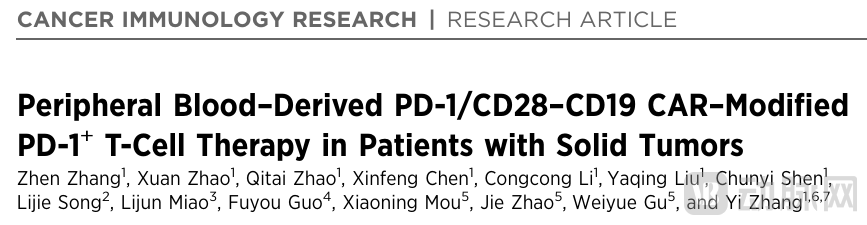
This is not the first clinical study of this "3-in-1" strategy. The initial clinical study of ScTILs for pan-carcinoma solid tumors was published in Cancer Immunology Research in 2024, which reported cases of complete remission (CR), a high disease control rate, and a favorable safety profile.
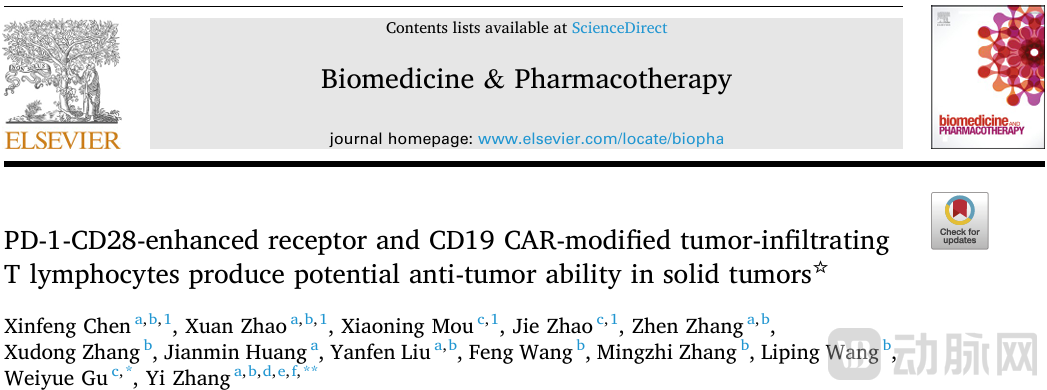
A slightly earlier clinical study of Beijing Chineo's previous-generation "3-in-1" strategy—enhanced receptor and CD19-CAR modified TIL cells (STIL, or "Super TIL") for solid tumors—was published in Biomedicine & Pharmacotherapy, reporting cases of partial remission (PR), a high disease control rate, and a favorable safety profile.
This ScTIL study treated a total of 10 patients with advanced biliary tract cancer who had either failed prior therapies or experienced postoperative recurrence.
·Significantly Shortened Production Cycle
The median time from peripheral blood collection to cell infusion (vein-to-vein time) was 18 days. This duration included a 7-day quality control period and delays due to patients' inability to receive the infusion promptly under pandemic conditions at the time. It is significantly shorter than that required for conventional TIL therapy. (It has been reported that the Beijing Chineo's latest-generation ScTIL technology has further reduced the vein-to-vein cycle to just 2 days.)
·Safety: Exceeding Expectations
No cytokine release syndrome (CRS) or autoimmune toxicity was observed in any of the subjects. An additional advantage is that ScTIL therapy eliminates the need for lymphodepleting chemotherapy and IL-2, significantly enhancing both safety and patient quality of life.
·Efficacy: Significant OS Improvement
Given that the design mechanism of ScTIL relies on its CD19-CAR to utilize B-cell stimulation for expansion, a post-hoc analysis included grouping based on baseline B-cell levels. Patients with baseline B-cell levels substantially below normal, for whom the mechanism is unlikely to be effective, can be considered the control group, while the others constitute the treatment group.
The data revealed a striking disparity between the treatment group and the control group: the disease control rate (DCR) was 100% versus 0%, respectively. The median overall survival (mOS) was 18.3 months versus 3.2 months, respectively—a difference of nearly fivefold. Overall survival (OS) represents the ultimate endpoint for evaluating anticancer efficacy, a metric recently specifically emphasized by the FDA.
A comparison with standard treatments further highlights the potential of ScTILs. The median overall survival (mOS) for the GC (gemcitabine + cisplatin) regimen, the first-line standard therapy for biliary tract cancer, is 11.7 months, while that for the triple-drug combination "GC + Keytruda" is 12.7 months. Keytruda (pembrolizumab, a PD-1 monoclonal antibody and a long-standing top-selling "blockbuster drug" globally) extends OS by only 1 month over chemotherapy alone in first-line patients. In contrast, ScTIL monotherapy achieved an mOS of 18.3 months in later-line patients, not only demonstrating a superior advantage over Keytruda but also representing a 50% extension compared to the first-line triple-drug combination.
As a cell therapy, ScTIL represents a paradigm shift compared to conventional TIL and solid-tumor CAR-T. First, ScTIL requires only apheresis, not surgery, significantly expanding its applicability while greatly improving the success rate of manufacturing. Second, it demonstrates a superior safety profile, eliminating the need for lymphodepleting chemotherapy and IL-2, and is associated with neither severe CRS nor on-target, off-tumor toxicity. Third, by avoiding the need for excessive ex vivo expansion, ScTIL substantially reduces the production cycle time and cost. Fourth, the therapy can be administered essentially in an outpatient setting, significantly lowering the demand for medical resources (hospital beds, healthcare personnel).
This study confirms the scientific validity and feasibility of the ScTIL technology approach. Although larger-scale confirmatory studies are still needed, it must be acknowledged that as an original Chinese innovation, ScTIL represents a paradigm breakthrough in solid tumor cell therapy and demonstrates significant potential for future clinical application.