Recently,AstraZeneca PLCKristina Pagh Friis TeamIn "Journal of Controlled Release" Journal, Issue 363, 2022, published an article titled "Spray dried lipid nanoparticle formulations enable intratracheal delivery of mRNA"Cover Article. The team prepared lipid nanoparticles (LNPs) loaded with eGFP mRNA through optimizationExcipients, phospholipids, cationic lipids, and buffersThe formula overcomes the temperature sensitivity of LNPs and ensures theirFunctional particles are produced after spray drying., increased the LNP loading capacity and recovery rate of the dry powder formulation. Intratracheal delivery of spray-dried eGFP mRNA LNPs to rat lungs produced eGFP protein in various cell types, which is crucial for inhalable vaccines targeting respiratory pathogens.With the global pandemic of COVID-19, mRNA vaccines have entered the market as an emerging vaccine technology. LNPs are currently the preferred carriers for mRNA delivery to overcome many extracellular and intracellular barriers during in vivo administration. However, most LNP mRNA vaccines require strictly controlled cold chain infrastructure. Spray drying is a rapid, scalable, and continuous process that produces room-temperature stable fine powders suitable for inhalation, and the physical properties of the powder can be controlled through spray drying process parameters. However, during the spray drying process, LNPs must withstand shear stress, liquid interface expansion, and stress caused by thermal dehydration during collection (as shown in Figure 1). The team initially used MC3 LNPs (MC3:DSPC:cholesterol:PEG lipid, ratio 50:10:38.5:1.5) loaded with mRNA and selectedTrehaloseAndTri-leucineSpray-dried LNP as an excipient in a 97:3 ratio, resultsParticles lose their active function, and the powder recovery rate is less than 50%., this article mainly focuses on optimizing and researching around this failed case.
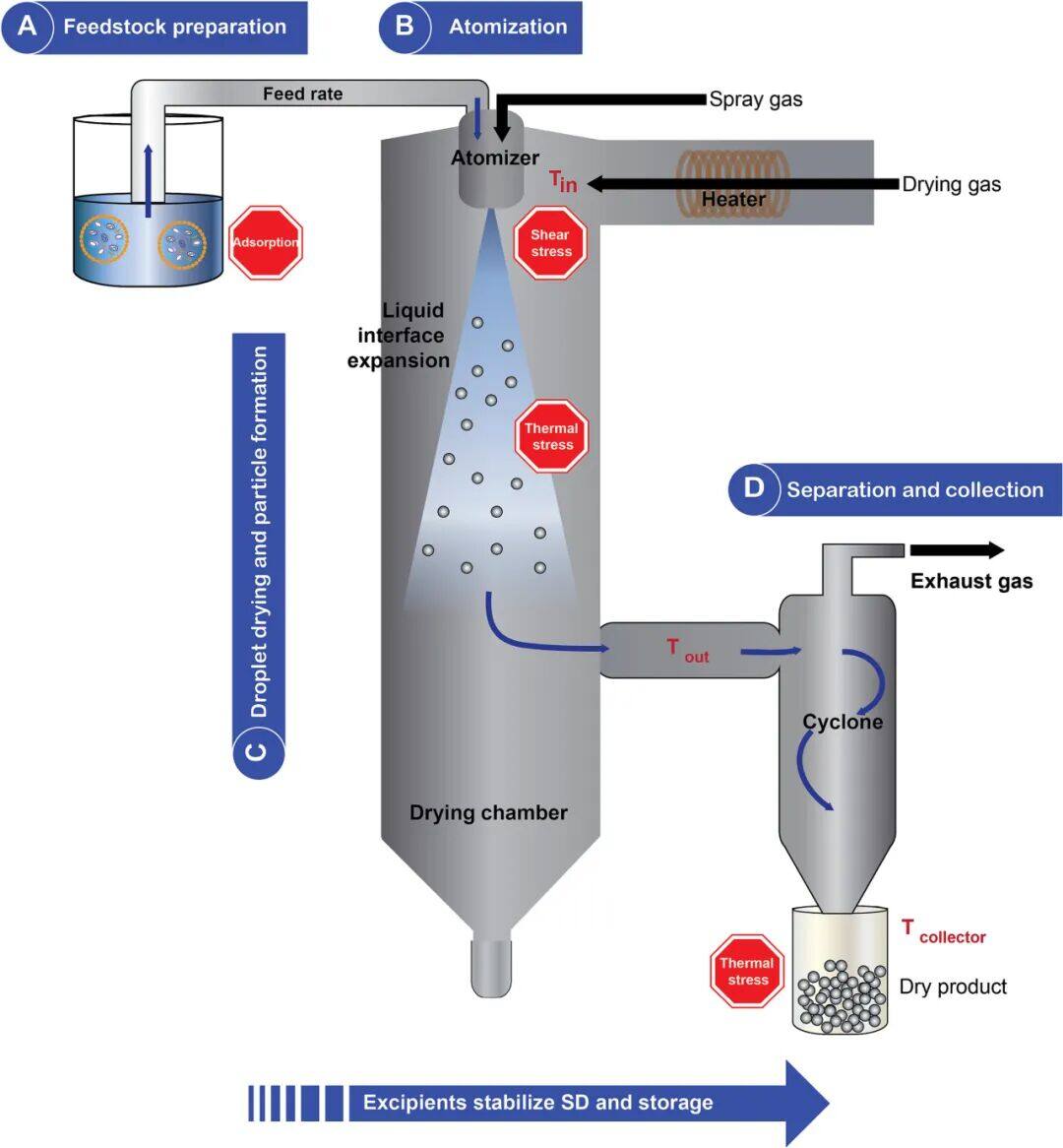
Figure 1. The spray drying process of LNP consists of four main stages.A) Mixing of LNP formulation with stabilizing excipients; B) Atomization, i.e., droplet formation; C) Solvent evaporation and droplet drying in the drying chamber, as well as particle formation; D) Powder collection.The team first focused on the impact of phospholipids and buffer solutions on the temperature sensitivity of LNPs themselves. Due toDSPCThePhase Transition Temperature(Tm) is 55°C, close to the outlet temperature of the spray dryer, andDOPEIt is an unsaturated phospholipid with a Tm of -16°C, which can improve the temperature sensitivity of LNPs. Studies have found that replacing DSPC with DOPE can enhance mRNA delivery efficiency [1]. The pKa of ionizable lipids in LNPs is 7; thus, significant changes in pH may lead to alterations in particle structure and stability. The team tested the effects of widely used PBS and 20 mM Tris buffers. Four different LNP formulations (DSPC PBS; DSPC Tris; DOPE PBS; DOPE Tris) were incubated across a range of temperatures to simulate the temperature span during LNP formulation and spray-drying processes. It was found that the DOPE Tris group remained stable at temperatures up to 75°C, with only about 20% RNA loss at 80°C.
Greater stability under spray-drying temperature conditions does not equate to better withstanding the spray-drying process. Therefore, the team also verified that DOPE Tris LNP can better withstand the spray-drying process. The DOPE Tris group enhanced particle stability during both spray drying and reconstitution of 306Oi10 and MC3 LNP. Tris buffer outperformed PBS in spray drying. Although the pH of both buffers decreases with rising temperature, the rate of change in Tris is 10 times faster than that of PBS. This means that when Tris buffer is heated from 25°C to 37°C, the pH will drop by 0.3 units, while PBS will only decrease by 0.025 units. The reduction in pH may ensure that RNA remains encapsulated within the LNP. The authors also found that the optimized LNP formulation (DOPE Tris) significantly improved the evaluation of LNP in hepatocellular carcinoma cell lines.HepG2The uptake in pulmonary bronchial cell line 16HBE showed that, compared with liquid LNP formulations stored at 4°C, LNPs processed by spray drying and stored at room temperature exhibited better stability, higher particle encapsulation efficiency, and more significant protein expression (Figure 2).
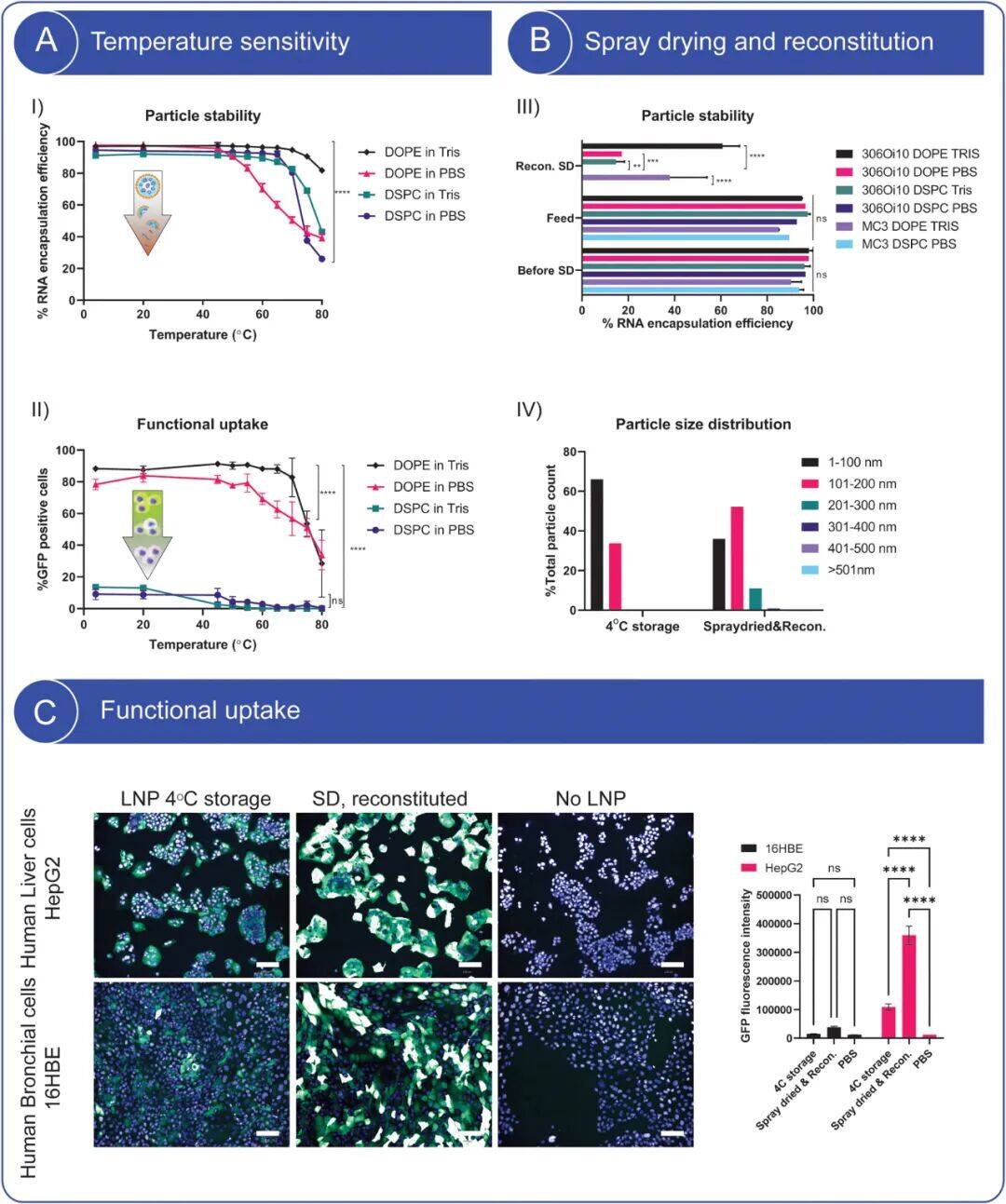
Fig. 2. By modifying the formulation, replacing DSPC with DOPE and PBS with Tris buffer, the stability of LNPs after spray drying can be improved.(A) LNP formulations produced using DSPC and PBS are sensitive to temperature increases; (B) When DSPC is replaced with DOPE and PBS is replaced with Tris, the stability of LNP particles significantly improves after spray drying and redispersion. (C) The enhanced stability of LNP formulations after spray drying (SD) results in good transfection efficiency of mRNA in HepG2 and 16HBE cells. Scale bar = 100 μm. **P < 0.01, ***P < 0.001, ****P < 0.0001, n.s = not significant.The team found that when spray-drying LNP formulations, a uniform thin film could be observed inside the drying tower, and film deposits were observed in the cyclone separator. This is because, in the absence of excipients, the solidification mechanism of each component in the spray-dried LNP formulation varies according to its diffusion rate and solubility, causing separation of the components. Therefore, the team optimized the ratio of LNP, trehalose, and trileucine [2]. They found that when the ratio of LNP to trileucine was between 1:4 and 1:5, it reduced powder loss in the cyclone separator and further improved mRNA encapsulation efficiency after reconstitution, increasing the LNP loading from 1.5% to 5%. After spray drying, SEM was used to analyze the powder particle size and surface structure, and CryoTEM was used to analyze the reconstituted particles. It was found that the reconstituted LNP samples after spray drying were dense small vesicles with a wider range of size variations (Figure 3).
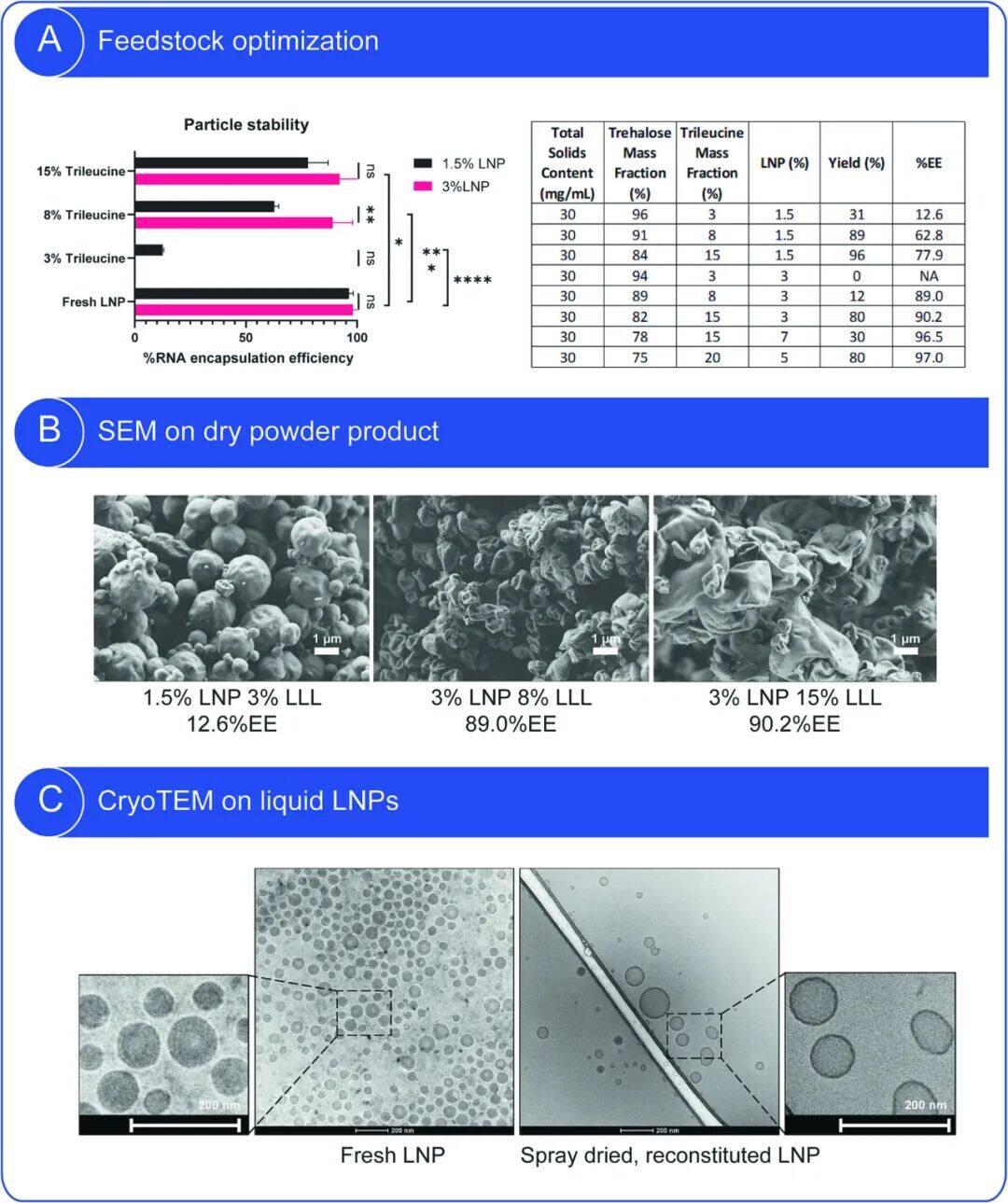
Figure 3. Optimization of Spray Drying Formulation(A) Optimization of the trileucine (LLL):LNP ratio in the powder formulation can minimize losses in the cyclone separator and maximize yield with an increase in RNA encapsulation efficiency (%EE) post-reconstitution. (B) Scanning electron microscopy images of spray-dried LNPs. As the concentration of trileucine (LLL) increases from 3% to 15%, the particle morphology gradually shifts from a smooth surface to a highly corrugated surface. (C) Representative cryo-transmission electron microscopy images of freshly prepared LNPs and spray-dried LNPs. Compared to fresh LNPs, reconstituted spray-dried LNPs are encapsulated within a dense lining. Scale bar = 200 nm.Next, the team validated the functional delivery of the mRNA LNP powder formulation in vivo. The Penn-Century Dry Powder Insufflator™-4 device was used to administer the powder directly into the lungs of rats. Immunohistochemistry on lung tissue sections (IHC) showed strong eGFP-positive cell staining. These cells were identified as bronchiolar epithelial cells, type II pneumocytes, and/or macrophages based on their localization, morphology, and immunofluorescence markers. Despite only a few eGFP-positive cells being detected, the staining of these positive cells was intense and free of background noise, indicating that inhaled administration of eGFP mRNA LNP after spray drying can produce clear eGFP expression in the lungs.
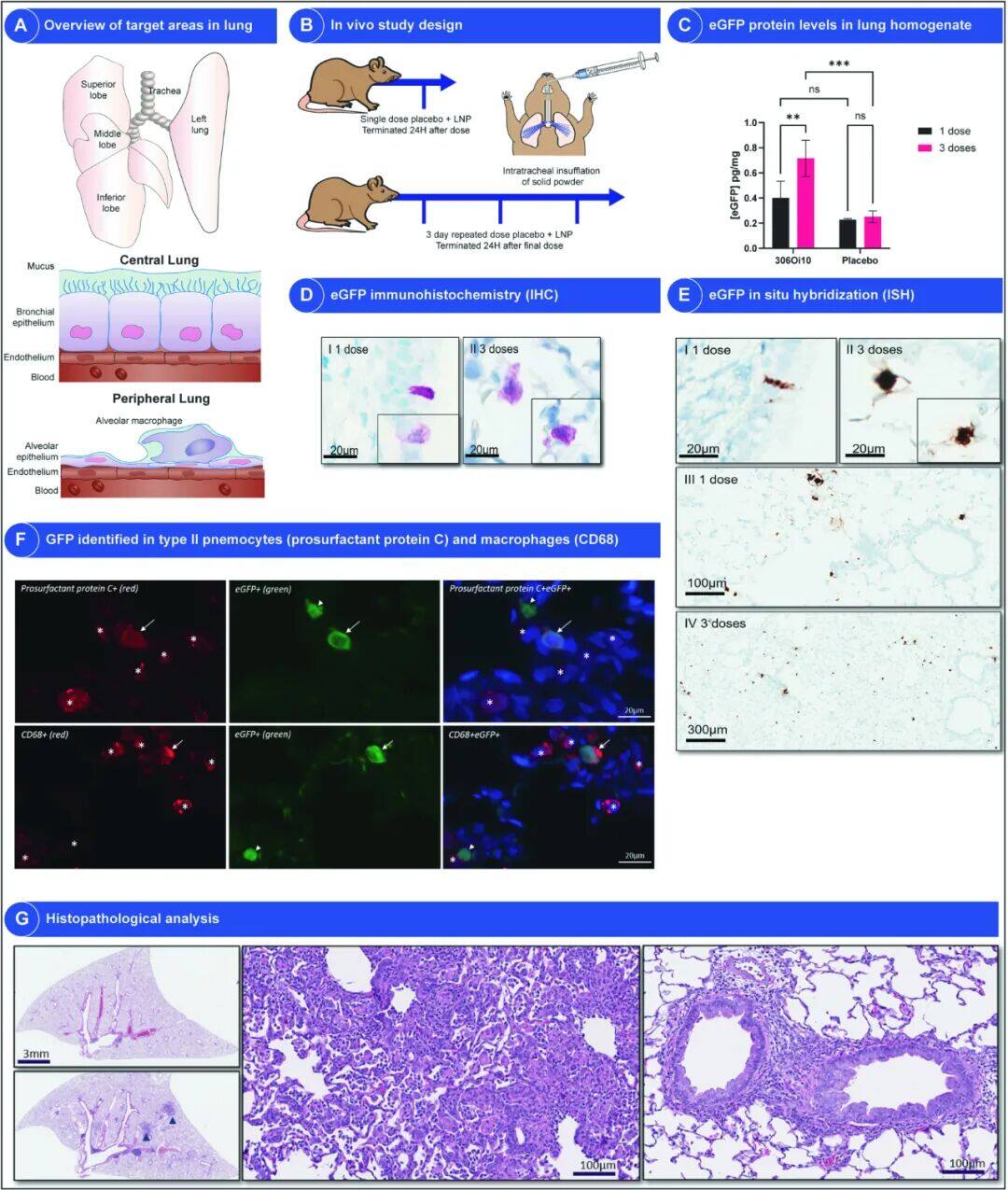
Figure 4. In vivo uptake and protein expression in the lungs(A) Schematic diagram of rat lungs; (B) Schematic diagram of the study design. Rats were sacrificed 24 hours after a single dose or 24 hours after three consecutive days of daily dosing. Administration methods included intratracheal (IT) instillation of spray-dried formulations containing eGFP mRNA LNPs or placebo. (C) Levels of eGFP protein measured in lung homogenates of the right lung lobe; (D) Images showing eGFP-positive cells (purple); (E) eGFP (brown) detected in the left lung lobe of rats 24 hours after single (I and III) and 3-day repeated (II and IV) IT instillation. Morphologically, eGFP-positive cells (purple) were identified as bronchiolar epithelial cells (D I) and type II pneumocytes and macrophages (D II). eGFP mRNA (brown) was identified in bronchiolar epithelial cells (E I) and type II pneumocytes and macrophages (E II). (F) Immunofluorescence labeling of eGFP combined with markers for type II pneumocytes or macrophages confirmed that both cell types express eGFP. (G) Histopathological analysis results of the left lung lobe. Upper left: Lung tissue from control rats showing no lesions. Lower left: Lung tissue from rats treated for 3 days showing consolidation areas in the alveolar parenchyma, representing inflammatory lesions (arrows). Middle: Higher magnification of mixed inflammatory cell infiltration areas centered around smaller airways and outlining alveolar ducts. Right: Image representing secondary bronchiolar epithelial changes.In general, the research team conducted a proof-of-concept study and successfully designed an mRNA LNP spray-dried formulation for inhalation through formula optimization. The formulation maintained its functionality after spray drying and reconstitution and effectively delivered mRNA both in vitro and in vivo. It enabled pulmonary administration of LNPs at clinically relevant dose levels, paving the way in the field of inhaled mRNA vaccines with significant promise [4].
Proposed a formulation for mRNA LNP suitable for spray drying;
It was confirmed that the use of DOPE and Tris buffer is beneficial for the spray drying and in vitro/in vivo transfection of mRNA LNP.
Demonstrated that spray-dried mRNA LNPs remain functional after reconstitution.
Volume 363, November 2023, Pages 389-401https://doi.org/10.1016/j.jconrel.2023.09.031

Image source: https://mbg.au.dk/aktuelt/nyhed/artikel
First Author and Corresponding Author of the ArticleDr. Kristina Pagh FriisShe is a researcher in the direction of pharmaceutical sciences at AstraZeneca's R&D department. Previously, she obtained her Ph.D. from the Department of Molecular Biology and Genetics, Science and Technology at Aarhus University. During her Ph.D., she studied various methods for repositioning the envelope protein of the murine leukemia virus SL3-2 and discovered new chimeric variants of the viral envelope protein. Currently, her work focuses on the design and development of novel delivery carriers for nucleic acid drugs, primarily researching new lipid nanoparticle (LNP) formulations, process optimization from lipid synthesis to preclinical studies, as well as exosome-derived carriers and viral vectors for gene therapy.- R.L. Ball, K.A. Hajj, et al. Lipid nanoparticle formulations for enhanced co-delivery of siRNA and mRNA, Nano Lett. 18 (2018): 3814-3822.
- M. Ordoubadi, F.K.A.et al. Trileucine as a dispersibility enhancer of spray-dried inhalable microparticles, J. Controlled Release 336 (2021) 522–536.
- W. KA, D. JR, et al. Degradable lipid nanoparticles with predictable in vivo siRNA delivery activity, Nat. Commun. 5 (2014) 4277.
- Friis KP, Gracin S, et al. Spray dried lipid nanoparticle formulations enable intratracheal delivery of mRNA. J Control Release. 2023 Nov;363:389-401. doi: 10.1016/j.jconrel.2023.09.031. Epub 2023 Sep 30. PMID: 37741463.
Suzhou.
The 2nd Peptide Drug Industry Innovation Forum
(2023.4.15-16)
Nanjing: The 3rd Small Molecule Drug Innovation and Development Forum
(2023.9.7-8)Suzhou: Advanced Training Course on Key Technologies for Inhalation Formulation Development
(2023.3.11-12)
Exciting articles continue.....*This WeChat Official Account remains neutral on all original and reproduced content, statements, and viewpoint judgments. The shared content is for non-commercial purposes only. If any reproduced works or images have incorrect author source markings or involve infringement, original authors are kindly reminded to contact the editor for removal.