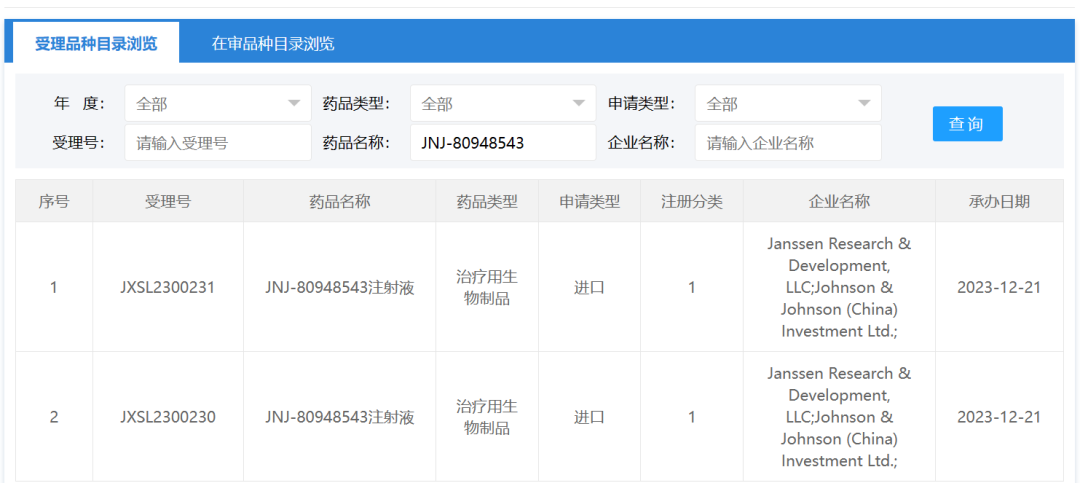
On December 21, 2023, the official website of the Center for Drug Evaluation (CDE) under the National Medical Products Administration (NMPA) showed that the clinical trial application for "JNJ-80948543 Injection" submitted by Janssen Pharmaceuticals, a subsidiary of Johnson & Johnson, has been accepted.
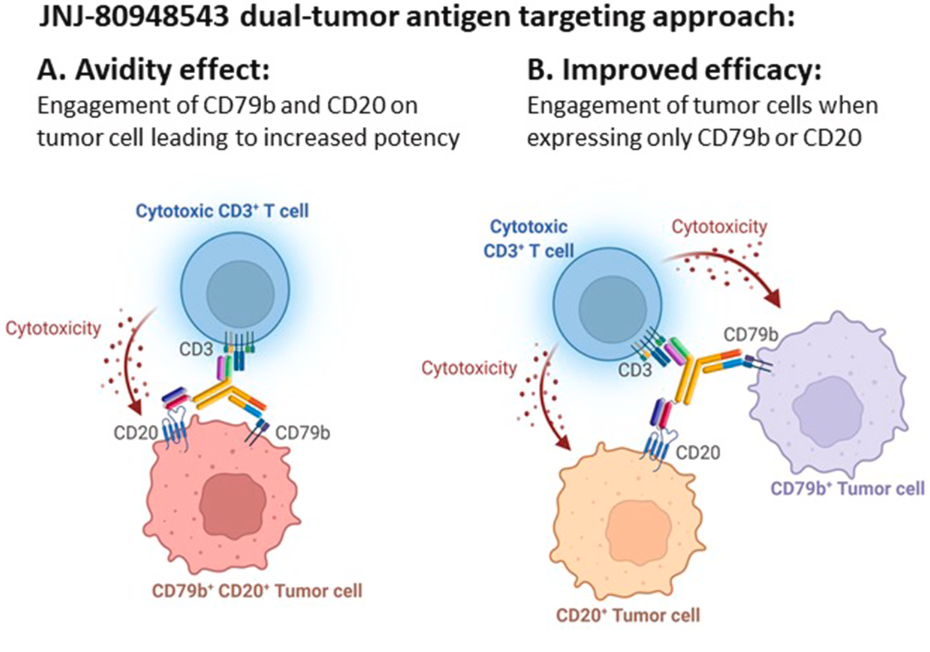
JNJ-80948543 is primarily developed for the treatment of B-cell non-Hodgkin lymphoma (B-NHL) and is currently under investigation forNon-Hodgkin's Lymphoma and Chronic Lymphocytic Leukemia (CLL) IDose-escalation study.JNJ-80948543 is a fully human immunoglobulin G1 trispecific antibody that simultaneously targets CD79b/CD20/CD3, comprising an anti-CD3ɛ single-chain variable fragment (scFv), an anti-CD20 scFv, and an anti-CD79b antigen-binding fragment (Fab).Expression of CD79b and CD20 is restricted to the B-cell lineage and is expressed in most B-cell malignancies, making them ideal targets for T-cell redirection; trispecific T-cell redirecting antibodies enable dual antigen recognition of B-NHL cells and enhance tumor cell binding through an affinity effect, maximizing tumor cell clearance in the presence of heterogeneous cell populations while preventing antigen escape-induced drug resistance and tumor recurrence.The study found that JNJ-80948543 exhibited high affinity and stable binding for 48 hours in lymphoma cells expressing varying endogenous CD79b and CD20 receptor densities; in contrast, low-affinity binding was observed with primary human T cells expressing CD3.In vitro studies have observed the cytotoxicity of JNJ-80948543 across a wide range of lymphoma cell lines and primary B cells. T-cell activation was observed with low cytokine secretion.NJ-80948543 mediates the expression of a single target(CD79b or CD20)Cytotoxicity of tumor cells, exhibiting >1000-fold potency against cells co-expressing CD79b and CD20.In addition, it was observed that there was no effect on target cell viability or T-cell activation when co-cultured with antigen-negative cells.In in vivo studies, JNJ-80948543 inhibited the growth of CARNAVAL (GCB-DLBCL) xenografts and induced dose-dependent regression of OCI-Ly10 (ABC-DLBCL) xenograft tumors.Currently, the research on trispecific antibodies shows a clear upward trend. Although most candidate products are in the early stages, the technical pathways continue to emerge, either by using additional signal domains to enhance T-cell stimulation, or by activating NK cells, or by simultaneously targeting multiple tumor antigens.
Trispecifics theoretically have stronger anti-tumor effects than bispecific antibodies, which has also attracted bets from many companies.
References:
1.https://ashpublications.org/blood/article/140/Supplement%201/3105/488652/Characterization-of-JNJ-80948543-a-Novel

Recommended Articles of the Week
If you need to reproduce this content, please contact BioValley and clearly state the source in a prominent position.
﹀