

Wugen Announces Preclinical Data Demonstrating WU-NK-101’s Metabolic Fitness, Tumor Microenvironment Resilience, and Synergistic Immune Activation in AML

Wugen
Cell Therapy Developer
NEWS IN BRIEF
Recently, Wugen released the latest preclinical data for its leading allogeneic NK cell therapy product, WU-NK-101 (W-NK). The data shows that it can overcome previous challenges faced by ACT, including antigen escape, limited tumor trafficking/infiltration, and functional restrictions within the tumor microenvironment (TME), demonstrating broad market potential.
Memory-like NK cells (Memory-like NK, ML-NK), discovered by Professor Todd of Washington University, can be generated from natural NK cells (cNK) upon activation by cytokines IL-12/15/18. Compared with natural NK cells, they exhibit enhanced adaptability, in vivo persistence, and functionality in killing tumor cells. In an early clinical trial (NCT#01898793), significant efficacy was demonstrated in treating AML, with a CR rate (CR/CRi/CRh) of 47% after a single infusion and a median duration of response of 9.4 months. Moreover, it was well-tolerated without occurrences of CRS, GVHD, or neurotoxicity. Wugen's WU-NK-101 (W-NK) is an off-the-shelf ML-NK cell therapy product developed through proprietary expansion, activation, and cryopreservation technologies, enabling large-scale production. W-NK leverages the advantages of ML-NK and further demonstrates enhanced metabolic activity and resistance to immunosuppression within the tumor microenvironment (TME), overcoming previous challenges faced by ACT. It has shown robust in vitro and in vivo anti-tumor activity in preclinical AML models.
1. W-NK exhibits stronger metabolic activity, flexibility, and plasticity.
Tumor cells have active metabolism, consuming large amounts of nutrients in the tumor microenvironment (TME), leading to nutrient depletion, acidity, and hypoxia. This results in a high metabolic demand within the tumor, suppressing the anti-tumor activity of ACT, which is a core issue for T cells. In contrast, W-NK has a naturally effective ability to kill tumor cells. More importantly, it can overcome the metabolic challenges present in the TME on its own.
Sc-RNA-seq analysis shows that, compared with cNK cells, W-NK cells have significant differences in transcription and composition. W-NK cells possess a unique metabolic phenotype, with higher expression of nutrient transporters (such as GLUT1, CD98, ASCT2, MCT1, and PiT1) on their cell surface, which can participate in various metabolic pathways.
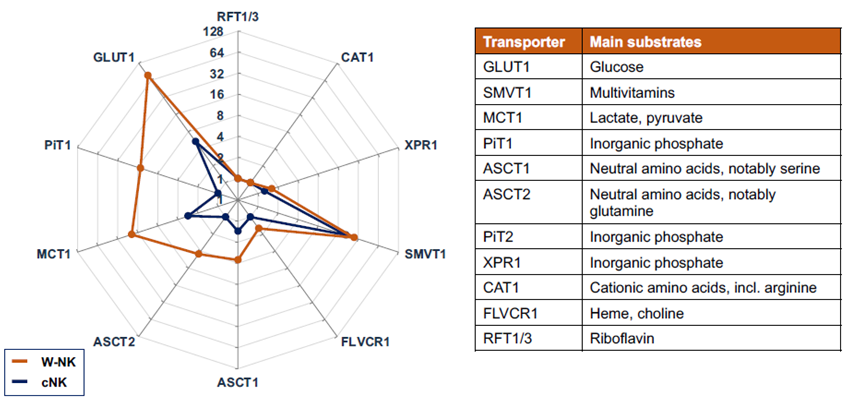
The metabolism of W-NK is consistent with aerobic glycolysis (Warburg effect), with ATP produced by glycolysis accounting for approximately 80%, compared to about 30% in cNK. Moreover, in TME/ascites medium, the expression of nutrient receptors on the surface of W-NK adapts to the increased metabolic demands. Specifically, transporters for amino acids, lactate, and pyruvate are all upregulated in these low-glucose media. This is consistent with 50% of ATP synthesis shifting from glycolysis to mitochondria, indicating that nutrients bypass glycolysis to enter the tricarboxylic acid cycle and oxidative phosphorylation.
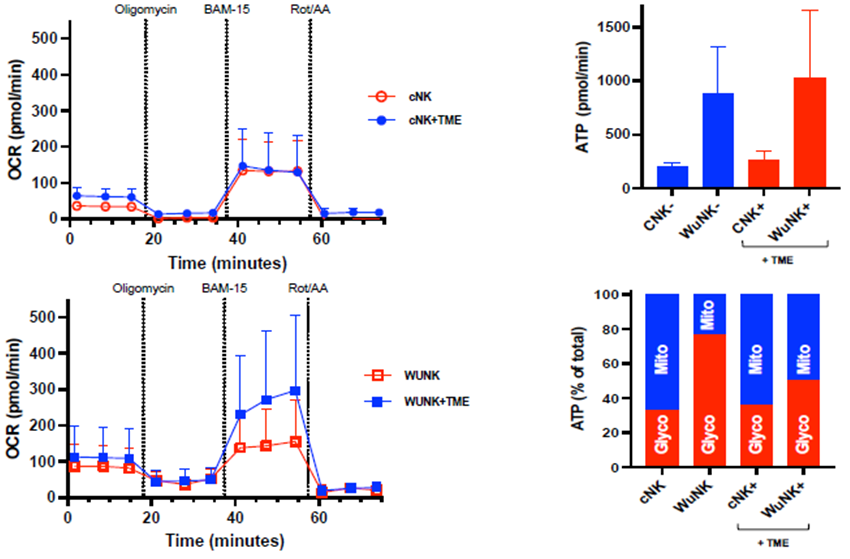
Single-cell RNA sequencing and proteomics data of cells cultured in TME-calibrated medium or ascites (from ovarian cancer patients) confirmed the aforementioned findings. Compared to cNK, W-NK activated various metabolic pathways when cultured in different media.
Overall, W-NK retains cytotoxic functionality in both the TME and ascites, as well as in 3D models simulating the native TME from primary surgical tumor samples. In contrast, cNK shows maladaptation to the TME medium in terms of nutrient transporter expression and ATP synthesis, resulting in reduced survival and functionality, including diminished cytotoxicity.
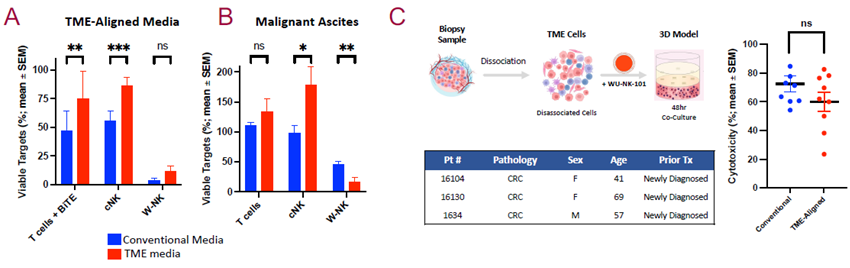
2. W-NK can still synergize with other immune cells in a highly immunosuppressive TME to effectively inhibit tumor growth.
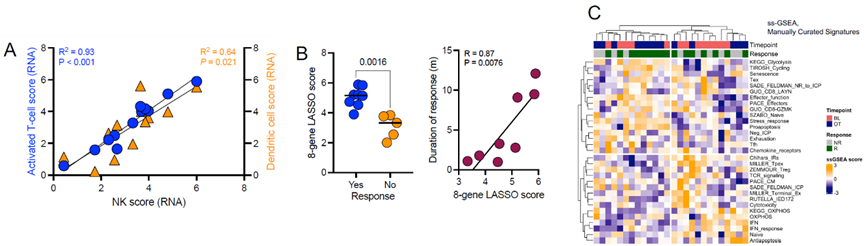
ML-NK cells not only acquired a differentiation phenotype distinct from conventional NK cells in vivo, but also demonstrated safety and efficacy in the AML patient population (NCT#01898793). Wugen further conducted multimodal analysis of bone marrow samples from 13 R/R AML patients treated with ML-NK cells to determine whether ML-NK cell-induced TME changes were associated with clinical benefit.
Dysfunction of immune effector cells (including CD8+ T cells and NK cells) in the tumor microenvironment (TME) is partly due to the activation of interferon-γ signaling and the senescence of T/NK phenotypes. In contrast to conventional NK cells, W-NK cells exhibit high IFN-γ and IL-2/STAT5 signaling. Spatial proteomic analysis of the AML TME indicates that W-NK cells participate in adaptive immune responses. Infusion of ML-NK cells is associated with coordinated changes in activated T cells and stimulatory DC cells within the AML TME. In AML patients who responded to ML-NK cell therapy (CR, defined as: tumor burden in the bone marrow <5% at Day+28): 1) RNA markers of NK cell infiltration were significantly positively correlated with the abundance of activated T cells and DC cell infiltration, indicating coordinated changes in immune cell populations after ML-NK infusion; 2) An 8-gene RNA score, including T/NK markers (e.g., CD7), IFN regulatory factors, and TLRs, was higher, not only predicting efficacy but also significantly positively correlating with the duration of remission; 3) Enhanced infiltration of CD8+ effectors, glycolysis, and cell cycle progression were observed. These data strongly suggest that infusion of ML-NK cells alters the tumor immune microenvironment (TIME) in AML patients, and the response to ML-NK cells in AML patients correlates with the coordinated upregulation of T-cell, NK-cell, and B-cell protein markers.
3. W-NK cells exhibit strong cytolytic activity in vitro, no "off-target" cytotoxicity, and can home to the bone marrow (bone marrow homing) and extramedullary tumor sites, effectively killing tumors in vivo.
Moreover, preclinical study results also showed that W-NK cells express higher levels of activating receptors (such as 2B4, DNAM-1, NKG2D, NKp30, etc.) and cytotoxic effector proteins (such as granzyme B), and lower levels of inhibitory receptors, thereby enhancing the in vitro cytotoxicity against HL-60 cells (the mEC50 for W-NK and cNK were 1.7 and 5.2, respectively; p = 0.032). A reduction in tumor burden was observed in THP-1 xenografts in a dose-dependent manner (p = 0.015). Meanwhile, W-NK cells also express high levels of CXCR4 (81.6% positivity rate, MFI 5552), which helps improve bone marrow homing (16.5 ± 2.4%), compared to the previously reported homing rate of 3% for IL-2 stimulated expanded NK cells (Sato et al. CCR. 2020).
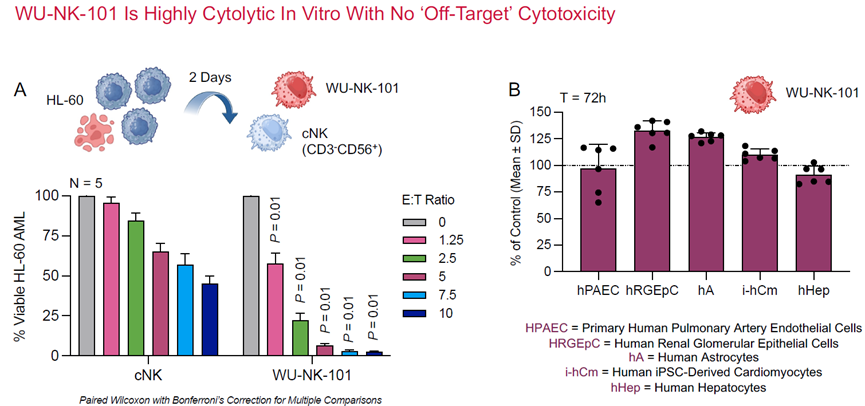
The above data show that W-NK cells have unique transcriptional, phenotypic, and functional characteristics, indicating their enhanced metabolic adaptability and cytotoxic functionality. The augmented metabolic capacity, flexibility, and plasticity of W-NK cells enable them to utilize various macronutrients, participate in different metabolic pathways, and maintain optimal ATP synthesis. Their ability to coordinate changes in the tumor immune microenvironment (TIME) enhances the abundance of activated T cells and the infiltration level of dendritic cells (DCs), allowing them to exert cytotoxic effects on AML cells under in vitro simulated hypoxic and immunosuppressive TME conditions (a limiting factor for ACT based on immune cells). Additionally, W-NK cells do not attack healthy human tissue cells, including PBMCs, suggesting that W-NK does not indiscriminately kill cells. This also indicates that W-NK has a lower potential for myelosuppression and favorable safety.
In summary, W-NK cells can effectively kill AML and robustly home to the bone marrow, overcoming issues such as hypoxia, immunosuppression, and nutrient deficiency, surviving in the leukemia TME and exerting tumor-suppressive effects. Moreover, they are not limited to a single antigen target, thereby reducing antigen escape. These characteristics address the challenges faced by ACT, indicating broad application prospects for NK cell therapy. Currently, a Phase I clinical study of W-NK cell treatment for AML is underway and recruiting patients (NCT# 05470140).
About Wugen, Inc.
Wugen is a clinical-stage biotechnology company dedicated to developing next-generation "off-the-shelf" memory NK (Natural Killer) cell therapies and CAR-T cell therapies for cancer treatment. Wugen leverages its proprietary technology platform and deep expertise in genomic engineering to pioneer a new class of memory NK cell and CAR-T cell therapies aimed at treating both hematologic and solid malignancies.
E.N.D
Previous article recommendations:
LianBio Announces Departure of CEO and CFO, Evaluating Strategic Options
Well-known investment bank: It's time to invest in biotechnology
AI Designs New Generation of Gene Therapy Vectors, Overcoming Major Challenges in Gene Therapy
HK$160 Million! Hillhouse Purchases 8.578 Million Shares of Genscript Biotech
Comprehensive Review of Organoid Applications
The Past, Present, and Future Development Directions of TIL Therapy
Pfizer Cuts Costs Again! Stock Price Plummets After Announcing 2024 Outlook
YouNu Bio DC Cell Drug Approved for Clinical Trials
Gene Therapy Approved by FDA for Market Launch, Bluebird Bio Plummets 40%
Comprehensive Overview of Organoid Applications
Chinese CAR-T Leader Suspends Three U.S. Clinical Trials Due to CMC Issues
Ru Jian Pharmaceutical's First iPSC Drug Approved for Clinical Trials
【Bookmark】In-depth Industry Report: Innovative Vaccine and Nucleic Acid Vaccine Technology
The Core Technology Behind the First CRISPR Gene-Editing Therapy Priced at $15.7 Million
LianBio Rejects Acquisition Bid
Precision Biotherapeutics CD20 NK Cell Therapy IND Accepted for Review
Research Report | CAR-T: Bringing a Ray of Hope for a Cure to Systemic Lupus Erythematosus
Statement: Content source Chen Tai Pharmaceuticals,This article is intended for knowledge sharing. All content is for reference only and does not constitute any advice.