Source: MedRobot; Editor: Jacky
Reprint Requirements: Please indicate the source of the article at the beginning of the text, and you can reprint it directly.On December 20, 2023, the U.S. Food and Drug Administration (FDA) announced a recall of navigation software: the recall of Medtronic's (NYSE: MDT) StealthStation S8 software was classified as Class I.
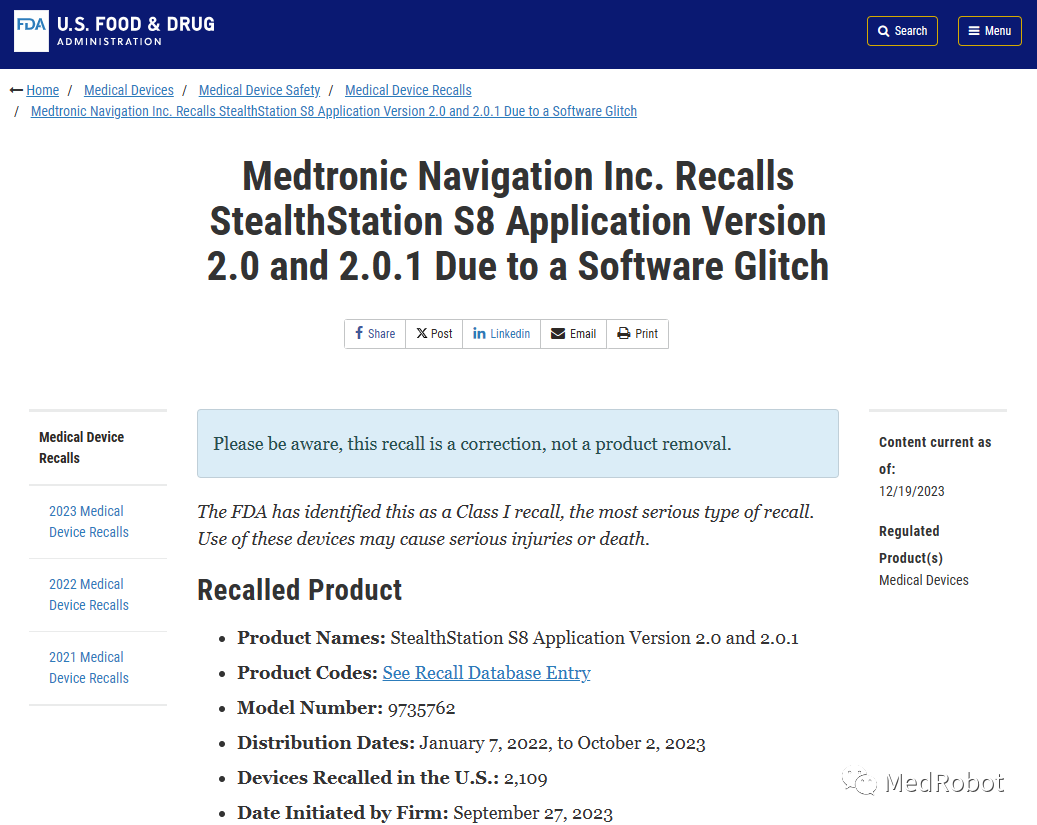
Medtronic Recalls Software Due to Error That Could Cause Incorrect Surgical PositioningThis recall is a corrective action rather than a product withdrawal, involving StealthStation S8 application versions 2.0 and 2.0.1.It affected from January 7, 2022, to October 2, 2023, in2,109 devices distributed in the U.S.(This sales volume is for reference by peers in China.) Medtronic initiated this recall on September 27, 2023.According to MedRobot's inquiry, the last recall of this product should have been in 2005, with no other recall information available.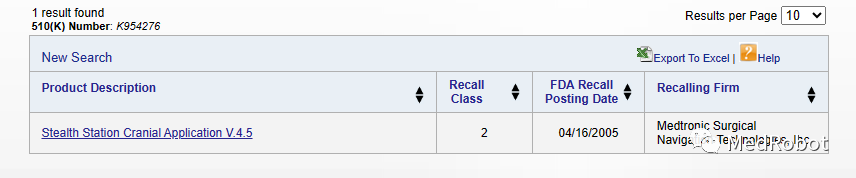
MedRobot adds that this incident has nothing to do with products from China. Hospitals and doctors need not worry.Medtronic has adopted an efficient and transparent approach to the recall, and since no accidents have been caused by this malfunction before, it is believed that the recall will not bring about much negative impact.What we want to discuss today is not the recall, but the issue of the cost of surgical robots that we previously discussed with readers, which was brought to mind by the news.Once, an outsider joked that after the centralized procurement, the prices of consumables dropped so much, indicating how much "price water" there was before. Could surgical robots also be included in centralized procurement? (Of course, centralized procurement of consumables has nothing to do with treatment equipment like surgical robots. In simple terms: consumables are paid for by medical insurance funds; surgical robots are purchased with the hospital's equipment budget. They are not the same thing.)
What we want to discuss today is that consumables (such as cardiac stents) and surgical robots, although both are called medical devices, their product complexity and costs cannot be compared at all.If the cost of surgical robots is simply calculated based on the BOM cost, it is a partial and unscientific method.For stents that are just a few millimeters in size, after years of fully drawing on overseas experience and achieving domestic substitution, significant price reductions are indeed possible. However, for surgical robots, which are still in the initial stage and require substantial R&D investment, a price reduction would be fatal.(First, let me explain that this article was written in a hurry, without using real and specific data for examples, and the descriptions are not entirely accurate. The main purpose is to express viewpoints, and I hope it offers some reading value to the audience.)
When it comes to product cost, it depends on how much money was invested in the research, development, manufacturing, and sales of the product.
First, let's talk aboutProduct Composition, taking cardiac stents and surgical robots as examples.Stent, composed of a single or a few components.Surgical robots are composed of thousands of components.With such a product structure, the variety of engineers required for the surgical robot in the R&D team alone is much greater than that for stents.
Differences in R&D Team Positions:Typical Engineer of Cardiac Stent:- Material Engineer: Focus on the material selection and testing of stents.
- Biomedical Engineer: Focus on biocompatibility and clinical outcomes.
- Clinical Researcher: Responsible for conducting clinical trials and data analysis.
- Quality Control Engineer: Ensure that products meet the specified quality standards.
Typical Engineer of Surgical Robots:- Industrial Designer: Conduct various exterior designs for the overall product appearance, multiple trolleys, etc.
- Structural Designer: Designs the physical composition of the product. (Surgical robots are highly complex devices, comprising thousands of components.)
- Mechanical Engineer: Design and manufacture robotic arms and other mechanical components.
- Electrical Engineer: Responsible for the integration of sensors and actuators.
- Software Engineer: Develop and maintain software systems.
- System Engineer: Coordinate the integration and testing of various subsystems.
- Human-Computer Interaction Designer: Design operation interface and user experience.
- Clinical Expert (usually a doctor): Provides knowledge on surgical procedures and medical practices.。
Differences in R&D Cycles:Due to the significant differences in the complexity of equipment, even "direct copying" takes years for large devices.Difference in the Number of R&D Teams:Stents may be dozens of people;Surgical robots require an interdisciplinary team of hundreds of people.
Operating Costs of a Surgical Robotics Company
1. Research and Development (R&D) CostPersonnel Cost:Including the salaries and benefits of professionals such as engineers, scientists, and designers.Material and Equipment Costs: The cost of materials required for prototype design and testing, as well as the purchase and maintenance of equipment used in research and development.Software and Technology Licensing: Costs associated with purchasing or licensing required software, including Computer-Aided Design (CAD) tools and simulation software.Laboratory and Testing Facilities: Costs associated with leasing or maintaining laboratories and their testing equipment.Manufacturing Cost: The direct cost of producing robot components, including materials, labor, and depreciation of manufacturing equipment.Quality Control: Testing and monitoring costs to ensure products meet industry standards and regulations.3. Administrative and General (A&G)Management Salaries: Including salaries and benefits for senior management and support staff.Office Premises Maintenance: Rent, Equipment, Utilities, and Insurance, etc.4. Sales and Marketing Costs (Sales and Marketing)Sales Team: Salaries and Commissions of Sales Personnel.Marketing Activities: Costs for advertising, promotion, and participation in industry conferences and exhibitions.5. Legal and Regulatory Compliance Costs (Legal and Compliance)Patent Application and Maintenance: Costs for Protecting Intellectual Property.Compliance Cost: The cost of ensuring that products and company operations comply with all relevant laws and industry regulations.6. Research Collaborations and Consulting FeesCosts for collaboration projects with universities and research institutions, as well as fees for external consulting advisors.
Since most surgical robot companies are currently in the pre-market stage for their products.Before the surgical robot product comes to market,The company's main costs are concentrated in research and development, testing, and preparing for market promotion.
Design and Engineering: R&D team salaries, prototyping, and testing costs.Technology Acquisition and Licensing: Purchase or license necessary software, technologies, and patents.Laboratory and Testing Facilities: Costs for the purchase and maintenance of laboratory equipment.2. Clinical Trials and Compliance CostsClinical Trials: Costs for conducting clinical trials to verify the efficacy and safety of surgical robots.Regulatory Compliance: Costs associated with ensuring products meet the requirements of regulatory agencies in various countries, such as fees incurred during the FDA approval process.3. Intellectual Property CostPatent Application and Maintenance: Costs for protecting innovation and technology with patents.4. Market Research and Initial MarketingMarket Research: Costs associated with understanding market demand and potential customers.Initial Market Promotion: Costs for brand establishment and activities to enhance product awareness.After the surgical robot product is launched, the cost structure shifts to more production, sales, marketing, and ongoing operational maintenance.1. Production Cost
Manufacturing and Supply Chain: The direct costs of mass-producing surgical robots, including materials, assembly, and logistics.Quality Control: Testing and monitoring costs to ensure products meet quality standards.Sales Team: Salaries and Commissions of Sales Personnel.Advertising and Promotion: Marketing expenses, advertising, exhibition participation, etc.3. Customer Support and ServiceInstallation and Training: Costs for installing equipment for customers and providing operation training.After-sales Service and Maintenance: Providing ongoing technical support and maintenance services.4. Continuous Investment in R&DProduct Improvement: Continue to invest in R&D to enhance product functionality and performance.New Technology Research: Exploration of R&D expenses for new technologies and applications.
Returning to today's recall news, a software malfunction— even a well-regulated, technology-innovating giant like Medtronic cannot completely avoid it. Readers will surely appreciate that behind the company’s long-term operations are countless efforts and years of investment, still accompanied by risks; and after-sales maintenance, recalls, etc., are all within the costs.Tens of millions of devices do not generate excessive profits but may still result in losses after years of hard work—all for the well-being of doctors and patients, and for better treatment and recovery outcomes.
Well-known Surgical Robot Companies in China: