Novartis Reports Novel Tissue-Specific E3 Ligase (TRIM58) Ligands for Targeted PROTAC Development

Novartis
Drug Development and Manufacturing
PROTAC based on tissue-specific E3 ligase ligands is expected to have a better safety window. RecentlyNovartis Reports a New Class of Tissue-Specific E3 Ligase (TRIM58) Ligands.TRIM58 is only expressed in erythroblast cells and is suitable for red blood cell-related diseases, such as sickle cell anemia.
Back to the discovery of the molecule. As shown in the screenshot below, a diversity set of 45,000 was initially screened, yielding several hits, among which molecule 1 increased the protein melting temperature by 0.5−0.7 °C. Further screening of molecules similar to molecule 1 led to the identification of TRIM-473.Protein melting temperature 2.5 °C. Further validation through other biophysical assays.TRIM-473 is a validated hit, including NMR, SPR, etc., with an SPR KD of 24 μM.
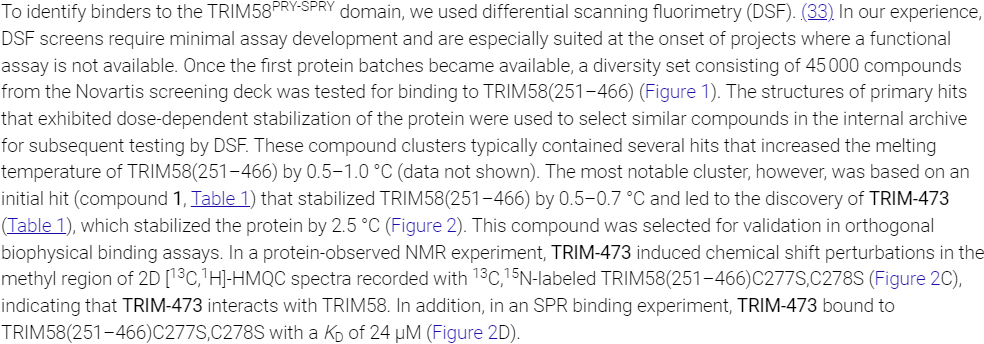
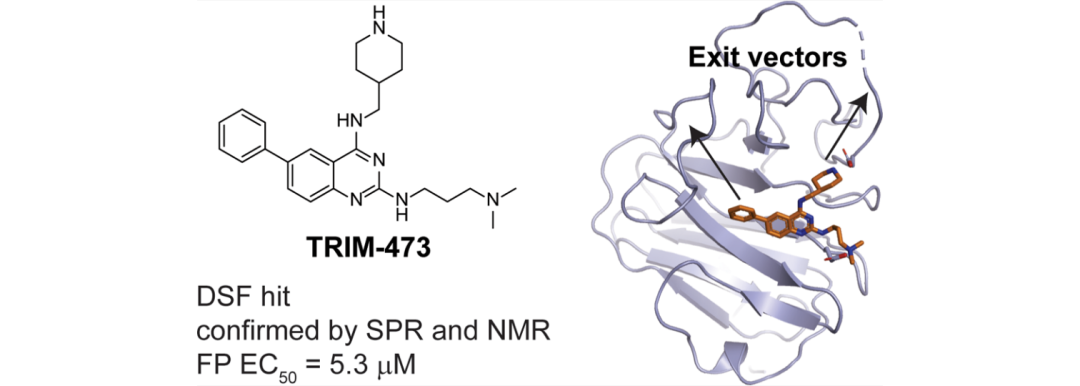
A competitive binding assay was then established.The activity (FP EC50) of TRIM-473 in this assay is 5.3. μM。
The co-crystal structure of this molecule was analyzed. TRIM-473 binds to a relatively shallow pocket, with both basic amines forming polar interactions with acidic residues, while the phenyl ring substitution exhibits some hydrophobic interactions with surrounding residues.
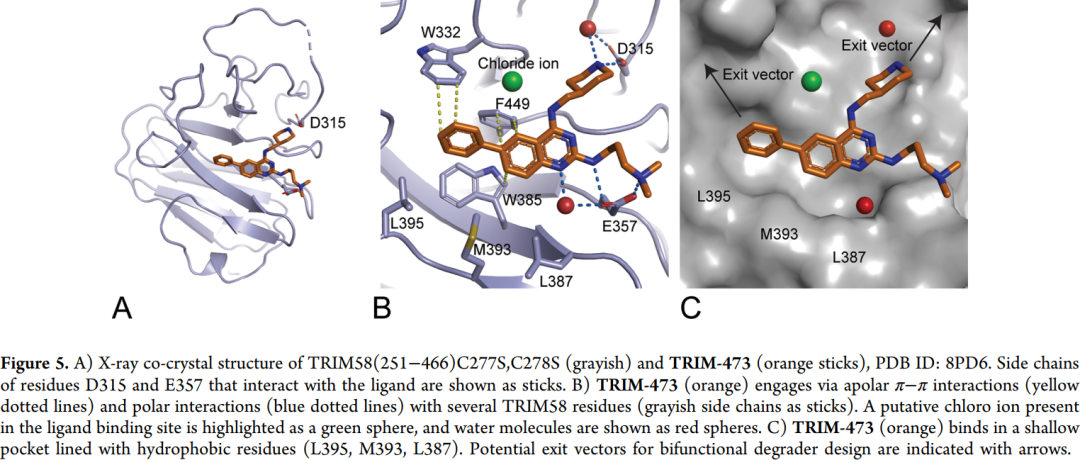
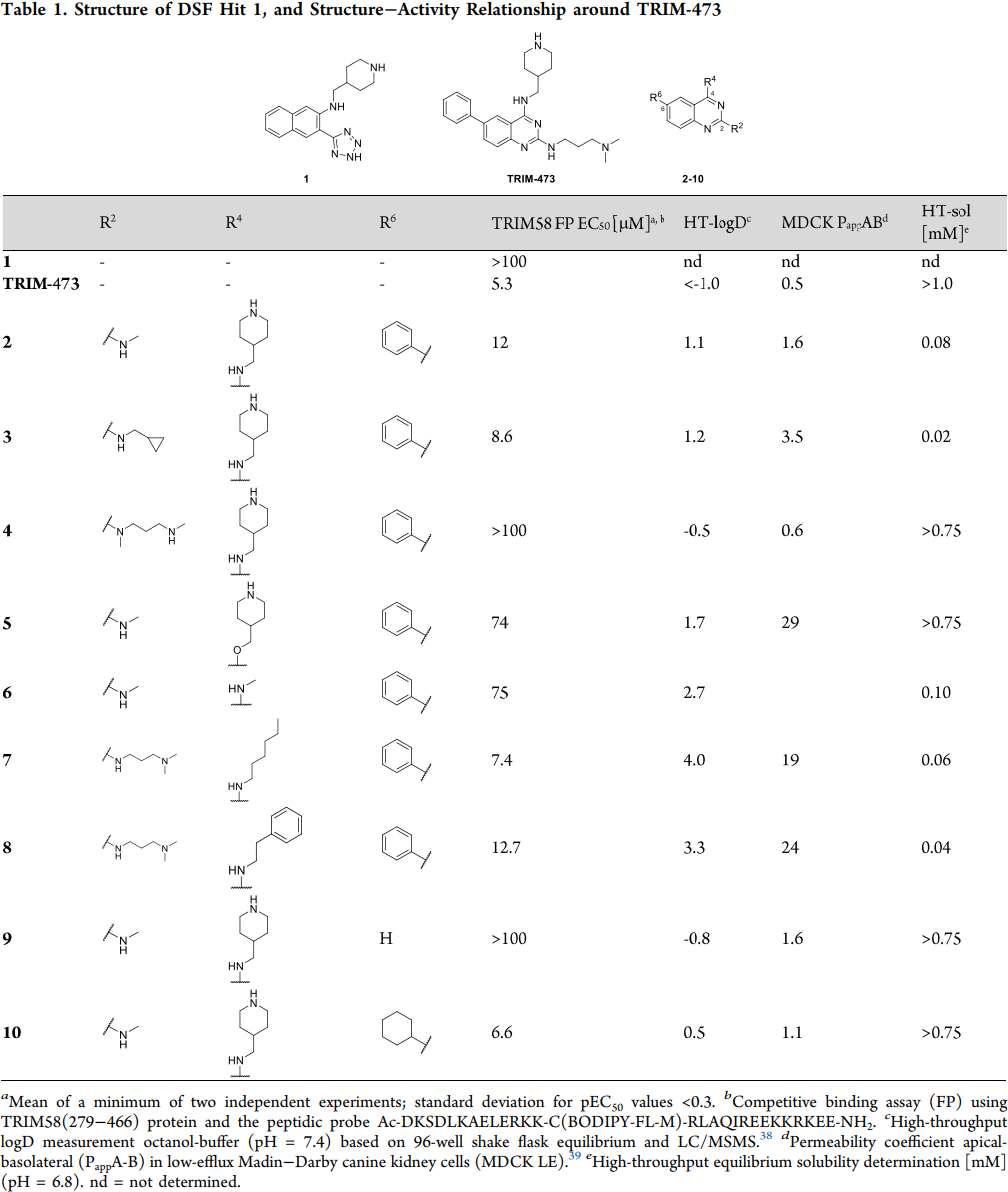
In general, the electrostatic attraction between a basic amine and an acidic residue is a relatively strong interaction. However, from the SAR perspective, removing one of these two basic amines does not significantly affect activity (molecule 2, molecule 7, 8), while removing both amines has a more pronounced impact on activity (molecule 6). In comparison, removing the benzene ring shows an even more significant effect on activity (molecule 9). It can be seen that the contribution of certain interactions to activity must be analyzed on a case-by-case basis, and is not so mechanical.Simple。
Possibly due to the poor druggability of the pocket, the article reports that it is difficult to further optimize the activity of this class of molecules. Of course, one advantage of a shallow pocket is that there are more exit vectors available for PROTAC design. As for whether the current level of activity can be successfully applied to PROTAC degradation, further experimental validation is needed.

https://pubs.acs.org/doi/abs/10.1021/acsmedchemlett.3c00259
Disclaimer: The publication/reposting of this article is solely for the purpose of information dissemination, and does not represent the views of this public account or confirm the authenticity of its content. Any judgment made based on this content is at your own risk.If there is any infringement, please inform us and we will delete it immediately!
Long press to follow this official account