In November 2023, the FDAMSDMSD's orally selective under researchP2X3 Receptor AntagonistgefapixantThe Pulmonary Allergy Drug Advisory Committee (PADAC) was convened to discussGefapixant in the treatment of adult refractory chronic cough (RCC) or unexplained chronic cough (UCC) in terms of risk-benefit and evidence validity issues.After more than 7 hours of discussion, 13 experts voted 12 to 1 against the benefits of gefapixant, making the approval of gefapixant increasingly difficult.On December 20, 2023, MSD indeed received a Complete Response Letter (CRL) from the FDA regarding its investigational oral selective P2X3 receptor antagonist, gefapixant.The Second LetterCRL。(The first rejection was in January 2022,MSD chose not to redo the clinical trial but instead conducted a completely new analysis of the original clinical trial results and, based on this, resubmitted the NDA application.)In this CRL, the FDA stated that gefapixantNT Data ResultsAndCannot prove its effectiveness in the treatment of RCC or UCC.AndIn fact, gefapixant was earlier thanJanuary 2022Approved for marketing in Japan, becoming the world's first approved P2X3 receptor antagonist;In September this year, gefapixant was approved for marketing in Europe.From this perspective, gefapixant is not completely ineffective, but why did the FDA question it?Effectiveness?ThisThis requires mentioning the special assessment method for the efficacy of gefapixant in its targeted indications...

Re-statistics of raw data,Statistics is not a panacea.
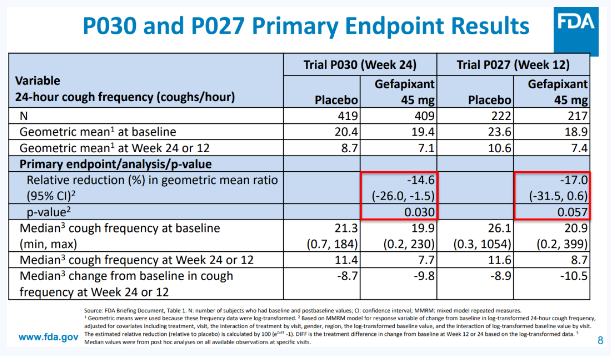
Because MSD did not conduct new clinical trials, the two Phase III COUGH-1 and COUGH-2 studies of gefapixant were repackaged under the names P027 and P030 for renewed discussion.The primary endpoints of the trial were set at 12 weeks (P027) and 24 weeks (P030).The cough frequency of subjects within 24 hours,The algorithm is the number of coughs ÷ statistical time.But the trial'sThe inclusion criteria are:During screening and baseline examination,Visual Analog Scale (VAS) for Cough Severity: 0 mm to 100 mm ScoreAll ≥ 40 mm。In other words,The inclusion criteria and primary endpoint of the gefapixant clinical study do not match.Not only asHowever, the VAS scale is not recognized by the FDA. Although the final recount showed a slight reduction in cough frequency among patients in the 45mg dose group, it was difficult for the FDA to accept.There are two reasons: (1) Since no therapies for chronic cough have been approved yet, the FDA has no regulatory precedent, and thus there is no standard statistical method, leaving pharmaceutical companies to find their own solutions. (2) The FDA does not recognize the analytical methods used by pharmaceutical companies.To take a step back,Even ifFDA ApprovalGefapixantAnalysis method, there are still issues with the test results:
(1) The experimental data are not statistically significant.In the larger-scale P030 trial,45mg doseGroupThe P value is barely significant.Reached 0.030;In the slightly smaller P02 trial, the P value reached 0.057.(2) Limited efficacy.InIn the P030 trial, the gefapixant 45mg dose group showed a 14.6% reduction in 24-hour cough frequency compared to the placebo group; in the P027 trial, the gefapixant 45mg dose group showed a 17% reduction in 24-hour cough frequency compared to the placebo group, neither reaching the pre-set goal of 30%.(3)General safety.Up to 65% of subjects in the 45mg dose group experienced taste disturbances or loss, and 14% of subjects discontinued the trial as a result……
Some people saw the situation and stopped in time.Some continue to blaze a trail.
Joerg Koglin, Senior Vice President of Global Clinical Development at Merck Sharp & Dohme AG Research Laboratories, expressed "disappointment" with the FDA's decision.Because there is a significant unmet clinical need in the RCC and UCC fields.An Austrian epidemiological study found that the prevalence of chronic cough in the community population (18-80 years old) is approximately 9%, with no significant gender difference. The incidence is not low, but there are few available therapies.Less and less,P2X3 receptor antagonists are one class of drugs that were "once" considered very promising.Currently, MSD is not the only company working on P2X3 receptor antagonists, but its gefapixant was in an absolutely leading position. Unfortunately, after being rejected twice in a row, its leading advantage has long disappeared.The rejection of gefapixant has caused a stir in the field of P2X3 receptor antagonists.One week after gefapixant was rejected for the first time, another player in the P2X3 receptor antagonist field — Bayer — announced that it would terminate the Phase II clinical trial of its investigational P2X3 receptor antagonist Eliapixant due to its disappointing benefit-risk profile, and return the rights of Eliapixant to Evotec SE.Rushed to flee the P2X3 receptor antagonist field.As gefapixant lost its leading position, GSK, which followed closely behind, began to show signs of overtaking it.Earlier this year, GSK acquired Canadian biotech company Bellus Health for $2.18 billion, aiming to obtain its core product Camlipixant (BLU-5937). Camlipixant is also a P2X3 receptor antagonist, which GSK claims has best-in-class potential. However, Camlipixant was held back by the design of the clinical trials.The Phase 2 clinical trial of Camlipixant, BLU-5937, failed to demonstrate dose-related effects. The only somewhat acceptable data came from the 200mg subgroup, which showed a relatively significant improvement and achieved statistical significance compared to the placebo group.Thus, the focus of subsequent trials was on the severe group. In this Phase 2b clinical trial, 249 patients with ≥25 coughs/hour were recruited. In the 50mg and 200mg dose groups, patients experienced over 30% significant improvement in their condition, a result that was statistically significant.However, the ladder in this dose-escalation trial is probably a "stairway to heaven," with dose increments so unbelievably large: 12.5mg → 50mg → 200mg… This is likely one of the main reasons why no dose-response relationship was established in this trial.As one of the most promising targets in the RCC and UCC fields, P2X3 has remained stagnant, unable to make any progress. The reasons for this are equally split between pharmaceutical companies and the FDA.The "chaotic" setting of primary endpoints by pharmaceutical companies and the "lack of precedent" in FDA reviews are both reasons why P2X3 receptor antagonists have not truly succeeded.P2X3 definitely has a future. But it still has a long way to go. Perhaps when the methods for evaluating cough become sufficiently objective and reliable, and when the FDA's review standards in this area are mature enough, P2X3 will see its dawn.References:
1.https://www.biospace.com/article/merck-s-chronic-cough-drug-fails-to-secure-fda-approval-for-second-time/2.https://www.biospace.com/article/bayer-abandons-evotec-compound-for-4-indications-including-chronic-cough/3.https://www.fda.gov/media/173850/download4.Chinese Journal of Tuberculosis and Respiratory Diseases, 2023,46(10): 1022-1027.5.https://mp.weixin.qq.com/s/gIOK3TkGxAwY8yRfkCbyRQ6. Other Public Information Click to read the original text and discover more exciting content!