Recently, Owkin, a unicorn in medical AI, announced a collaboration agreement with MSD (the trademark name of Merck & Co., Inc.) to develop and commercialize AI-driven digital pathology diagnostics for the EU market. The aim of this partnership is to create pre-screening processes to enhance the detection rates and outcomes of microsatellite instability (MSI) screening in endometrial cancer, gastric cancer, small intestine cancer, and biliary tract cancer.
In cancer types such as endometrial cancer and gastric cancer, the prevalence of MSI is low, and MSI screening is not routinely performed. However, increasing evidence suggests that MSI levels can help determine which cancer patients should receive immunotherapy.MSI is a genomic biomarker.MSI-H tumor phenotype is crucial for the treatment and prognosis assessment of hereditary CRC., especially with the increasing application of Immune Checkpoint Inhibitor (ICI) therapy. Clinical studies have shown that cancer patients with MSI are more likely to respond to ICI therapies such as pembrolizumab, while these treatments are not recommended for microsatellite stable (MSS) CRC patients. Therefore, the National Comprehensive Cancer Network (NCCN) recommends MSI screening for newly diagnosed CRC cases. Pre-screening helps minimize the time spent exploring different treatment options and ensures patients receive the most effective cancer treatment from the outset.MSI screening can be performed using methods such as immunohistochemistry, PCR, or NGS, but each method has limitations related to cost and turnaround time.Owkin currently has the only microsatellite digital pathology diagnostic tool, MSIntuit CRC, that has received CE certification in China.MSIntuit CRCIs the first AI solution to receive CE-IVD approval.This solution applies machine learning to digital pathology slides, assisting pathologists and oncologists in better evaluating images and identifying microsatellite stable (MSS) CRC patients, significantly reducing the time and number of diagnostic tests required for MSI detection in clinical practice.MSIntuit CRC can be used to determine which patients may respond to immunotherapy.Generally speaking, MSI-type colorectal cancer responds well to immunotherapy and is associated with better treatment outcomes. However, about 85% of CRC patients are of the MSS phenotype, with a lower likelihood of benefiting from immunotherapy. MSIntuit CRC is expected to accelerate the time for CRC patients to receive treatment and help select more effective treatment options.Based on this collaboration, Owkin will utilize multimodal patient data from multiple academic centers and hospitals to expand the development of its MSI-H AI diagnostic tool to the aforementioned four new cancer types.Meriem Sefta, Chief Diagnostic Officer of OwkinSaid: "The strategic alliance with MSD focuses on improving the way patients are diagnosed and receive treatment, advancing our shared mission of supporting healthcare providers in adopting innovative digital diagnostics. It is clear that we need AI diagnostics to not only alleviate medical bottlenecks and resource pressures but also increase biomarker testing to match patients with the best treatment options."
Scott K. Pruitt, Vice President of MSD Research Laboratories and Head of Translational OncologySaid: "The application of artificial intelligence technology has great potential in patient screening and disease diagnosis. We look forward to collaborating with the Owkin team to seize this opportunity to identify more MSI-H cancer patients who may benefit from ICI treatment."
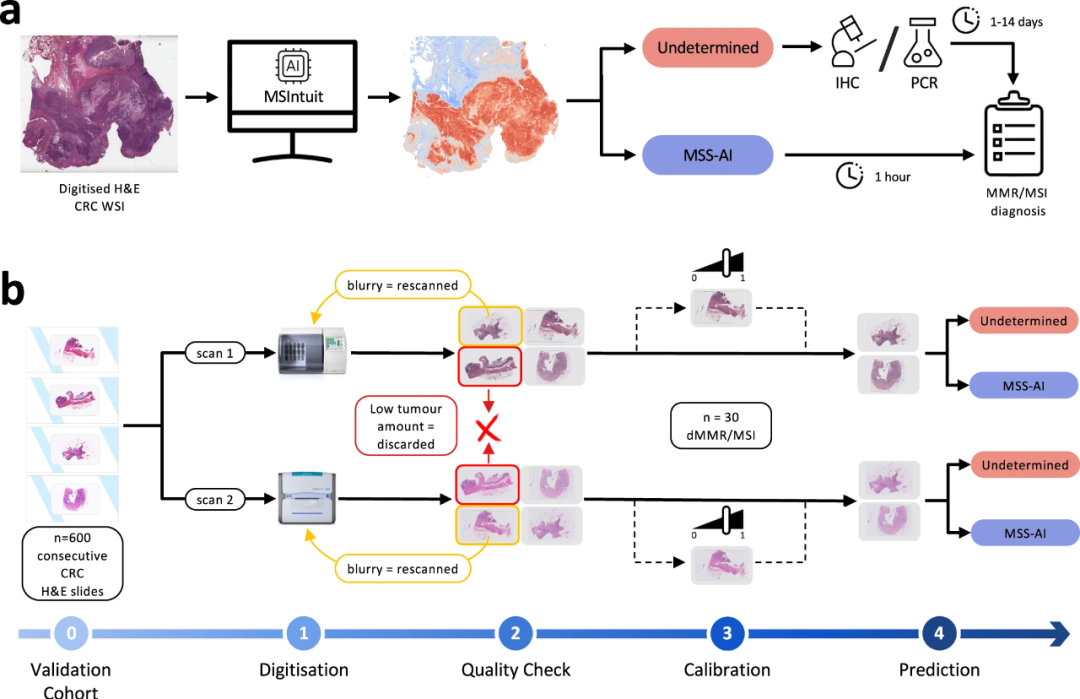
According to Owkin, the aim is for MSIntuit to have a significant impact on both doctors and patients by reducing workload and turnaround time, optimizing costs, and preserving tissue materials and consumables. The tool can also support reproducibility by addressing variability between observers, with the ultimate goal of optimizing the quality and efficiency of critical tests.Previously, OwkinNature CommunicationsPublished the validation research results of MSIntuit CRC, demonstrating that AI-based solutions can reliably screen CRC patients in clinical settings. The study focused on the sensitivity, specificity, and negative predictive value (NPV) of MSIntuit CRC to evaluate its diagnostic accuracy.Figure:MSIntuit CRCClinical Workflow and Blinding Validation Methods. A: Clinical workflow of MSIntuit for MSI screening. B: H&E slides from 600 consecutively resected CRC specimens were collected and digitized on two scanners.In the study, Owkin trained an artificial intelligence model using samples from The Cancer Genome Atlas (TCGA) and performed a blind validation of the model on a separate dataset of 600 CRC patients diagnosed across nine different pathology laboratories. The reliability between scanners was investigated by digitizing each H&E stained slide using two different scanners. The results showed,MSIntuit CRC has a sensitivity of 0.96-0.98, specificity of 0.46-0.47, NPV of 0.98-0.99, and excellent inter-scanner consistency.By achieving high sensitivity comparable to the gold standard method,MSIntuit CRC accurately excluded nearly 50% of MSS patients while correctly classifying over 96% of MSI patients., indicating that MSIntuit CRC can serve as an effective prescreening tool to alleviate the burden of MSI testing in clinical practice, and oncologists canGet results within a few hours, instead of taking several days.Owkin's solution represents the first step in developing an AI diagnostic capable of identifying actionable biomarkers from a single H&E slide used in clinical routine.Article author: Dr. Magali Svrcek"It is believed that: 'This solution has the potential to change the screening method for CRC patients and improve prognosis. Specifically, it will have a direct impact on oncologists' decision-making and help provide the best treatment for patients more quickly. This solution can also optimize the cost and structure of MSI testing in pathology laboratories, especially in countries applying universal MSI screening.'"
Recently, Owkin also announced a new partnership with Cerba Path, a network of diagnostic laboratories, to integrate Owkin's AI-driven diagnostics into Cerba Path’s routine digital workflows and further validate AI-based precision medicine tools. These tests include Owkin’s RlapsRisk BC, designed to help doctors assess the recurrence risk in early-stage breast cancer patients. Cerba Path will also incorporate MSIntuit CRC into its processes and participate in validating an extended version of the test, including surgical resection and tissue biopsy.Owkin is also strengthening its development in the field of drug research and development through partnerships with pharmaceutical companies and other firms. In October 2023, Owkin announced a partnership with Servier, an independent pharmaceutical group, to leverage artificial intelligence in advancing and accelerating more targeted treatments across multiple disease areas, including oncology. The collaboration will initially focus on two major challenges: translational medicine and digital pathology. Under the terms of the agreement, Owkin will apply its machine learning capabilities to Servier’s clinical data to uncover new insights into disease biology and identify patient populations most likely to benefit from Servier's novel therapies.It is reported that the first project of this cooperation aims to identify tumor types, tumor microenvironments, and the optimal patient subgroups responding to an unnamed Servier therapy. By analyzing tumor evolution data, the project seeks to determine drug combinations that may act on additional immune checkpoints or intrinsic mechanisms of tumor cells. The second project will explore the implementation of digital pathology and its potential to accelerate screening and enable broader tissue biomarker analysis.In addition, Owkin has reached an agreement with Genmab, which specializes in developing antibody therapies for cancer and other diseases. The agreement allows Owkin to use its platform to evaluate the impact of Genmab's clinical products on certain types of cancer.References:
1.https://www.owkin.com/newsfeed/owkin-enters-collaboration-agreement-with-msd-to-develop-ai-powered-diagnostics-for-cancer
2.Saillard, C., Dubois, R., Tchita, O. et al. Validation of MSIntuit as an AI-based pre-screening tool for MSI detection from colorectal cancer histology slides. Nat Commun 14, 6695 (2023). https://doi.org/10.1038/s41467-023-42453-6
3.https://www.insideprecisionmedicine.com/topics/oncology/merck-and-owkin-partner-on-ai-powered-precision-cancer-tests/?_ga=2.179295267.605296053.1703238050-849232800.1681975868
4.https://www.owkin.com/newsfeed/major-study-validates-owkins-best-in-class-ai-diagnostic-for-colorectal-cancer-biomarker-aimed-at-optimizing-patient-access-to-immunotherapy
·END·
Popular Articles Recommendation
If you like it, click "Watch" below.