

Neuropsychiatry Sector Heats Up: Zai Lab Gains Early Lead as BMS, AbbVie and Other MNCs Make Billion-Dollar Bets

Karuna Therapeutics
Developer of Treatment Drugs for Mental and Neurological Disorders
Bristol-Myers Squibb
Biopharmaceutical and Nutritional Product R&D and Sales

AbbVie
Innovative Drug Developer

Cerevel
Biopharmaceutical Manufacturer

Zai Lab
Innovative Global Biopharmaceutical Company
In less than a month, the neuroscience field, especially the psychiatric disorders track, has become extremely hot. Multinational corporations (MNCs) have heavily invested through large-scale acquisitions, drawing significant market attention.
At the end of this month, Bristol-Myers Squibb (BMS) announced that it has reached a definitive acquisition agreement with Karuna Therapeutics, a company focused on neuroscience, for a total acquisition value of up to 14 billion US dollars. The transaction is expected to be completed in the first half of 2024.
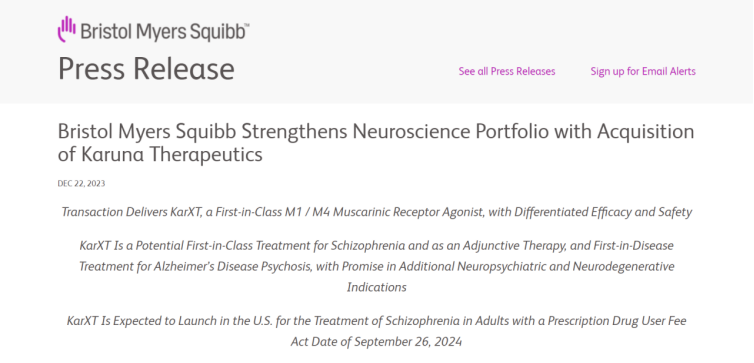
According to the terms of the deal, BMS will acquire all outstanding shares of Karuna for $330.00 per share in cash, representing a premium of approximately 53.35% over the closing price the day before the acquisition was announced.
Earlier this month, AbbVie reached a definitive agreement with neuroscience pharmaceutical company Cerevel Therapeutics to acquire all its outstanding shares at $45.0 per share, with a total equity value of approximately $8.7 billion. This represents a 22% premium over Cerevel's closing price the previous day and a 73% premium over Cerevel's closing price on December 1.
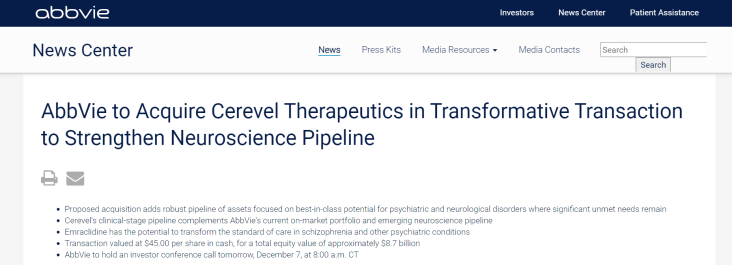
Karuna and Cerevel are both biotech companies dedicated to the field of neuroscience. The heavy investments from two major MNC pharmaceutical giants have drawn significant attention to this field, both within and outside the industry.
In fact, research in the neuropsychiatric field has always been one of the important directions in the medical community. In 2023, the neuropsychiatric field witnessed a mix of progress and setbacks in new drug development: some pipelines advanced successfully, while others faced challenges, and more innovative therapies are still under development. Industry experts believe that although the neuropsychiatric field still faces many challenges, the progress achieved so far is sufficient to keep us optimistic about the future.


BMS Acquires Karuna Therapeutics for a Hefty Sum
Has Zai Lab "Hit the Jackpot" with Its China Rights?
Karuna Therapeutics' pipeline mainly focuses on KarXT (xanomeline-trospium), a drug for treating schizophrenia. On November 29, the FDA accepted the New Drug Application (NDA) for KarXT for the treatment of adult schizophrenia. According to the press release, if approved, KarXT will become the first new mechanism drug for treating schizophrenia in decades.
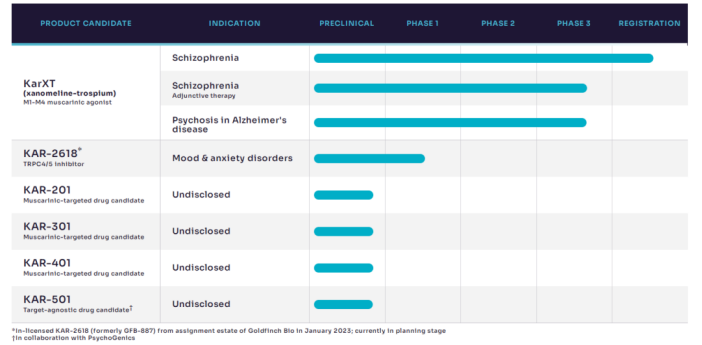
Karuna Therapeutics R&D Pipeline
KarXT is actually a combination of two single drugs, respectively an agonist and an inhibitor of the M1/M4 muscarinic receptor (muscarinic acetylcholine receptor), where the inhibitor trospium is an already approved marketed inhibitor (for inhibiting overactive bladder). This combination activates the CNS while avoiding activation of other peripheral tissues, thereby reducing drug side effects.
It is reported that Karuna Therapeutics introduced xanomeline from Eli Lilly in 2012 with an upfront payment of $100,000, total milestones of $70 million, and a single-digit percentage royalty on sales.
After a decade of dedication, this drug, once overlooked by Eli Lilly, has regained its brilliance through Karuna's dedicated research. Karuna addressed the drug's tolerability issues by formulating it in combination with rospium chloride.
The NDA submission by Karuna to the FDA for KarXT in patients with schizophrenia will include efficacy and safety data from three placebo-controlled registrational studies, EMERGENT-1, EMERGENT-2, and EMERGENT-3, as well as long-term safety data from the ongoing EMERGENT-4 and EMERGENT-5 studies.
In three placebo-controlled studies, KarXT achieved the primary endpoint, showing statistically significant and clinically meaningful improvements in schizophrenia symptoms compared to placebo, as measured by the Positive and Negative Syndrome Scale (PANSS) total score. KarXT was generally well-tolerated, with the most common adverse events being mild to moderate cholinergic adverse events.
Breakthroughs in the schizophrenia field have made Karuna Therapeutics a hot commodity, while also validating Zai Lab's foresight.
Zai Lab took action two years earlier than Bristol-Myers Squibb.
In November 2021, Zai Lab acquired the China rights to KarXT, gaining the rights to develop, manufacture, and commercialize KarXT in Greater China for an upfront payment of $35 million, total milestone payments of $150 million, and double-digit percentage royalties on sales. According to the CDE website, on July 25, 2022, Zai Lab's KarXT capsules were approved for clinical trials.
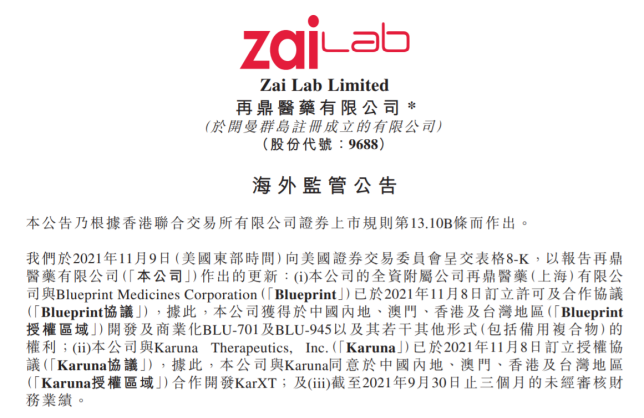
A drug that Eli Lilly sold to Karuna for a bargain a decade ago has now fetched nearly $200 million just for its rights in the Chinese market, and recently, Karuna was acquired by BMS for $14 billion.
It is reported that, apart from treating schizophrenia, KarXT is currently undergoing registrational clinical trials to evaluate its efficacy in treating psychosis associated with Alzheimer’s disease, with data expected by 2026. Additionally, BMS believes KarXT has potential in other indications, including Type I bipolar disorder and agitation associated with Alzheimer’s disease.
According to analysts' estimates, Karuna's KarXT has entered the FDA's schizophrenia treatment program, with potential sales reaching up to $6 billion. Additionally, KarXT is undergoing registration trials for adjunctive therapy with existing standard drugs for schizophrenia and for treating psychiatric symptoms in Alzheimer's patients. It is believed that the future market potential for KarXT is enormous, promising significant revenue contributions.


Multiple multinational pharmaceutical companies invest and layout
A Thorny Path with Joys and Sorrows
With the aging population and changes in lifestyle, the incidence of neurological diseases will continue to rise, and the market demand in the field of neuroscience will keep growing.
According to Frost & Sullivan's forecast, the global neuroscience drug market size will grow from $160 billion in 2022 to $220 billion in 2028.
In addition to BMS, AbbVie, Novartis, Roche, and Merck also sensed this trend and have made strategic moves in the neuroscience field.
As early as 2021, AbbVie acquired Neurocrine Biosciences for $30 billion, gaining access to drugs treating Parkinson's disease, Alzheimer's disease, and other neurological disorders.
On December 6, 2023, AbbVie announced that it would spend $8.7 billion to acquire Cerevel Therapeutics, further solidifying AbbVie's leading position in the field of neuroscience.
Cerevel boasts a diversified product pipeline, including five clinical-stage investigational therapies and several preclinical compounds, with the potential to treat a range of neuroscience disorders such as schizophrenia, Alzheimer's disease, psychosis, epilepsy, panic disorder, and Parkinson's disease. Upon completion of the transaction, AbbVie will acquire ownership of Cerevel’s late-stage assets, including Emraclidine, Tavapadon, Darigabat, and others.
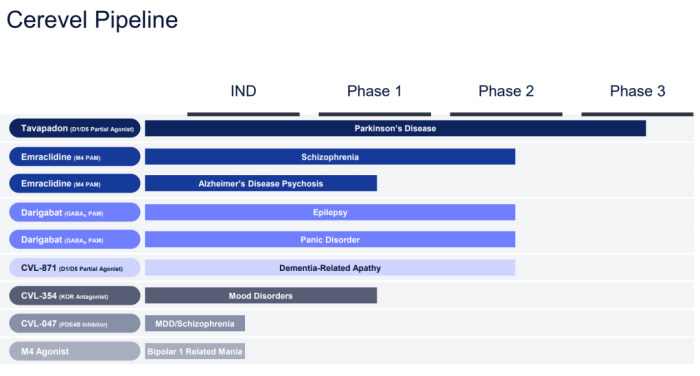
Emraclidine is a new generation antipsychotic drug currently completing two Phase II registrational studies for schizophrenia. This candidate drug is a positive allosteric modulator of the muscarinic M4 receptor, with "Best-in-Class (BIC)" potential for the treatment of schizophrenia.
Tavapadon is a selective partial agonist of the dopamine D1/D5 receptor. Tavapadon is being developed as a monotherapy and adjunctive treatment for Parkinson's disease (PD) and has currently entered phase 3 clinical trials.
Darigabat is a Phase II selective positive allosteric modulator of the GABAA receptor α 2/3/5 subunits, used for the treatment of panic disorder and refractory epilepsy; and CVL-354, a kappa opioid receptor antagonist with best-in-class potential, used for the treatment of major depressive disorder.
Neuropsychiatric disorders represent a significant medical need. In 2023, on the journey of exploring new drug development in the neuropsychiatric field, there were those who rejoiced and those who worried.
While potential drugs for treating schizophrenia have drawn significant attention, some companies have faced setbacks in clinical research, quietly terminating their pipelines.
In May, Roche Terminates Phase II Clinical Trial of New Psychiatric Drug. According to the U.S. Clinical Trials website, Roche has terminated the Phase II clinical trial (NCT03669640) of its schizophrenia candidate drug ralmitaront (RO-6889450). This study aimed to evaluate the efficacy of ralmitaront compared to placebo in treating patients with negative symptoms of schizophrenia or schizoaffective disorder. The reason for terminating the trial was that an interim analysis indicated ralmitaront was unlikely to meet the primary endpoint in this study. This marks the second Phase II clinical trial for this drug to be terminated.
On July 31, Sumitomo Pharma USA announced that its clinical candidate drug for schizophrenia, Ulotaront (SEP-363856), did not meet the primary endpoint in two recent Phase 3 clinical studies, DIAMOND 1 and DIAMOND 2. Ulotaront is a dual agonist of the 5-HT1A receptor and TAAR1, and is currently under investigation for the treatment of schizophrenia, generalized anxiety disorder, and as an adjunctive treatment for major depressive disorder.
The field of depression appears even more desolate.
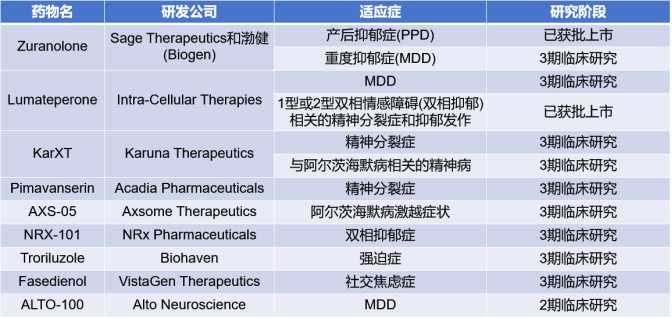
In August, Sage Therapeutics announced that the FDA had rejected the marketing application for Zuranolone, developed in collaboration with Biogen, for the treatment of major depressive disorder (MDD). In response, Sage is evaluating resource allocation, including determining pipeline priorities and restructuring its workforce.
In September and October, Merck successively halted two Phase II clinical trials of its MK-1942, respectively as an adjunctive treatment for major depressive disorder and as an adjunctive treatment for mild to moderate Alzheimer's disease. Merck revealed that the decision was based on concerns about hepatotoxicity.
In October, Novartis discontinued the Phase II clinical trial for MIJ821, a drug intended to treat severe depression associated with suicidal ideation. This decision was made following a benefit-risk assessment based on existing data.
Due to the difficulty, high cost, and low success rate in developing drugs for the central nervous system, there were few entrants in this field previously. However, with social development and the acceleration of population aging, the incidence of central nervous system diseases is gradually increasing, creating a billion-dollar "blue ocean market" for neuroscience drugs, which has made many pharmaceutical giants eager to get a share.
Just the road of clinical new drug development is full of thorns; failure is not due to a lack of capability, and success also involves an element of luck.
In the field of neuropsychiatric drug development, several promising treatments have now entered the late stages of research and development. It is hoped that these cutting-edge candidate drugs in the neuropsychiatric field will soon benefit patients worldwide who suffer from mental and neurological disorders.





www.yyjjb.com.cn
Insight into Industry Trends

"Pharmaceutical Economy Herald"
Academic Official Account
Focus on the Frontiers of Oncology Research

Terminal Official Account