

Peide Biopharma Secures Tens of Millions in Pre-A Funding to Develop Novel Peptide Therapeutics from Animal Toxins

PDBio
Peptide Innovation Drug Developer
36Kr exclusively learned that PDBio, a peptide drug research and development company, has recently completed a Pre-A round of financing worth tens of millions of yuan. The round was led by the Sichuan Academician Science and Technology Innovation Equity Investment Guidance Fund Partnership, with participation from Huaxi Securities Co., Ltd. and other institutions. The funds will mainly be used for the research and development of new peptide drug pipelines.
PDBio, founded in May 2021, has built a library of hundreds of millions of natural peptides from venomous animals. Based on the targeted mining system of animal venom peptides, PDBio screens and develops peptide drugs through a "high-throughput + cloud computing" screening platform and AI technology. According to 36Kr,The company will independently develop new peptide drugs for anti-infection and cardiovascular disease directions.; For candidate drugs of other indications, the focus will be on transferring them after reaching a certain stage of development.
The founding team of PDBio mainly comes from the State Key Laboratory of the Chinese Academy of Sciences and Hunan Normal University. Rong Mingqiang, the chairman, stated in an interview with 36Kr that the technical threshold for developing new drugs based on toxic animal peptide components is higher than that for plants, mainly due to two reasons: First, the difficulty in sampling—plants generally grow in clusters, making them easier to harvest and extract, whereas capturing required animals like spiders and snakes in nature is not easy, and the amount of venom secreted by a single animal is limited.
Moreover, peptides are composed of dozens of amino acids, equivalent to multiple small molecules polymerized together, forming a substance with medium molecular weight. The structure, target interactions, design modifications, etc., of this substance are more complex than those of small molecule drugs.
However, polypeptide drugs also have many advantages: In terms of the success rate of drug development, hundreds of compounds based on natural polypeptides from venomous animals may lead to the screening of a peptide candidate drug, with a higher success rate than small molecule drugs. During the evolution of venomous animals, the peptides in their bodies are inherently highly active and highly selective; moreover, after metabolism in the body, peptides produce amino acids, and the metabolites are non-toxic, making the drug relatively safe.
PDBio has established a technical system for large-scale mining of bioactive peptides from animal venoms, and has so far collected more than 1,000 venomous animal species. It uses multi-omics technologies such as genomics, transcriptomics, and peptidomics to conduct omics analysis on venomous animal samples. Furthermore, it employs a functional peptide screening technology system to gather highly active peptide sequences.
Based on the survival strategies of venomous animals, functional drug components can be directionally mined from animals. According to clinical needs, active natural peptides can be screened from peptide libraries without designing peptide drug sequences and conformations from scratch based on target structures, which can shorten the R&D cycle. For example, during predation or defense, snakes secrete venom to paralyze prey or cause embolism. Based on this biological strategy, relevant peptides can be directionally mined for neurotoxins used in pain relief, as well as substances that accelerate blood coagulation for the treatment of cardiovascular diseases.
Currently, PDBio has selectively developed four candidate peptide new drugs, which are in the preclinical research stage; the pipelines targeting acne, pulmonary fibrosis, and antithrombotic are expected to file IND applications successively in the next two years.
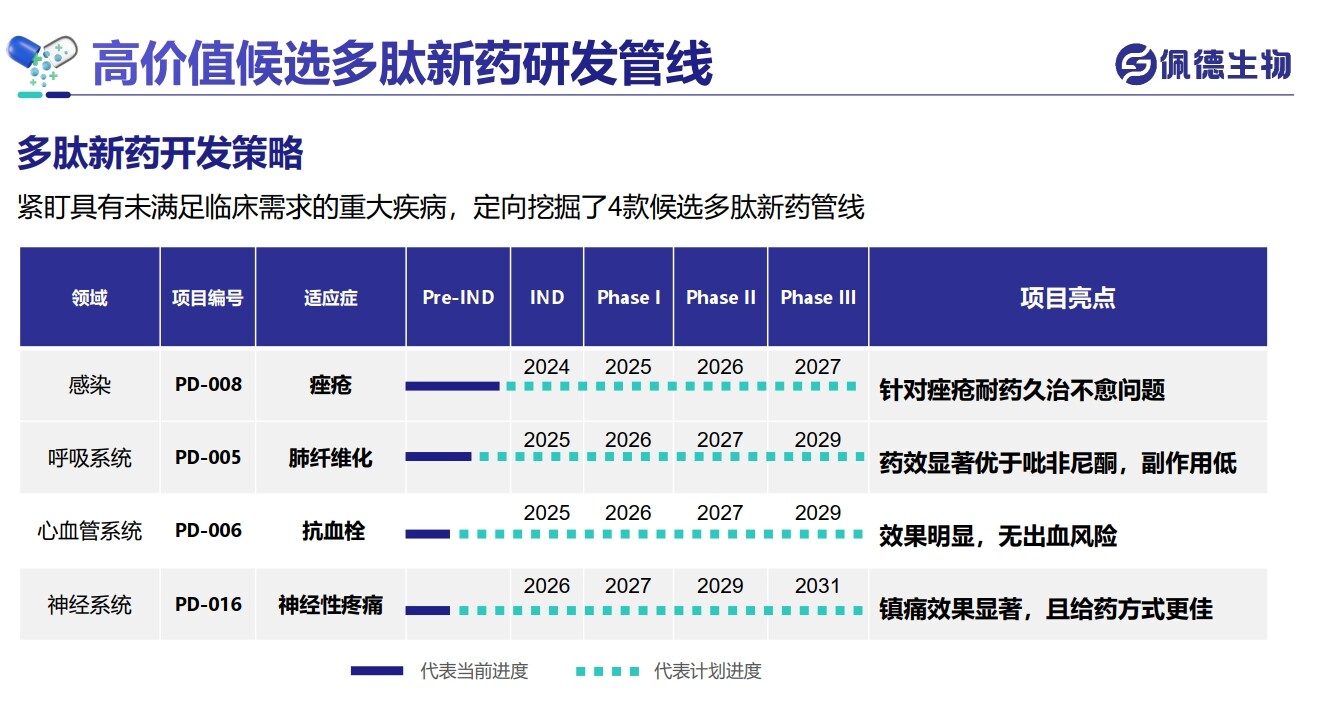
Photo provided by the company
In terms of business model, PDBio adopts the "self-research, licensing, and CRO" model. In addition to independently developing the aforementioned pipelines, it also provides CRO services to other companies with new drug development needs and can transfer some scientific and technological achievements for a one-time transfer fee.
The world's first GLP-1 receptor agonist for the treatment of diabetes, derived from the venom of the toxic Gila monster lizard, has a derivative analog, semaglutide, which is expected to exceed $20 billion in global sales in 2023, heading straight for the top-selling drug position. In addition, captopril for treating hypertension, hirudin for treating cerebral thrombosis, ziconotide and leconotide for treating chronic pain, among others, have been successfully developed into blockbuster drugs by extracting bioactive peptide substances from toxic animals, with multiple successful historical cases. Integrating BT+IT and using AI to accelerate peptide drug development is also a highly promising R&D approach.
Introduction to Investment Institutions
About Sichuan Academician Fund for Development: Sichuan Development (Holdings) Co., Ltd. was established in January 2009. It is a provincial state-owned enterprise formed by the Provincial Party Committee and the Provincial Government to innovate the investment and financing mechanism and promote industrial development and revitalization across the province, adopting the "1+N" model with a registered capital of 80 billion yuan. Sichuan Development (Holdings) Co., Ltd. focuses on enhancing value leadership capabilities, playing a key role as a shareholding platform, an industry leader, a capital leader, and a science and technology innovation leader. The company concentrates on cultivating strategic emerging industries, promoting scientific and technological innovation, establishing a modern industrial system, advancing new urbanization, and revitalizing rural areas, serving the implementation of major strategies across China.
Sichuan Academician Science and Technology Innovation Equity Investment Guidance Fund (referred to as the "Academician Fund") was established by Sichuan Development. It is a thematic fund that precisely serves high-level talents such as academicians of the Chinese Academy of Sciences and the Chinese Academy of Engineering. The fund aims to better promote the transformation and implementation of high-level scientific and technological innovation achievements in Sichuan. It is an equity investment fund led by state-owned enterprises, specifically serving academicians and other high-level expert teams in carrying out the transformation of scientific and technological achievements.